The World Cup Sleep-Deprivation Trap: Why Late-Night Matches are Causing Your Hair Loss & Scalp Inflammation in Thailand 2026
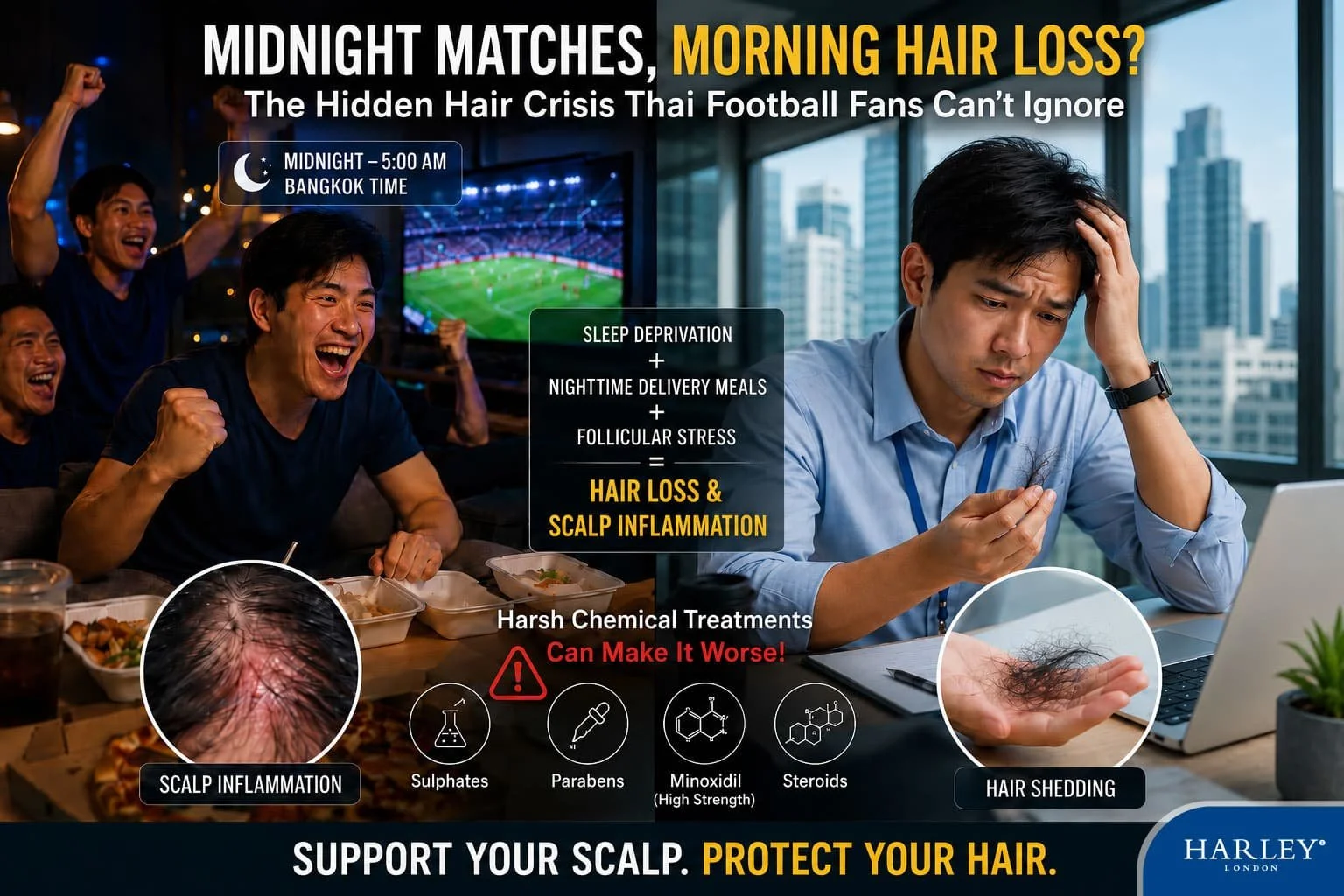
A lifestyle dilemma: contrasting a midnight world cup football match routine vS. morning work routine of an office man with an inflamed scalp and hair loss.
The 2026 FIFA World Cup is officially underway, bringing world-class football drama straight to screens across Thailand. But while the tournament is delivering unforgettable moments on the pitch, many Thai fans are noticing an unwelcome side effect in the mirror: accelerated hair shedding, intense scalp itchiness, and a sudden surge in oiliness.
If your hair brush is collecting more strands than usual or your scalp feels inflamed during this tournament month, you are not alone. With key matches kicking off between midnight and 5:00 AM Bangkok time, football fans are falling straight into a biological trap that directly damages the hair follicles.
The Sleep-Deprivation Trap: Cortisol and The Midnight Hair Cycle
Your hair follicles are among the most metabolically active tissues in the human body. They rely heavily on a strict circadian rhythm to function. When you stay up late to watch matches, drastically disrupting both your sleep architecture and your daytime work hours, you flip a biological switch that forces hair to fall out.
The Neuroendocrine Cascade
When sleep is restricted, the Hypothalamic-Pituitary-Adrenal (HPA) axis kicks into overdrive, causing a massive spike in cortisol (the body's primary stress hormone). Chronically elevated cortisol acts as a biological handbrake on your hair: it actively breaks down essential skin elements like hyaluronic acid and proteoglycans surrounding the hair root.
Furthermore, deep slow-wave sleep is the exact window when your body releases peak levels of growth hormone (GH), which is vital for cellular repair and follicular regeneration. Missing this crucial midnight recovery window starves your hair roots of their prime rebuilding time, abruptly forcing active, growing hairs (anagen phase) prematurely into the resting and shedding phase (telogen phase). This condition is clinically classified as Telogen Effluvium—or what we are calling "World Cup Shedding." (Thom, E., 2016)
Suffocating the Roots: Reduced Microcirculation and Nocturnal Diet Spikes
Sleep deprivation doesn’t just alter your hormones; it physically alters the environment beneath your skin.
Elevated cortisol levels induce peripheral vasoconstriction (the tightening of small blood vessels). The human scalp relies on an ultra-fine microvascular network to deliver oxygen and crucial amino acids to the dermal papilla at the very base of each hair follicle. When blood flow is restricted due to lack of sleep, your follicles experience a state of hypoxia (oxygen deprivation). Deprived of oxygen, the hair matrix cells cannot divide properly, resulting in weakened hair shafts and premature root death. (Boghosian, T., et al., 2024)
The Late-Night Delivery Food Factor
Compounding this microcirculatory crisis is the classic match-day lifestyle. Staying up until dawn in Thailand usually involves ordering late-night convenience foods, processed snacks, or high-glycemic delivery meals rich in saturated fats and refined sugars.
Consuming these heavy foods late at night causes a sharp spike in systemic insulin and blood glucose levels. This sudden metabolic stress alters the composition of your sebum (scalp oil), making it much thicker and more abundant. This excess oil accumulates at the follicle opening, feeding Malassezia—a naturally occurring yeast on the scalp. The result? A rapid onset of seborrheic dermatitis, characterized by itchy, red, flaky scalp inflammation that chokes the hair root from above while it is already starving from below. (Punyani, S., et al., 2021)
Why Every Scalp is Unique: The Trap of Generic Treatments
It is vital to recognize that everyone’s hair responds differently to World Cup sleep deprivation. A person with an underlying genetic predisposition to Male Pattern Baldness (Androgenetic Alopecia) may find that sleep loss acts as an accelerator, permanently shrinking follicles that were already vulnerable. Meanwhile, someone with sensitive skin may experience severe, burning scalp inflammation without immediate hair loss.
Because everyone's underlying health conditions vary, treating this sudden shedding with generic, over-the-counter methods can be incredibly hazardous.
A Warning on Commercial Cosmetics: During football season, many beauty and cosmetic aesthetic salons in Southeast Asia, including Thailand, heavily market festive "anti-hair loss scalp detoxes" or "hair spa" packages. Clinical data reflects that an alarming number of patients in Thailand suffer from severe contact dermatitis, chemical irritation, and worsened shedding after visiting these cosmetic establishments. These treatments focus solely on superficial, aesthetic beauty—often using harsh surfactants, heavy perfumes, and steam machines that further strip the delicate, sleep-deprived scalp barrier. (Waśkiel-Burnat, A., et al., 2023).
Trichological Insights: Why Advanced Medication Isn't Always the Answer
When noticing sudden thinning, many people immediately rush to buy strong medical hair loss treatments, such as oral medications or synthetic minoxidil solutions. However, leading hair journals and trichological studies suggest that for acute lifestyle-induced shedding like Telogen Effluvium, jumping straight to aggressive systemic drugs can be counterproductive.
Strong medical interventions alter blood pressure or hormonal pathways throughout your entire body. If applied to a scalp that is already experiencing acute inflammation or an altered sebum barrier, synthetic topical solutions can cause extreme irritation, itching, and ironically, trigger a massive secondary shedding phase.
Clinical trichologists agree: The safest, most effective approach to lifestyle-induced shedding is to avoid self-medication and opt for non-pharmaceutical, targeted therapies that restore the scalp’s natural ecosystem and microcirculation. (Cheong, W. K., et al., 2015).
The Ultimate Recovery: Harley St. Hair Centre
If you want to halt "World Cup shedding" and reverse scalp inflammation, you need a protocol that meets true clinical standards, not a cosmetic hair salon treatment. At Harley St. Hair Centre, we provide a dedicated path to follicular recovery built on the prestigious standards of UK Trichology.
We treat the scalp as a living organ, mapping out a non-medication-based session completely tailored to your unique scalp profile.
We care for the scalp and prioritize designing programs that consider the life cycle of hair follicles and hair roots, not just focusing on "cosmetic enhancement" or superficial scalp cleansing. Our programs are non-medicinal and steroid-free, developed with research by chemists and hair and scalp experts from the United Kingdom – the birthplace of Trichologists. We design products specifically tailored to the unique hair and scalp conditions of individuals living in Thailand, ensuring a truly personalised approach.
Don't Let Late-Night Matches Cause Long-Term Damage
Your love for football shouldn't cost you your hair. If late-night matches, broken sleep, and stressful days have left your scalp feeling oily, itchy, or visibly thinner, it is time for professional care.
Skip the cosmetic salons and the risks of self-medication. Experience the elite, non-pharmaceutical standard of UK Trichology designed to save your hair from the tournament grind.
Medical References :
Boghosian, T., et al. (2024). The Intersection of Sleep and Hair Loss: A Systematic Review. Skin Appendage Disorders.Cheong, W. K., et al. (2015). Treatment of Seborrhoeic Dermatitis in Asia: A Consensus Guide. Skin Appendage Disorders, 1(4), 187-196.Punyani, S., et al. (2021). The Impact of Shampoo Wash Frequency and Sebum Dynamics on Scalp Health. Skin Appendage Disorders, 7(1), 183-193.Suchonwanit, P., Iamsumang, W., & Thammarucha, S. (2019). Efficacy and safety of low-level light therapy in the treatment of hair loss. Lasers in Medical Science, 34(6), 1157-1165.Thom, E. (2016). Stress and the Hair Growth Cycle: Cortisol and the Breakdown of Proteoglycans. Journal of Drugs in Dermatology, 15(4), 1001-1004.Waśkiel-Burnat, A., Czuwara, J., Blicharz, L., Olszewska, M., & Rudnicka, L. (2023). Differential diagnosis of red scalp: the importance of trichoscopy. Clinical and Experimental Dermatology, 49(9), 961-968.