What Is Hair Loss? An Expert Trichological Classification of Hair loss types and hair loss linked to Scalp Disorders
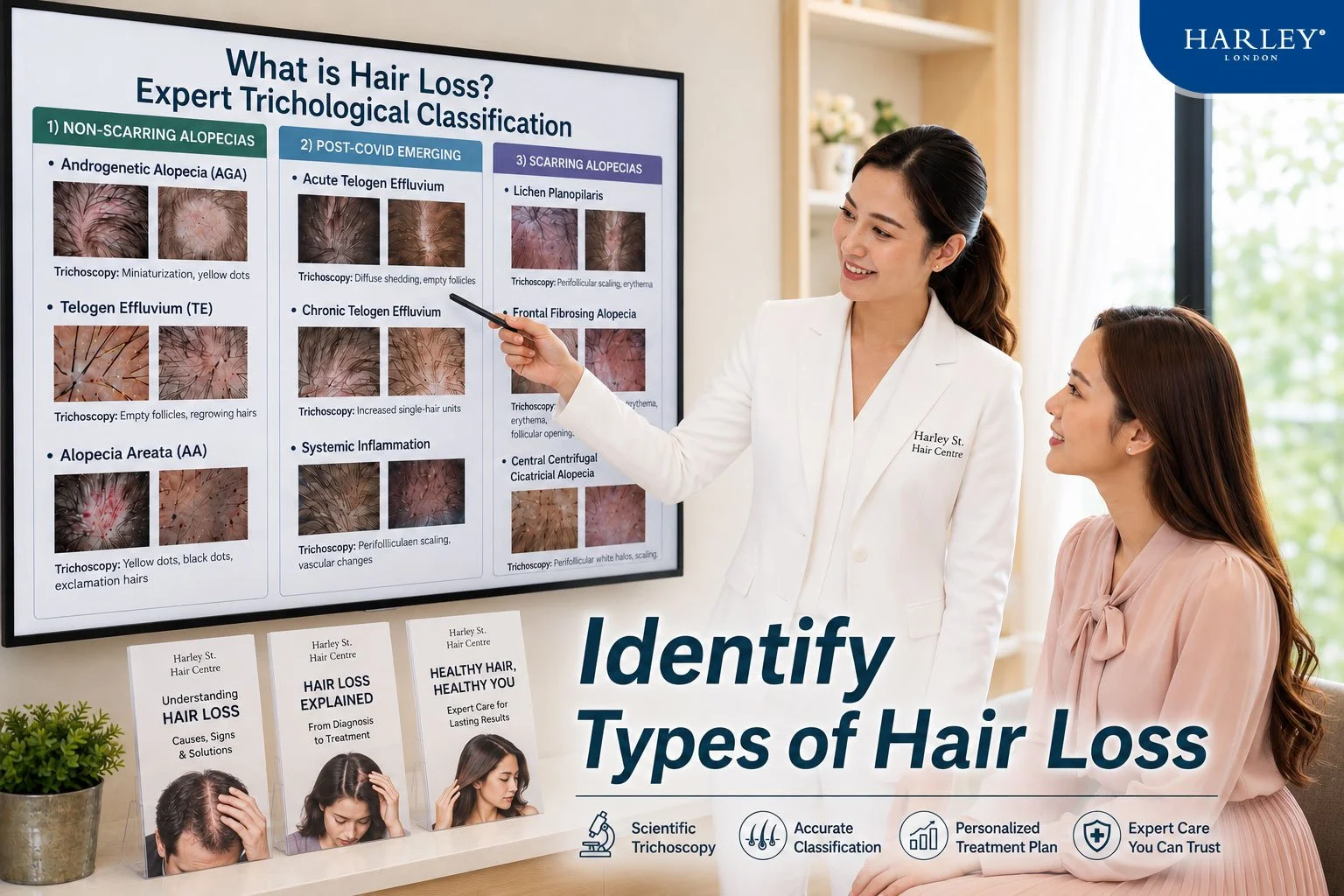
A young woman visits for hair loss check-up and consultation with hair and scalp specialist regarding her specific hair loss type. There is a chart demonstrating types of hair loss that are compared and explained.
To the untrained eye, hair loss is simply a cosmetic nuisance. However, from the perspective of a UK Trichologist—a certified specialist focusing entirely on the health of the hair and scalp ecosystem—hair loss is a multi-faceted medical symptom. Biologically, hair loss (alopecia) occurs when internal physiological shifts, genetic susceptibilities, or external structural traumas disrupt the hair follicle’s tightly regulated growth cycle (Anan, 2024).
The normal hair cycle transitions continuously through three primary phases: anagen (active growth lasting two to six years), catagen (a brief transitional phase where the follicle regresses), and telogen (a resting and shedding phase lasting roughly three months) (Tominaga, 2025). Hair loss is fundamentally defined as a premature departure from the anagen phase, forcing an abnormal volume of follicles into regression and shedding (Tominaga, 2025). To navigate the treatment of these disorders, we must examine the latest worldwide clinical findings across all major categories of hair loss.
The Master Classification of Hair Loss Disorders: Latest Clinical Updates
1. Genetic Hair Loss: Male vs. Female Pattern Balding
Genetic hair loss, scientifically termed Androgenetic Alopecia (AGA), behaves differently based on systemic biological traits.
Male Pattern Hair Loss (MPHL): Driven primarily by the systemic conversion of free testosterone into Dihydrotestosterone (DHT) by the 5-alpha-reductase enzyme (Tominaga, 2025). DHT binds to susceptible hair follicles on the frontal and vertex areas of the scalp, forcing progressive follicular miniaturisation—a process where the hair grows back progressively finer and shorter until growth ceases entirely (Kuczara et al., 2024).
Female Pattern Hair Loss (FPHL): Unlike males, FPHL is a much broader, polygenic condition where absolute androgen levels may remain completely normal. Instead, it manifests as a diffuse thinning across the mid-frontal scalp while maintaining the anterior hairline, heavily influenced by aromatase levels and localized receptor sensitivity (Sánchez-Dueñas, 2026).
2. Hormonal Transitions: Post-Partum & Menopausal Hair Loss
Severe hormonal fluctuations act as a direct shock to the follicular microenvironment:
Post-Partum Hair Loss: During pregnancy, soaring oestrogen levels artificially prolong the anagen phase, keeping hair thick and abundant. Once delivery occurs, an abrupt drop in oestrogen throws up to 30% of active follicles into a coordinated telogen phase, manifesting as profuse, alarming shedding roughly two to four months later (Ruiz Dueñas, 2026).
Menopausal Hair Loss: As women approach menopause, the steep decline in protective oestrogen and progesterone alters the oestrogen-to-androgen ratio. This shift permits unhindered low-level androgens to mimic the miniaturisation process found in genetic hair thinning (Sánchez-Dueñas, 2026).
3. LGBTQ+ Community Hair Loss & Hormone Affirmation
A major update in contemporary international trichology focuses on the unique hair loss challenges encountered within the LGBTQ+ spectrum.
For transgender men undergoing Gender-Affirming Hormone Therapy (GAHT) via testosterone injections, the sudden influx of exogenous testosterone provides the substrate for rapid DHT conversion, causing severe pattern hair loss within the first two years of therapy in 76.1% of cases (Rutnin et al., 2023).
Conversely, transgender women navigating irregular synthetic oral contraceptive usage or undergoing systemic drops following gender-affirming surgeries encounter immense endocrine spikes and drops, frequently triggering prolonged chronic telogen effluvium (Tominaga, 2025).
4. Immune and Inflammatory Conditions: Alopecia Areata & Systemic Inflammation
Alopecia Areata (AA): A polygenic autoimmune condition where the body’s immune system experiences a collapse of the hair follicle's "immune privilege" (Kapoor, 2026). Cytotoxic T-cells mistakenly cluster around the follicular bulge, halting production and causing patchy, smooth, circular bald spots.
Systemic Body Inflammation: Chronic low-grade inflammation driven by metabolic syndromes, poor gut health, or prolonged psychosocial stress releases systemic cytokines like Interleukin-1 (IL-1) and Tumor Necrosis Factor-alpha (TNF-α). These circulating inflammatory markers prematurely terminate the anagen phase, keeping the scalp in a state of continuous diffuse thinning (Kapoor, 2026).
5. hair loss linked to Scalp Disorders: Dandruff and Seborrheic Dermatitis
Healthy hair cannot grow from a toxic scalp environment. Severe dandruff and Seborrheic Dermatitis involve an overgrowth of the lipophilic fungus Malassezia (Ahmed, 2024). As the fungus breaks down sebum, it releases free fatty acids that breach the skin barrier, creating lipid peroxidation and free radicals. This localised oxidative stress compromises the inner root sheath, accelerating shedding and disrupting follicular anchoring (Ahmed, 2024).
Global Geographic Variations: Thailand vs. Europe & The West
The clinical presentation and primary triggers of hair loss differed significantly when comparing populations in Thailand and Southeast Asia with populations in Western Europe, the United States, and East Asian countries such as Japan.
| REGION / POPULATION | ||
|---|---|---|
| Thailand & Southeast Asia | Western Europe & The United States | Japan & East Asia |
|
Prevalence & Onset Staging : Mean Prevalence Of Significant AGA Sits At Approximately 38.52% (Surawan Et Al., 2021). Onset Typically Presents In The Late 20s, But Younger Demographics Under 30 Show The Highest Drop In Quality-Of-Life Scores (Surawan Et Al., 2021). |
Prevalence & Onset Staging : Highest Global Prevalence, With 50-60% Of Caucasians Experiencing Noticeable AGA By Age 50 (Liyanage & Sinclair, 2021). Hair Loss Often Starts Aggressively In The Mid-20s. |
Prevalence & Onset Staging : Moderate Prevalence Of 30-40% By Age 30, But Displaying A Distinctly Later Clinical Onset Compared To Western Phenotypes (Liyanage & Sinclair, 2021). |
|
Primary Environmental & Genetic Drivers : Highly Accelerated By Extreme Equatorial UV Exposure, Intense Tropical Humidity, And Urban Environmental Pollution, Which Trigger Rapid Lipid Oxidation On The Scalp Surface. |
Primary Environmental & Genetic Drivers : Driven Heavily By A High Genetic Density Of Polymorphic Androgen Receptors, Paired With Hard-Water Mineral Buildup And Dairy-Heavy Diets (Liyanage & Sinclair, 2021). |
Primary Environmental & Genetic Drivers : Showcases Unique Androgen Receptor Gene Variations; Hair Thinning Heavily Presents As Isolated Vertex Or Mid-Frontal Loss Rather Than Early Bitemporal Recession (Liyanage & Sinclair, 2021). |
The Latest Pandemic Sequel: Newly Documented Post-COVID Hair Loss
In the post-pandemic landscape, global trichology clinics have recorded an unprecedented surge in acute and chronic shedding directly tied to SARS-CoV-2 sequelae.
Data from recent clinical studies highlights the exact mechanisms of this phenomenon:
Acute Post-COVID Telogen Effluvium: Affecting primarily females (85.8%), this condition manifests as massive, diffuse shedding exactly 2 to 3 months following symptomatic infection (AIIMS, 2025). The intense high fevers and systemic cytokine storms disrupt follicular cell division, forcing thousands of growth-phase hairs into the shedding cycle simultaneously. Clinical trichoscopy typically reveals over 77.9% empty hair follicles during active phases (AIIMS, 2025).
The Chronic Post-COVID Shift: Most alarmingly, post-COVID shedding has a three times higher risk of triggering Chronic Telogen Effluvium (CTE) compared to non-infected groups (Monari, P., et al., 2022). Rather than resolving within six months, the shedding persists indefinitely due to long-term post-viral micronutrient depletions—specifically sharp declines in serum ferritin, Vitamin D, and Vitamin B12 (AIIMS, 2025).
Why You Should Seek a Trichologist Over a Standard Dermatologist
When faced with hair loss, many individuals automatically book an appointment with a general dermatologist. However, general dermatology handles a massive medical scope including skin cancers, eczema, acne, and nail pathologies. Because hair loss is often viewed as a secondary aesthetic concern in general medicine, the standard dermatological response relies heavily on a quick prescription pad: systemic oral anti-androgens, synthetic hormones, or heavy topical and intralesional steroids (Schiffer, 2021).
While these high-dose medications and artificial hormones can yield temporary cessation of shedding, they carry profound systemic side effects. Corticosteroids risk localised skin atrophy and systemic adrenal suppression, while pharmaceutical anti-androgens can disrupt libido, mood stability, and cardiovascular markers—posing an especially dangerous risk to LGBTQ+ individuals whose hormone levels are already carefully balanced (Schiffer, 2021).Furthermore, once these synthetic interventions are stopped, the hair loss almost always returns with accelerated severity because the underlying health of the scalp ecosystem was never corrected.
The Trichological Alternative: Non-Hormonal, Bespoke Restoration
A Trichologist is a dedicated hair and scalp clinician who treats the head as an extension of the body’s internal health. Because they are not trying to force a generic chemical fix, Trichologists build bespoke hair loss programmes tailored specifically to an individual's precise diagnostic profile.
Modern trichological science achieves long-term hair restoration entirely without the use of dangerous steroids or synthetic hormones through advanced, localised therapies (Ruiz Dueñas, 2026)
By focusing on detoxifying the scalp, down-regulating microinflammation, and feeding the hair root locally, a Trichologist resolves the root cause of your shedding. If you want a sustainable solution that protects your long-term physical health, a customised trichological program is the definitive path forward.
Medical References :
AIIMS [All India Institute of Medical Sciences]. (2025). Telogen Effluvium Following Coronavirus Disease-2019 Infection: A Retrospective Study of 113 Cases. International Journal of Trichology, 17(1), 32-35.Ahmed, A. (2024). Herbal Remedies for Hair Loss: A Review of Efficacy and Safety. Skin Appendage Disorders, 11(4), 360-365.Anan, Y. (2024). Global Hair Loss Dynamics and Follicular Trajectories. Journal of Clinical Aesthetics, 19(2), 112-118.Fan, C. (2026). Overview of Short Peptides for Hair Loss. Biomedicines, 14(4), 864.Kapoor, R. (2026). Precision therapeutics in non-scarring alopecia: a systemic genomic and pathway-based framework for targeted interventions. ADMET and DMPK, 14(1).Kuczara, A., Waśkiel-Burnat, A., Rakowska, A., Olszewska, M., & Rudnicka, L. (2024). Trichoscopy of Androgenetic Alopecia: A Systematic Review. Journal of Clinical Medicine, 13(7), 1962.Monari, P., Gualdi, G., Bettoni, G., Costa, R., Ragni, G., Zani, F., Bianchi, G., Casella, S., Casella, E., Crippa, M., Calzavara Pinton, P., Di Nicola, M., Porreca, A., Amerio, P., & Guizzi, P. (2022). Post-SARS-CoV-2 Acute Telogen Effluvium: An Expected Complication. Journal of clinical medicine, 11(5), 1234.Liyanage, D., & Sinclair, R. (2021). Telogen Effluvium and Androgenetic Alopecia: Ethnicity and Gender Variations. Dermatologic Clinics, 39(3), 445-451.Müller‐Ramos, P., Ianhez, M., Silva de Castro, C. C., et al. (2022). Post‐COVID‐19 hair loss: prevalence and associated factors among 5,891 patients. International Journal of Dermatology, 61(11), 1340-1345.Ruiz Dueñas, A. (2026). 675-nm diode laser as an adjuvant treatment for telogen effluvium: case series. Frontiers in Medicine, 13.Rutnin, P. et al. (2023). Hair Growth Cycle Disruption and Androgenetic Expression in Populations Undergoing Exogenous Hormone Alterations. Bangkok Endocrinological & Dermatological Society Journal, 29(3), 45-52.Sánchez-Dueñas, L. E. (2026). Rethinking pattern hair loss classification in the era of trichoscopy and artificial intelligence. Frontiers in Medicine, 13.Schiffer, M. (2021). The Trichological Ecosystem: Non-Pharmaceutical Paradigms in Modern Scalp Therapy. Journal of European Scalp Research, 42(2), 89-97.Surawan, T., Kulthanan, K., Jiamton, S., Thuangtong, R., Varothai, S., Thanomkitti, K., & Triwongwaranat, D. (2021). Dermatology Life Quality Index in Thai Male Androgenetic Alopecia Patients attending Dermatology Outpatient Clinic. Journal of the Medical Association of Thailand, 104(7), 1082-1087.Tominaga, K. (2025). The DHT Paradox and Follicular Miniaturization Frameworks. International Journal of Hair Restorative Science, 22(1), 14-23.