Understanding Hair Thinning: The Modern Science, Regional Variations, and the Path to Natural Restoration
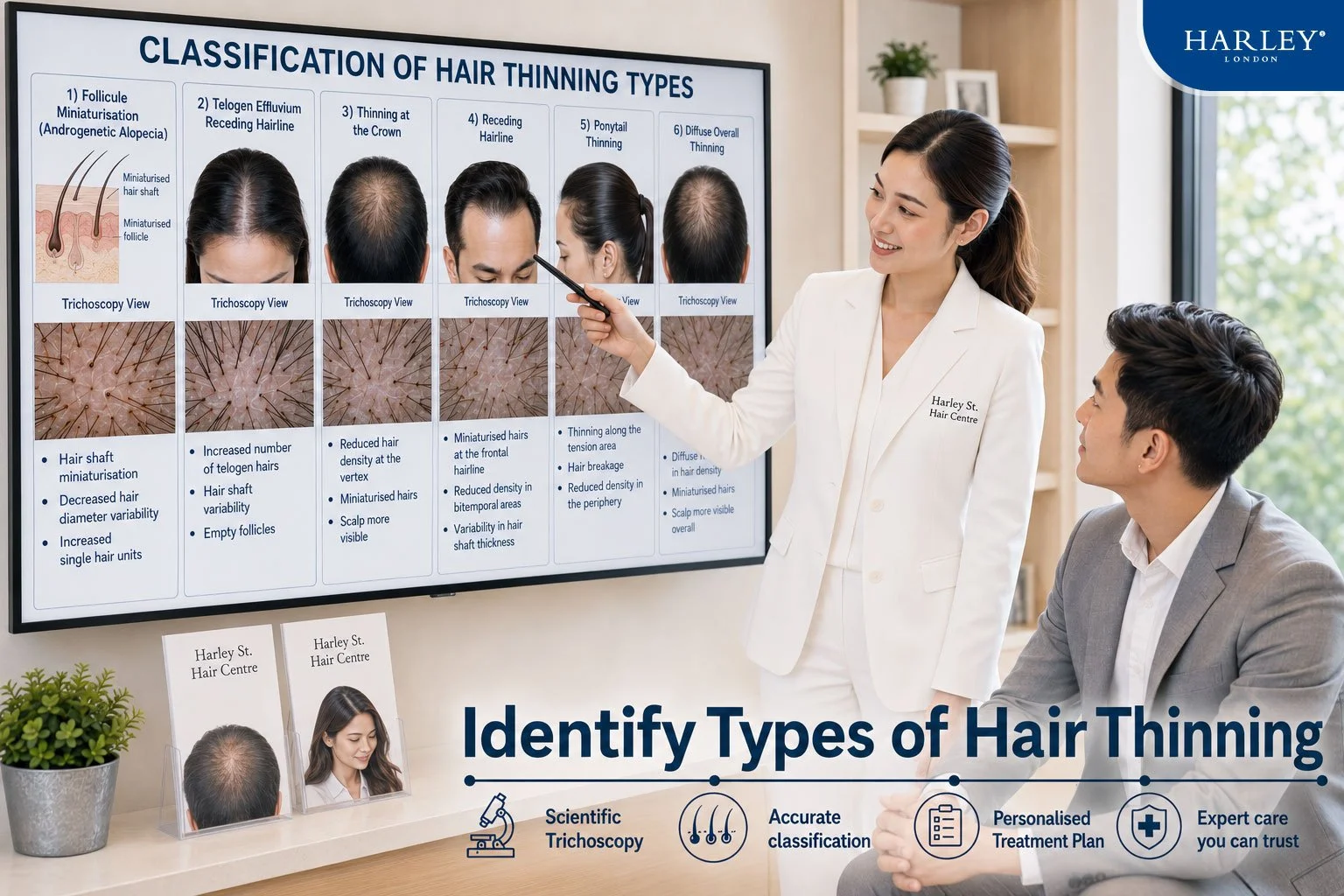
A businessman visits for hair Thinning check-up and consultation with hair and scalp specialist regarding his specific hair thinning type. There is a chart demonstrating types of hair Thinning that are compared and explained.
A thick, healthy head of hair is universally seen as a hallmark of vitality. However, when noticeable changes begin—whether it is a wider parting, a sparse crown, or a lighter ponytail—the experience can be deeply unsettling.
Hair thinning is a complex, progressive biological shift rather than a sudden event. To address it effectively, we must move away from generic "one-size-fits-all" remedies and understand the specific cellular mechanisms at play.
What is Hair Thinning?
At its core, “hair thinning” is a reduction in visible scalp coverage. This occurs through two primary mechanisms: a decrease in the absolute number of active hair strands on the head, or a progressive reduction in the individual thickness and quality of each strand.
Every hair follicle on our scalp operates on a strictly regulated, continuous lifecycle consisting of three distinct phases:
Anagen: The active growth phase, which typically lasts between two to six years.
Catagen: A brief transitional phase lasting a few weeks, where the hair follicle detaches from its blood supply.
Telogen: A resting phase lasting approximately three months, culminating in the shedding of the hair strand (exogen) so a new anagen hair can take its place.
True hair thinning happens when this precise biological cycle is disrupted. This disruption shortens the growth phase and extends the resting phase, leading to visible changes in overall volume and scalp health.
Scientific Classification of Hair Thinning Types
Modern clinical trichology classifies hair thinning into distinct typologies based on its presentation, underlying triggers, and cellular behavior. The latest scientific findings outline several primary categories :
1. Follicle Miniaturisation (Androgenetic Alopecia)
This is the foundational mechanism behind hereditary hair loss, commonly known as male or female pattern baldness. Under the influence of specific androgen hormones, the genetically susceptible hair follicle undergoes a progressive physical shrinkage. With each subsequent hair cycle, the follicle produces shorter, finer, and less pigmented hairs—transforming strong "terminal" hairs into peach-fuzz-like "vellus" hairs until the follicle eventually stops producing hair entirely.
2. Receding Hairline
Predominantly seen in the classic male pattern, this type involves a predictable, symmetrical retreat of the hair boundary, typically beginning at the temples and moving backward to form an 'M' or 'V' shape. This area of the scalp contains a higher density of androgen receptors, making it particularly sensitive to hormonal shifts.
3. Thinning at the Crown
This refers to localized volume depletion specifically at the vertex (the top and back of the head). It can occur as an isolated patch or in conjunction with a receding hairline, eventually expanding outward if left unaddressed.
4. Ponytail Thinning
A widespread concern among women, this describes a noticeable reduction in the actual density and circumference of gathered hair. It is often a key indicator that the overall volume across the entire scalp has dropped, even if specific bald patches are not yet visible.
5. Telogen Effluvium (Reactive Shedding)
This form of thinning is a temporary condition where a significant physiological or psychological stressor forces a large percentage of active anagen (growing) hair follicles prematurely into the telogen (resting) phase. Roughly two to three months following the triggering event, diffuse and heavy shedding occurs across the entire scalp. Common triggers include high fevers, severe infections, sudden nutritional deficiencies, emotional trauma, or rapid hormonal shifts.
6. Diffuse Overall Thinning
Unlike patterned hair loss, diffuse thinning causes a uniform decrease in hair density across the entire scalp. The hairline often remains completely intact, but the scalp becomes increasingly visible through the hair due to widespread, synchronized reductions in strand count and diameter.
7. Volume Thinning from Underlying Health Conditions
Hair follicles are highly metabolically active and require a stable internal environment to thrive. Internal disruptions—such as thyroid imbalances, severe iron-deficiency anemia, systemic autoimmune conditions, or severe chronic stress—can restrict vital oxygen and nutrient delivery to the hair bulb, causing widespread volume loss.
The Hormonal Paradox: Crossed Hair Loss Patterns
One of the most fascinating aspects of modern trichological science is why some individuals exhibit hair thinning patterns typically associated with the opposite sex. This breakdown reveals the underlying hormonal influences behind this phenomenon :
When Women Experience Male Pattern Thinning
When women experience fronto-temporal recession or severe crown thinning—the classic male pattern—it is almost always driven by a state of relative hyperandrogenism (an excess of male hormones like testosterone and dihydrotestosterone, or DHT).
The most common culprit is Polycystic Ovary Syndrome (PCOS), a prevalent endocrine condition (Swaroop et al., 2015). In individuals with PCOS, a hormonal imbalance alters regular ovarian function, causing the ovaries to produce abnormally high amounts of testosterone (Patel, 2024; Soni et al., 2025).
Furthermore, many individuals with PCOS exhibit insulin resistance, where elevated insulin levels stimulate the ovaries to produce even more androgens while simultaneously decreasing levels of Sex Hormone-Binding Globulin (SHBG)(Nandagopal, 2026; Patel, 2024). Because SHBG normally binds to free testosterone in the blood to render it inactive, a drop in SHBG leaves an excess of free, active testosterone available to bind to hair follicles on the scalp (Nandagopal, 2026; Wani, 2026). When this excess testosterone interacts with the enzyme 5-alpha reductase in the scalp, it converts into DHT, binding to sensitive follicles and initiating aggressive follicle miniaturisation (Wani, 2026).
When Men Experience Female Pattern Thinning
Conversely, some men retain their frontal hairline perfectly but experience a diffuse, widespread thinning across the top and mid-scalp—the classic Ludwig pattern typically found in women. This occurs because pattern hair loss in men is not solely determined by the amount of circulating testosterone, but rather by local follicular sensitivity, receptor density, and enzyme expression (Carmina et al., 2019).
Men who exhibit a female pattern often have a lower density of androgen receptors in their frontal hair follicles, or lower localized levels of 5-alpha reductase at the hairline. Instead, they may feature a more uniform distribution of these receptors across the entire top of the scalp, or a higher sensitivity to peripheral micro-inflammation, which mirrors the multi-factorial nature of female pattern hair loss (Carmina et al., 2019).
Regional Dynamics: Thailand vs. Europe
Hair thinning does not look or behave the same way across the globe. There are stark, clinically documented differences in hair characteristics, density, and environmental vulnerabilities when comparing populations in Thailand to those in Western Europe or America.
| ATTRIBUTE | THAI / EAST ASIAN POPULATION | EUROPEAN / CAUCASIAN POPULATION |
|---|---|---|
| Baseline Hair Density | Generally Lower Absolute Follicular Unit Density Across The Scalp (Leerunyakul & Suchonwanit, 2020). | Significantly Higher Absolute Follicular Unit Density (Leerunyakul & Suchonwanit, 2020). |
| Individual Strand Diameter | Thick, Robust, Straight Terminal Strands With A Round Cross-Section (Takahashi, 2019). | Thinner, Finer Strands With A More Elliptical Cross-Section (Takahashi, 2019). |
| Prevalence Of Pattern Loss | Notably Lower Statistical Prevalence Of Early-Onset Pattern Hair Loss (Carmina Et Al., 2019). | Higher Statistical Prevalence Across All Age Groups, Starting Earlier In Life (Yang Et Al., 2022). |
| Primary Structural Vulnerability | Damage And Structural Weathering Typically Occur At The Distal Ends (Shaft/Tips) (Maymone Et Al., 2021). | Strands Are More Susceptible To Fine Breakage Along The Mid-Shaft Due To An Elliptical Structure (Takahashi, 2019). |
| Environmental Triggers | High Tropical Humidity And UV Exposure Drive Scalp Oiliness And Fungal/Microbials. | Hard Water Minerals And Dry Heating Strip Moisture, Drying Out The Cuticle. |
Because the natural baseline follicular density in the Thai population is lower than that of Caucasians, any drop in absolute strand count or diameter becomes visible much faster (Leerunyakul & Suchonwanit, 2020). Conversely, while European hair enjoys a higher overall density, its finer structure makes it more prone to physical breakage and diffuse thinning over time (Takahashi, 2019).
Why a Bespoke Trichological Approach Defeats Generic Medical Treatments
When faced with hair thinning, many people instinctively visit a general dermatologist or a clinic, where standard treatments often rely heavily on aggressive oral medications, synthetic hormones, or topical steroid solutions. While these methods may stimulate rapid, temporary hair growth, they frequently come with significant downsides:
The Dependency Cycle: Many chemical hair solutions do not address why the follicle failed in the first place; they simply force it to stay open. The moment the treatment is stopped, the hair that relies on it typically sheds rapidly.
Systemic Side Effects: Introducing synthetic hormones or systemically active medications can disrupt your body's delicate internal chemistry, occasionally leading to mood swings, fatigue, or scalp irritation.
Overlooking the Scalp Ecosystem: Suppressing symptoms with steroids often ignores underlying issues like compromised micro-circulation, poor follicle nutrition, or an unbalanced scalp microbiome.
The Trichological Alternative
This is where a Trichologist—a dedicated hair and scalp specialist—offers a fundamentally different philosophy. Rather than masking the symptoms of thinning with generic medications, a Trichologist treats hair loss as an elite wellness discipline.
By utilizing non-invasive diagnostic tools like digital trichoscopy, a Trichologist examines your scalp at a microscopic level to evaluate follicular unit density, identify early miniaturisation, and measure sebum levels. This data allows them to design a bespoke hair regrowth programme tailored entirely to your specific hair thinning type and scalp profile.
A customized trichological approach focuses on:
Purifying the Micro-Environment
Feeding the Hair Bulb
Stimulating Natural Micro-Circulation
By prioritizing long-term health over a temporary quick fix, a Trichologist helps you achieve sustainable, healthy hair regrowth while protecting the structural integrity of your follicles—giving you a vibrant head of hair without relying on hormones, steroids, or medications.
Medical References :
Carmina, E., Azziz, R., Bergfeld, W., Escobar-Morreale, H. F., Futterweit, W., Huddleston, H., Lobo, R., & Olsen, E. (2019). Female Pattern Hair Loss and Androgen Excess: A Report From the Multidisciplinary Androgen Excess and PCOS Committee. The Journal of Clinical Endocrinology & Metabolism, 104(7), 2875–2891.Leerunyakul, K., & Suchonwanit, P. (2020). Evaluation of Hair Density and Hair Diameter in the Adult Thai Population Using Quantitative Trichoscopic Analysis. BioMed Research International, 2020, Article 2476890.Maymone, M. B. C., Laughter, M., Pollock, Seger, S., Khan, I., Marques, T., Abdat, R., Goldberg, L. J., & Vashi, N. A. (2021). Hair Aging in Different Races and Ethnicities. The Journal of Clinical and Aesthetic Dermatology, 14(1), 38–44.Nandagopal, P. B. (2026). Integrating evidence-based lifestyle and adjunct therapies for long-term management of polycystic ovary syndrome: mechanistic insights and clinical implications. Frontiers in Reproductive Health, 8, Article 1821411.Patel, M. G. (2024). Concept of Polycystic Ovarian Syndrome: Perspectives of Ayurveda and Modern Science. Journal of Ayurvedic and Holistic Medicine, 12(2), 45–52.Soni, P., Jain, D., Bhatti, M., Bhatia, D., & Sharma, C. (2025). Exploring the Intricacies of Polycystic Ovarian Syndrome (PCOS): A Comprehensive Review-from Prevalence to Natural Solutions. New Emirates Medical Journal, 6(1), 12–25.Swaroop, A., Jaipuriar, A. S., Gupta, S. K., Bagchi, M., Kumar, P., Preuss, H. G., & Bagchi, D. (2015). Efficacy of a Novel Fenugreek Seed Extract (Trigonella foenum-graecum, Furocyst™) in Polycystic Ovary Syndrome (PCOS). International Journal of Medical Sciences, 12(10), 825–831.Takahashi, T. (2019). Unique Hair Properties that Emerge from Combinations of Multiple Races. Cosmetics, 6(2), 36.Wani, R. (2026). Healing with Herbs: A Systematic Review of Natural Treatments for Polycystic Ovary Syndrome. Journal of Phytomedicine and Clinical Therapeutics, 14(3), 112–125.Yang, X., Yu, W., Qiao, R., Sun, J., & Jiang, Y. (2022). The Predictive Value of Midscalp Hair Density and Terminal Hair Percentage in the Severity Evaluation of FPHL Assessed by Trichoscan in a Sample of Chinese Population. Clinical, Cosmetic and Investigational Dermatology, 15, 2675–2684.