Is your hair extension routine causing irreversible thinning and Traction Alopecia? the science behind Bangkok’s 2026 hair extension trends
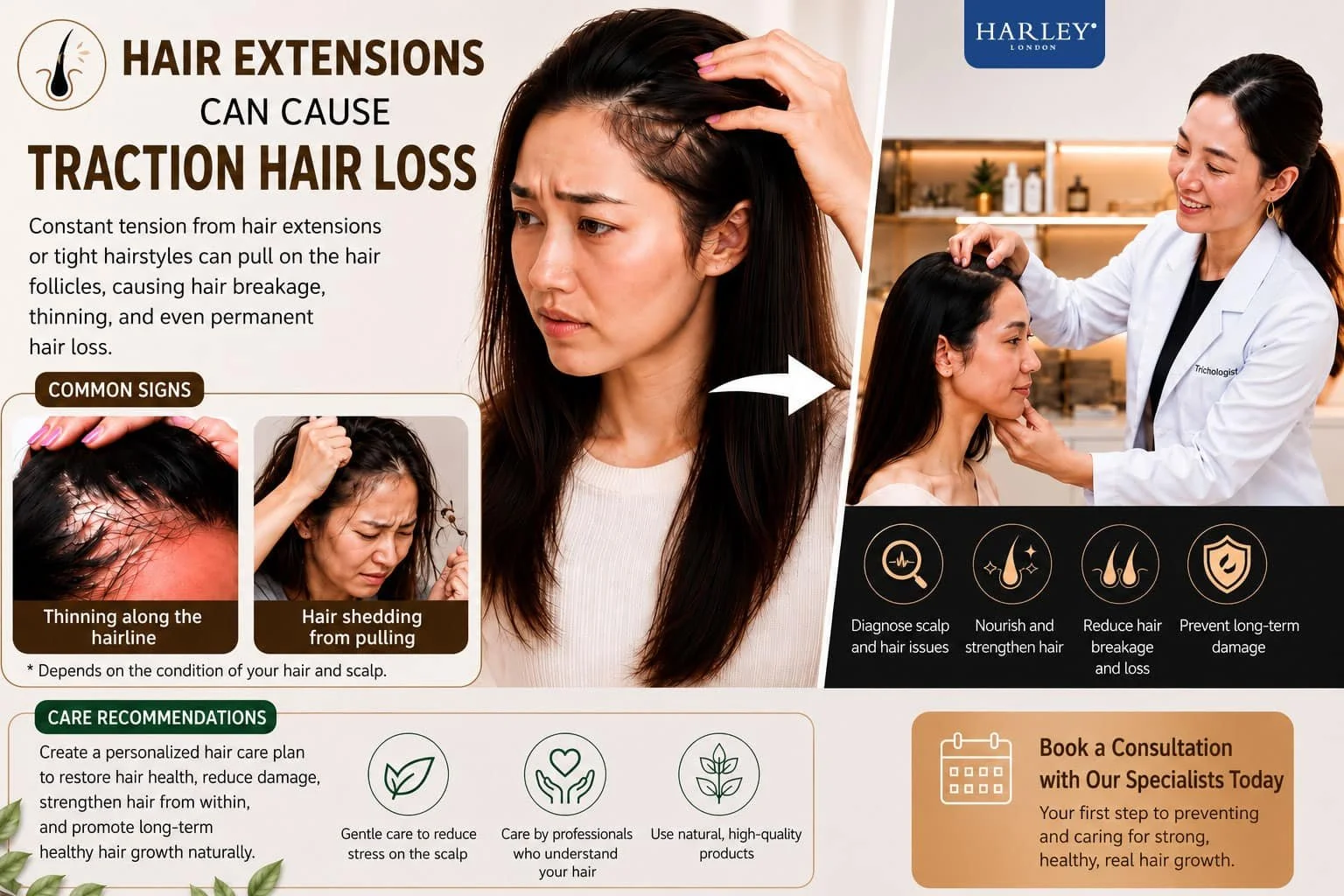
an Asian woman suffering from traction alopecia from hair extensions, showing symptoms of thinning hair, hair shedding, and miniaturised hair follicles.
The obsession with ultra-long, high-volume hair shows no signs of slowing down. Across premium salons from Sukhumvit to Chiang Mai, hair extensions have transformed from occasional luxury statements into permanent lifestyle fixtures.
However, beneath the glamorous, seamless results of modern installation techniques lies an alarming clinical reality. Trichologists and dermatologists across Southeast Asia are documenting an unprecedented surge in localised hair thinning, persistent scalp inflammation, and permanent hair loss.
When structural beauty treatments run contrary to biological boundaries, the scalp pays the price. This clinical analysis breaks down the science of how hair extensions interact with your scalp, why the popular installation methods of the 2026 trend pose severe biological risks, and what happens at a microscopic cellular level when hair follicles are subjected to unnatural, prolonged load.
The 2026 Hair Extension Trends Dominating Thailand
The hair extension market has evolved significantly, moving away from heavy, historic "weave" tracks toward hyper-targeted, lightweight installation methods advertised as "invisible" and "weightless." The three most requested techniques in Bangkok salons today include :
9D Hair Extensions : A mechanical innovation using specialized tools or Hair Extension Glue Gun to attach 5-10 tiny hair extension strands to the natural hair simultaneously. This is done using small, intricate plastic or synthetic material connectors. The technique emphasizes speed and very delicate knots.
Korean Braid (Invisible Braid) : A skilled craftsmanship technique where the natural hair is interwoven with the extension base into tiny braids, then knotted with elastic thread or thin silk. Often advertised as the safest method because it doesn't rely on chemical glue or heat.
Feather (Micro-Weft Extensions) : Using ultra-lightweight, feather-like woven hair panels placed against the scalp and secured with tiny connectors one by one. This distributes the weight of the hair evenly and creates a natural, flowing look.
Ultra-Nano Rings & Micro-Links : Microscopic copper or aluminum loops lined with silicone that clamp natural hair strands together with a pre-tipped keratin extension strand.
Seamless Tape-Ins : Medical-grade, double-sided acrylic adhesive strips sandwiching thin sections of natural hair.
Keratin Micro-Bonds (Fusion Extensions) : An installation method where an ultrasonic or thermal heating tool melts a polymer bond directly around natural hair fibers near the root.
Salons frequently market these attachments as completely safe because the individual points of contact are smaller and lighter than ever before. However, trichological science reveals that reducing the size of the bond does not eliminate the chronic physical stress exerted on the delicate architecture of the hair follicle.
How Extensions Scientifically Cause Traction Alopecia
Your hair follicles are perfectly evolved to support the physiological weight of their own individual hair strands. They are not biologically designed to anchor an external, synthetic weight load over extended periods.
When an extension strand is attached, it exerts a continuous, unyielding gravitational pull on the root of your natural hair. This constant mechanical strain triggers a specific pathological condition known as Traction Alopecia (Khumalo et al., 2008).
The human hair growth cycle is divided into distinct phases: an active growing phase (Anagen), a brief regression phase (Catagen), and a resting phase (Telogen) (Lim, 2025). Under normal conditions, approximately 85% to 90% of your scalp's follicles reside in the active anagen phase (Lim, 2025).
When a salon stylist clamps or glues extensions close to the scalp, the continuous mechanical tension disrupts this cycle. The tension forces growing anagen hairs into a premature telogen resting phase—a process known as mechanical avulsion. The persistent pulling creates structural microscopic micro-tears in the epithelial root sheath, directly damaging the Dermal Papilla (DP) located at the base of the hair follicle (Sekhavat, 2026).
Because the dermal papilla houses the crucial vascular networks and stem cells required to sustain hair growth and repair the skin, structural damage here starves the follicle of oxygen and essential nutrients (Sekhavat, 2026). Over time, the repeated trauma forces the follicle to undergo follicular miniaturisation (Molamodi et al., 2021). With each subsequent cycle, the hair follicle shrinks, producing progressively thinner, weaker vellus-like hairs until the follicle shuts down entirely, leaving behind smooth, permanent scar tissue.
The clinical mechanism of hair extension
According to the biological and anatomical architecture of human hair, the scalp houses a highly delicate microvascular network responsible for delivering oxygen and vital systemic nutrients to the dermal papilla at the base of the hair follicle.
When rows of hair extensions are installed—regardless of whether they utilize 9D synthetic slots, feather micro-wefts, or tight Korean braids—the cumulative weight of these attachments exerts a continuous, unyielding mechanical tension (tissue strain) on a restricted surface area of the scalp.
From a Trichological and dermatological standpoint, this prolonged traction physically compresses the microscopic networks of blood vessels that wrap around individual hair follicles (perifollicular capillaries). This sustained compression significantly restricts local blood microcirculation, directly inducing local tissue ischemia (restricted blood flow). Starved of blood and oxygen (hypoxia), the follicular cells signal distress through localised micro-inflammation. This prematurely forces natural anagen (growth) hairs into the telogen (shedding) phase. Over time, chronic ischemia triggers follicular apoptosis (cellular death) and permanent dermal fibrosis (scarring), ultimately destroying the hair-producing stem cells and leaving behind closed, barren pores.
Scalp Irritation, Hidden Bacteria, and Accelerating Thinning
The mechanical pull is only one half of the biological problem. Hair extensions create a physical barrier directly on the surface of the skin, altering the natural microenvironment of the scalp.
1. Traction Folliculitis and Chronic Micro-Inflammation
As extensions weight down the roots, they cause the hair to stand at an unnatural, stressed angle. This chronic friction creates entry pathways for environmental pathogens, leading to traction folliculitis—an inflammation of the hair follicles characterized by painful, sterile pustules, redness (perifollicular erythema), and localized itching (Akingbola & Vyas, 2017). Case studies show that a staggering 24.3% of individuals using high-tension styles display symptoms of this inflammatory disorder (Akingbola & Vyas, 2017).
2. The Microbially Overloaded Scalp
The attachment zones of nano-rings, tapes, and keratin bonds act as physical traps for sebum, dead skin cells, sweat, and product buildup. Because these attachment points cannot be thoroughly cleansed with normal washing techniques, they become ideal breeding grounds for opportunistic microflora, such as Malassezia restriction fungi and Cutibacterium acnes bacteria. This toxic environment triggers seborrheic dermatitis, flaking, and severe pruritus (itching). When patients scratch these irritated areas, they inadvertently cause further mechanical trauma to already compromised follicles, accelerating diffuse hair thinning.
Clinical Case Evidence in Southeast Asia
The humid, tropical climate of Thailand and Southeast Asia significantly amplifies these risks. High atmospheric humidity and consistent ambient sweat production accelerate the breakdown of extension adhesives and soften the natural keratin proteins of the hair shaft.
Clinical observational studies evaluating focal non-scarring and scarring alopecias emphasize that hair traction is a definitive, 100% direct risk factor for severe localized scalp erythema, scaling, and deep follicular inflammation (Ahmed et al., 2024). In clinical presentations across Southeast Asian dermatological clinics, patients regularly present with a distinct "fringe sign"—severe, visible hair recession along the frontotemporal hairline and temporal margins where the weight of long extensions pulls most aggressively against the natural contours of the skull (Akingbola & Vyas, 2017).
Under microscopic trichoscopy analysis, these cases consistently show pathognomonic (identifying) indicators of structural failure :
Hair Casts (Pseudonits): Cylindrical rings of epithelial root sheath cells that have been forcibly pulled upward along the hair shaft due to constant extension tension (Akingbola & Vyas, 2017).
Pin-point White Dots: A clear trichoscopic indicator marking the complete loss of follicular openings (ostia), signaling that the hair follicle has been replaced by permanent scar tissue (Akingbola & Vyas, 2017).
Truth vs. Marketing: What The Beauty Salons Hide
Commercial hair salons operate on a transactional model built on high-frequency, repeating maintenance appointments. To protect their revenue streams, many venues hide the long-term biological consequences of extensions behind a series of dangerous myths.
| The Salon Claim | The Trichological Fact |
|---|---|
| "Our Micro-Nano Rings And Tapes Are Completely Weightless And Cause Zero Hair Strain." | False. No Attachment Is Weightless. Accumulating Multiple Rows Of Extensions Places A Cumulative, Heavy Mechanical Load On A Very Small Surface Area Of Natural Hair Roots, Inducing Focal Tissue Ischemia (Restricted Blood Flow). |
| "If Your Scalp Is Tender, Itchy, Or Painful After Installation, That Is Just Normal Adjusting." | False. Pain, Tenderness, And Inflammation Are Acute Bio-Feedback Danger Signals. It Indicates Your Hair Follicles Are Experiencing Severe Mechanical Stress And Acute Micro-Tears (Akingbola & Vyas, 2017). |
| "Extensions Protect Your Natural Hair From Environmental Damage And Styling Heat." | False. Extensions Actively Weaken Natural Hair Fibers. Long-Term Studies Show That Frequent Extension Wearers Have Significantly Thinner, Structurally Weaker Hair Shafts With Compromised Cuticle Cohesion (Molamodi Et Al., 2021). |
Salon Hairdressers vs. Certified Trichologists: Understanding the International Standards
When addressing structural hair loss and scalp irritation, it is vital to recognize the vast difference in training, ethics, and diagnostic capabilities between a professional salon hairdresser and a certified Trichologist (Hair and Scalp Specialist).
| PROFESSIONAL SALON HAIRDRESSER | |
|---|---|
| Focus | Aesthetic appearance, styling, and cut |
| Diagnostic Depth | Visual cosmetic assessment only |
| Toolset | Commercial hair care products, chemical bonds, heat styling |
| Regulatory Standard | Cosmetic / Vocational certification |
| CERTIFIED TRICHOLOGIST | |
|---|---|
| Focus | Biological hair follicle health and cellular scalp pathologies |
| Diagnostic Depth | Deep microscopic trichoscopy & scientific analysis |
| Toolset | Clinical topical agents, anti-inflammatories, growth serums |
| Regulatory Standard | International paramedical / Trichological boards |
A hairdresser's primary training focuses on cosmetics, aesthetics, visual trends, and styling techniques. They lack the diagnostic authority or medical education to assess cellular scalp pathologies, differentiate between scarring and non-scarring hair loss types, or interpret the underlying physiological changes occurring within the skin.
The primary training of hairdressers focuses on cosmetics, aesthetics, visual trends, appearance, fashion trends, and styling techniques. They lack the diagnostic authority or in-depth medical, health, and hair and scalp science expertise to assess cellular scalp pathologies, differentiate between scarring and non-scarring hair loss types, or interpret the underlying physiological changes occurring within the skin. or interpret physiological changes occurring beneath the skin's surface. They also do not track trichological results with topical treatment outcomes for hair and scalp problems that may arise as side effects from beauty services, such as hair extensions. It is not professional and very risky for any hairdressers self-utilising Topical treatments infused with hair medications without certified monitoring from a Dermatologist.
In stark contrast, a Trichologist(Hair and scalp specialists) is semi-medical professional trained under rigid international clinical standards with long-standing foundations in the UK, USA, Europe, and etc. Trichologists look far beyond the visible hair strand to analyse the cellular ecosystem of the follicle. Utilising state-of-the-art trichoscopy tools and artificial intelligence-assisted instance segmentation frameworks (such as Mask R-CNN systems), a Trichologist can precisely measure your actual hair density, track early-stage follicular miniaturisation, and calculate your exact local hair loss severity index long before the naked eye can spot visible balding. While some salons offer hair examinations and sell hair growth products, this is a fundamental difference and cannot replace the practice of Trichologist. Ultimately, medical science has highlighted the conflicting practices between “cosmetic enhancement” by hairdressers vs. “treatment of hair loss and thinning” officially monitored by Trichologists (Kim et al., 2022).
Non-Invasive Solutions for Follicle Recovery
If your Traction Alopecia is caught early before permanent scaring occurs, a Trichologist can initiate a highly effective, completely drug-free recovery protocol. Rather than relying on pharmaceutical intervention, international trichological standards prioritise gentle, bio-compatible methods designed to detoxify the scalp, neutralise mechanical tissue inflammation, and encourage natural cellular renewal:
Why Regular Follicle Health Checks Are Essential
If you are currently dependent on your hair extension routine, scheduling regular follicular health checks with a qualified Trichologist is a non-negotiable step to save your natural hair.
Much like visiting a dentist to prevent cavities before a tooth fails, a routine trichological scalp mapping session monitors the integrity of your hair pores under the load of your extensions. A Trichologist can objectively tell you if your natural hair density is dropping, if your follicles are developing early traction folliculitis, or if you need to enforce a mandatory "rest period" to allow your hair roots to recover before permanent scarring sets in.
Do not sacrifice the biological future of your hair for a temporary cosmetic trend. If you notice persistent tenderness, itching, or thinning along your hairline, remove the extensions immediately and book a comprehensive, scientific scalp analysis with a certified Trichologist.
Medical References :
Ahmed, G. M. A., El-Sayed, S. K., & Ahmed Galal, S. (2024). Trichoscopic Evaluation of Focal Non-Cicatricial Alopecia in Egyptian Children. Dermatology Practical & Conceptual, 14(4), e2024238.Akingbola, C. O., & Vyas, J. (2017). Traction alopecia: A neglected entity in 2017. Indian Journal of Dermatology, Venereology and Leprology, 83(6), 644–649.Darwin, E., Heyes, A., Hirt, P. A., Wikramanayake, T. C., & Jimenez, J. J. (2018). Low-level laser-light therapy for androgenetic alopecia: A 24-week, randomized, double-blind, sham-device-controlled multicenter trial. Lasers in Medical Science, 33(4), 817–824.Khumalo, N. P., Jessop, S., Gumedze, F., & Ehrlich, R. (2008). Determinants of marginal traction alopecia in African girls and women. Journal of the American Academy of Dermatology, 59(3), 432–438.Kim, J. H., Kwon, S., Fu, J., & Park, J. H. (2022). Hair Follicle Classification and Hair Loss Severity Estimation Using Mask R-CNN. Journal of Imaging, 8(10), 283.Lim, Y. S. (2025). A Multifaceted View on Ageing of the Hair and Scalp. Cosmetics, 12(6), 284.Miteva, M., & Tosti, A. (2012). Hair casted by traction: trichoscopic features. Journal of the American Academy of Dermatology, 66(4), AB116.Molamodi, K., Fajuyigbe, D., Sewraj, P., Gichuri, J., Sijako, B., Galliano, A., & Laurent, A. (2021). Quantifying the impact of braiding and combing on the integrity of natural African hair. International Journal of Cosmetic Science, 43(3), 321–331.Poonkiat, S., Suchonwanit, P., & Leerunyakul, K. (2024). Efficacy and safety of botanical extracts in the treatment of hair shedding and scalp sensitivity: A clinical evaluation. Journal of Cosmetic Dermatology, 23(8), 2541–2549.Sekhavat, H. (2026). Using the Mechanisms of Action Involved in the Pathogenesis of Androgenetic Alopecia to Treat Hair Loss. International Journal of Molecular Sciences, 27(21), 10712.Sperling, L. C. (2001). Scarring alopecia: a clinicopathologic overview. Archives of Dermatology, 137(9), 1217-1223.Trüeb, R. M. (2016). "Ischemia and Hair Loss" ใน Aging Hair. Springer, Berlin, Heidelberg.