Understanding Hair Thinning in Thailand (2026): How Urban Lifestyles Damage Follicles and the Safer Way to Regrow Your Hair
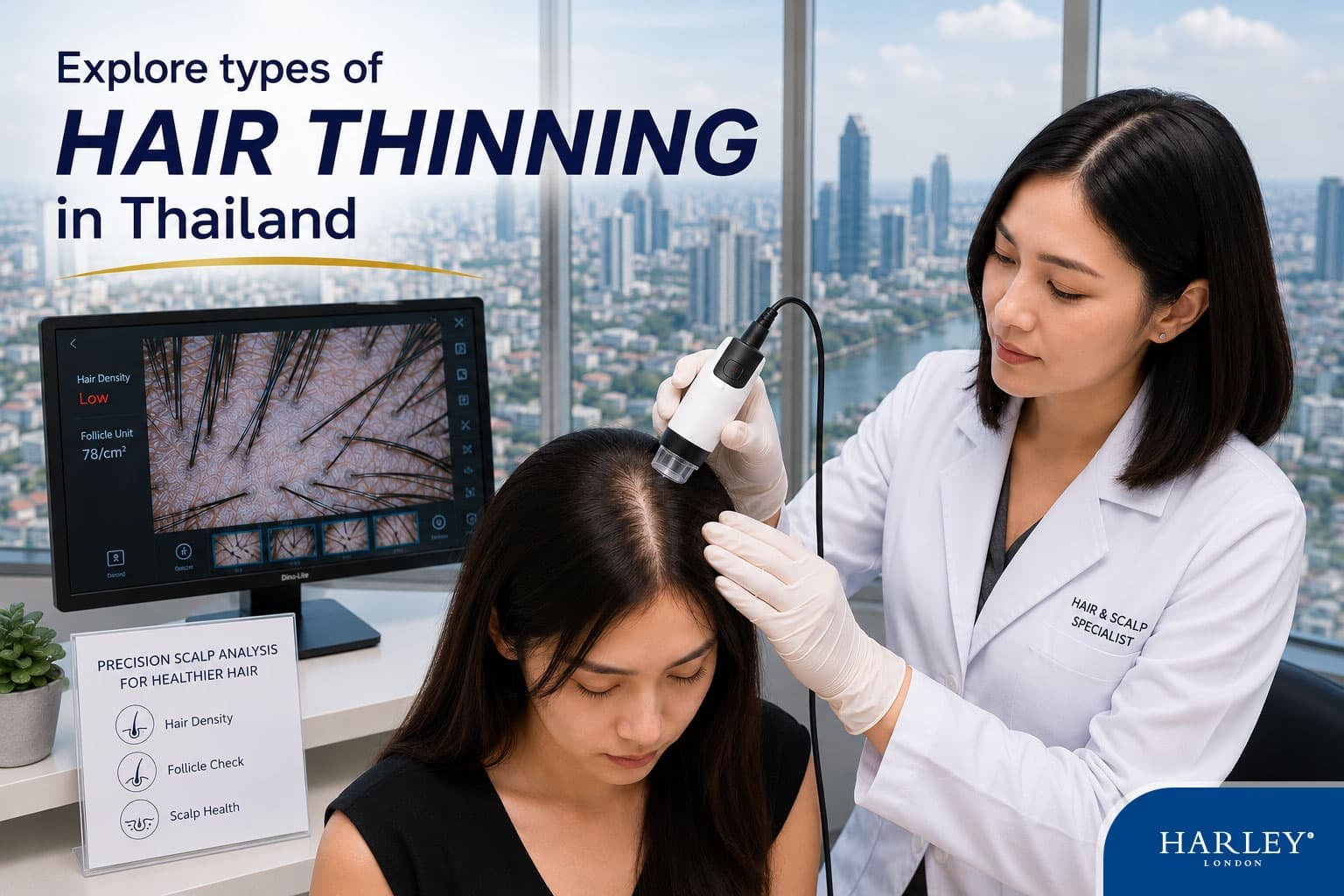
A Trichologist in Bangkok evaluating a young woman's thinning hair density and follicle spacing using precision scalp analysis..
If you have noticed your ponytail feeling significantly lighter, your central parting widening, or your scalp becoming more visible under bathroom lighting, you are not alone. In 2026, hair thinning has emerged as one of the most searched health and beauty concerns in Thailand.
Unlike acute shedding—where hair falls out in alarming clumps—hair thinning is a gradual, progressive process where the hair follicles themselves shrink, producing progressively finer, weaker strands until they cease production altogether.
While genetics play a role, the modern Thai lifestyle is increasingly taking the blame. Before you rush to buy commercial counter-brand treatments or opt for aggressive prescription drugs, let’s explore what is really happening to your hair follicles and how to treat them safely.
What is Hair Thinning? Common Types Reported in Thailand in 2026
“Hair thinning” occurs when a process called follicular miniaturisation takes place. External and internal stressors cause the hair’s active growth phase (Anagen) to shorten, while the resting phase (Telogen) lengthens. With each cycle, the hair follicle degrades, producing a thinner hair shaft.
In 2026, clinics across Bangkok and other major Thai provinces have reported a massive influx of patients suffering from three distinct types of hair thinning:
Diffused Hair Thinning (Chronic Telogen Effluvium): A progressive, even thinning across the entire scalp, predominantly triggered by internal systemic stress, nutritional gaps, and environmental toxicity.
Early-Onset Androgenetic Alopecia: Genetic thinning that is showing up much earlier in life (often in late teens and early twenties) due to lifestyle factors accelerating hereditary predispositions.
Traction and Chemical Thinning: Thinning concentrated around the hairline and parting, severely exacerbated by the popular Thai trends of frequent chemical straightening, perming, and tight hairstyling.
Global Comparison: Thailand vs. UK, USA, and Europe
The patterns and catalysts for hair thinning show a fascinating geographical split when we compare Thailand's 2026 data to established data from Western nations :
Feature
| Thailand (Urban Context) | UK, USA, and Europe |
|---|---|
| Primary Thinning Pattern : Diffused Thinning All Over The Scalp With Significant Loss Of Hair Volume And Diameter. | Primary Thinning Pattern : Disconnected, Localised Thinning (E.G., Severe Receding Hairlines Or Bald Crowns). |
| Dietary Triggers : High Intake Of Ultra-Processed Fast Foods, Hidden Sodium In Local Cuisine (Causing Dehydration), And Micronutrient Deficiencies (Vitamin D And Iron). | Dietary Triggers : Diets Lacking In Essential Fatty Acids Or Heavy Caloric Excesses, Combined With Severe Vitamin D Deficiencies Due To Low Sunlight. |
| Environmental Pollution : High Exposure To PM2.5 Microparticles In Cities Like Bangkok And Chiang Mai, Which Physically Clog Follicle Openings. | Environmental Pollution : Industrial Pollutants And Hard Water Minerals (Calcium/Limescale) That Coat The Hair Shaft Rather Than Invading The Follicle Pore. |
The Lifestyle Factors Damaging Follicles in Bangkok and Beyond
Living in a bustling metropolis like Bangkok, or even in rapidly growing provincial hubs, subjects your body to unique physiological stressors that directly impact the scalp microenvironment.
The Cortisol Spike & Sleep Deprivation
Long, exhausting commutes in traffic, work-related pressures, and the blue-light exposure of digital city life have severely disrupted circadian rhythms. Sleep deprivation suppresses the nocturnal surge of melatonin—a potent antioxidant that directly protects hair follicles from oxidative stress. This induces a state of chronic micro-inflammation around the follicle bulb, restricting blood flow and starving the hair root of oxygen.
Dietary Shifts and the PM2.5 Crisis
The convenience of modern urban diets often means missing out on vital amino acids and trace minerals necessary for keratin synthesis. Compounding this is the PM2.5 atmospheric crisis. These microscopic particles are small enough to penetrate the follicular infundibulum (the opening of the hair pore). Once inside, they induce systemic oxidative stress, causing cellular damage to the dermal papilla cells responsible for hair growth.
The Hidden Risks of Standard Dermatological and Counter-Brand Methods
When faced with thinning hair, many people instinctively seek out standard dermatological treatments or high-end counter-brand lotions. However, these traditional routes often come with heavy compromises :
Dermatological Medications: Conventional dermatologists frequently prescribe systemic hormone blockers (like Finasteride) or synthetic vasodilators (like oral Minoxidil). While they can stimulate growth, they carry well-documented risks of underlying side effects, including severe mood drops, chronic fatigue, and cardiovascular strain.
The Counter-Brand Pitfall: Expensive anti-thinning shampoos and serums found at beauty counters often rely heavily on denatured alcohols to ensure a quick-drying texture. Over time, these alcohols strip the scalp's protective moisture barrier, causing chemical dermatitis that further weakens the follicle anchorage, occasionally leading to a severe rebound hair fall.
The Safer Alternative: Why You Should Consult a Trichologist
If you want to reverse hair thinning without compromising your systemic health or damaging your hair follicles, consulting a certified Trichologist (Hair & Scalp Specialist) is the safest and most effective alternative.
Unlike a general dermatologist who treats hair as a purely cosmetic add-on to skin health, a Trichologist specializes exclusively in the science of the hair and scalp.
Why Trichology Offers a Better Path :
Zero-Side-Effect Protocols
Follicle-First Philosophy
Holistic Lifestyle Integration
Personalised product tailored to match individual’s hair and scalp condition
Avoid using medications, strong chemicals, or steroids that can cause wounds and irritation to the scalp
Do not wait until follicular miniaturisation becomes irreversible. Step away from high-risk chemicals and generic counter products, and book a consultation with a qualified Trichologist (Hair & Scalp Specialist) to restore your hair's natural density safely and sustainably.
Medical References :
Birnbaum, M. R., McLellan, B. N., Shapiro, J., Ye, K., & Reid, S. D. (2018). Evaluation of Hair Density in Different Ethnicities in a Healthy American Population Using Quantitative Trichoscopic Analysis. Skin appendage disorders, 4(4), 304–307.Leerunyakul, K., & Suchonwanit, P. (2020). Evaluation of Hair Density and Hair Diameter in the Adult Thai Population Using Quantitative Trichoscopic Analysis. BioMed research international, 2020, 2476890.Lim, S. H. & Wong, T. V. (2024). The impact of circadian rhythm disruption and cortisol on follicular miniaturisation. Clinical and Experimental Dermatology, 49(8), 892-899.Loussouarn, G., Lozano, I., Panhard, S., Collaudin, C., El Rawadi, C., & Genain, G. (2016). Diversity in human hair growth, diameter, colour and shape. An in vivo study on young adults from 24 different ethnic groups observed in the five continents. European journal of dermatology : EJD, 26(2), 144–154.Patterson, E. M. & Sinclair, R. (2025). Urban atmospheric pollution (PM2.5) and its direct oxidative pathways on human dermal papilla cells. Journal of Investigative Dermatology, 145(4), 310-318.Whiting, D. A. (2026). Chronic Telogen Effluvium and diffused hair thinning in modern metropolitan populations: A ten-year cohort study. International Journal of Trichology, 18(1), 45-53.