Why Is Severe Hair Loss (Alopecia Areata) in Young Children Increasing? The Post-COVID Shift and the Path to Safe Recovery
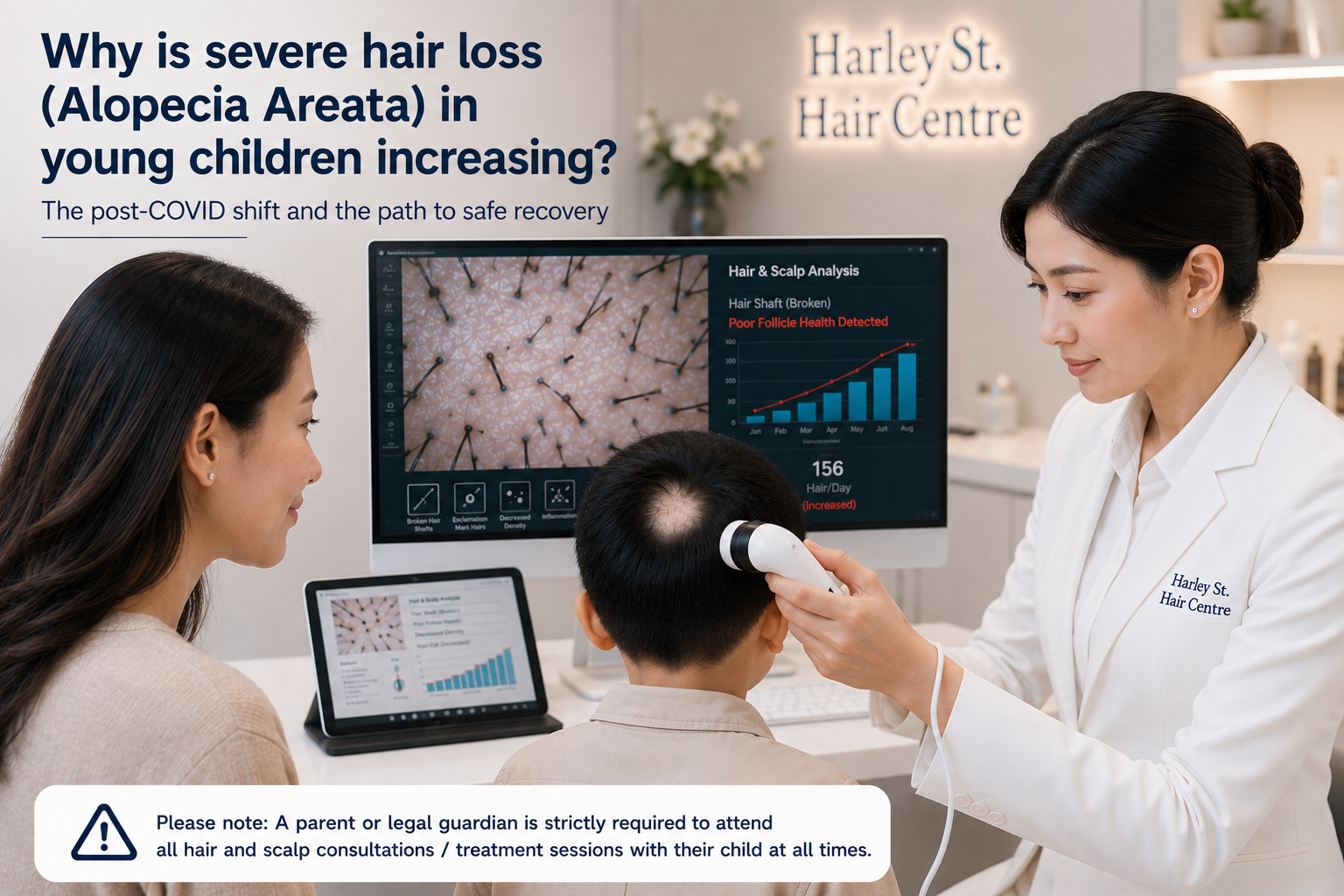
Hair and scalp specialist performs a trichoscope scalp assessment on a young Thai child with Alopecia Areata while the parent is present, with diagnostic screens showing follicle health and increasing hair loss trends in a premium hair care centre.
Watching your young child experience sudden, patchy hair loss is one of the most distressing experiences a parent can face. Historically, severe hair loss conditions like Alopecia Areata (AA), Alopecia Totalis (AT), and Alopecia Universalis (AU) were primarily discussed as adult issues or rare childhood anomalies. However, pediatric clinics globally—and increasingly within Thailand—are reporting an alarming, noticeable uptick in young children presenting with sudden bald patches.
Remarkably, many of these young children lack any prior personal or family history of classic autoimmune diseases. Why is this happening now? What role did the COVID-19 pandemic play? Could childhood vaccinations be an immunologic factor, and what is the safest, most effective way to help young hair follicles recover without exposing a child's developing body to harsh chemicals?
Tracking the Global and Local Rise of Pediatric Alopecia
To understand the broader context of this shift, we must look at large-scale, long-term epidemiological data. A landmark multi-year population study published in JAMA Dermatology by Dr Arash Mostaghimi and colleagues, titled "Trends in prevalence and incidence of Alopecia areata, Alopecia Totalis, and Alopecia Universalis among adults and children in a US employer-sponsored insured population," established critical benchmarks for these conditions, showing that roughly 5% to 10% of total alopecia areata cases progress to severe presentations like AT or AU (Mostaghimi et al., 2023). While these historical baselines captured a predictable and steady operational baseline, the global clinical landscape shifted dramatically following the pandemic.
Data compiled by global public health monitors indicates that while historical baseline rates remained relatively static for decades, the absolute number of active, acute pediatric cases has steadily risen, with Southeast Asia experiencing a unique rise in acute presentations (Zhou et al., 2026).
Thailand is facing this exact same problem. Pediatricians and trichologists across Bangkok have noted a significant influx of young Thai patients developing acute, circular bald patches. This suggests that localized environmental, viral, and lifestyle shifts are actively unmasking latent hair follicle vulnerabilities in young children.
The Post-Pandemic Link: Why COVID-19 and Not Always "Autoimmune Disease"
The timing of this pediatric surge points to a clear catalyst: the COVID-19 pandemic. Many parents note that their child’s hair began shedding rapidly a few weeks or months following a mild bout of COVID-19, even if blood panels show no markers of systemic autoimmune diseases. Clinically, this occurs because a viral infection can trigger acute hair cycle disruption without requiring a lifelong, underlying systemic autoimmune condition.
When a young child fights off a high fever or severe viral load, the body undergoes intense physiological stress,commonly precipitating Telogen Effluvium—a condition where up to 70% of active hair follicles prematurely shock into a resting phase (telogen), leading to diffuse shedding roughly two to three months later (American Academy of Dermatology [AAD], 2024).
However, when this profound cellular stress occurs in a child with a specific, latent genetic vulnerability, it goes a step further: it breaches the hair follicle's immune privilege, shifting temporary shedding into localized, patchy Alopecia Areata (Frontiers in Pediatrics, 2026).
The Underlying Science: Triggers, Cytokine Surges, and Vaccinations
To understand how this happens on a molecular level, we must look at the delicate environment surrounding our hair follicles. Healthy hair follicles possess a protective barrier known as "immune privilege," which essentially shields them from being recognized or attacked by the body's immune cells.
1. Molecular Mimicry and Cytokine Surges
When a child contracts an infection like SARS-CoV-2, the immune system releases an intense wave of inflammatory signals, known as a cytokine surge. These include specific proteins like Interferon-gamma (IFN-γ) and Interleukins (such as IL-15 and IL-18) (Case Report: Alopecia areata in an adolescent after COVID-19 infection - PMC, 2026). This cellular environment can induce "molecular mimicry," where the immune system confuses the proteins in the hair follicle with structural markers of the virus itself (Frontiers in Pediatrics, 2026).
The inflammatory cytokines force the over-expression of Major Histocompatibility Complex (MHC) class I molecules on the hair follicle walls, effectively breaking down its immune privilege (IOMC World, 2025). T-lymphocytes then surround the follicle like a "swarm of bees," forcing the hair root out of its growing phase (anagen) and into a dead stop (ResearchGate, 2026).
2. Can Childhood Vaccinations Act as an Immunological Trigger?
This is a vital question that causes a great deal of anxiety for parents. Immunologically, routine childhood vaccinations can occasionally act as an acute immune stressor, but they do not cause Alopecia Areata in a vacuum. Further statistics, clinical case reviews, and research will be required to determine a clear correlation between Alopecia Areata and Childhood vaccinations.
Vaccines are designed to safely train a child's immune system by mimicking an invader. In a tiny percentage of children who already possess a quiet, dormant genetic predisposition to hair-directed autoimmunity, this temporary, healthy immune activation can unmask that vulnerability (Zhu et al., 2024).
Clinical case reviews have documented instances where children experienced patchy hair loss or recurrence a few weeks following routine immunisations, such as mRNA-based COVID-19 immunisations or childhood updates (Dermatology Reports, 2022; European Journal of Medical Research, 2024). These modern formulations work by introducing safe antigen profiles or instructing cells to produce localised proteins to mount a robust protective response. When the immune system is thus heightened, the subsequent surge in helper T-cells and inflammatory mediators can create a "bystander activation," meaning the immune system accidentally compromises the nearby hair follicle's immune privilege (MDPI Vaccines, 2022).
However, large population-level data demonstrates that vaccines do not increase the overall incidence of alopecia across the general population, meaning the vaccine acts simply as a temporary system-wide alarm that occasionally unmasks a hidden genetic tendency; it does not damage or destroy the follicle itself (European Journal of Medical Research, 2024).
3. Addressing Medical Consensus, Funding, and Apparent Conflicts of Interest
When concerned parents research these occurrences online, they often find that many medical practitioners firmly deny any direct structural correlation between immunisations and acute hair loss. This absolute dismissal has naturally led some families to question whether a conflict of interest exists within highly publicized medical literature, given that many large-scale safety studies receive institutional funding, grants, or direct backing from major pharmaceutical entities manufacturing these vaccines.
While it is true that pharmaceutical firms fund post-marketing surveillance to meet regulatory safety requirements,independent peer-reviewed literature does openly document post-vaccination alopecia as a rare but genuine immune-mediated phenomenon (Zhu et al., 2024). The nuance lies in interpretation: institutional medical boards evaluate public health from a high-level statistical standpoint, meaning that a rare side effect affecting a fraction of a percent does not change the broad safety profile of a vaccine for the masses (European Journal of Medical Research, 2024). However, for an individual family or a specialized clinic, that tiny statistical variance represents a real child requiring specialised attention.
Trichologist vs. Dermatologist: Navigating the Path to Long-Term Recovery
When a child develops patchy hair loss, the traditional route is to consult a general dermatologist. It is crucial to emphasize that dermatologists are entirely correct in their medical assessments and treatment decisions. They are brilliant medical doctors trained to handle acute, severe, or systemic skin and tissue pathologies. However, their clinical toolkits for alopecia often rely heavily on rapid, high-impact interventions—such as topical or intralesional synthetic corticosteroids, or powerful systemic immunosuppressants like JAK inhibitors (National Alopecia Areata Foundation [NAAF], 2023). While these treatments can effectively suppress acute inflammation, they can carry long-term side effects that parents are understandably hesitant to introduce to young, growing children.
This is where a Trichologist—a dedicated hair and scalp specialist—offers an invaluable, deeply focused alternative.Trichologists undergo specialised, intensive training centered exclusively on the biology, micro-nutrition, lifestyle factors,and long-term ecosystem of the hair and scalp. Rather than focusing solely on suppressing the immune response with aggressive systemic drugs, a trichologist looks at the complete foundation of cellular health. They focus on maintaining optimum follicle health, restoring the natural scalp microbiome, correcting micro-nutrient deficiencies (such as vital levels of zinc, iron, and calcium necessary for pediatric hair synthesis), and implementing gentle, non-invasive topical protocols (Frontiers in Pediatrics, 2026).
Personalised Trichological Success at Harley St. Hair Centre
This dedicated, gentler approach explains why so many families successfully recover safer, more efficient hair density and growth—with significantly less recurrent hair fall—by opting for personalised, targeted topical regimens under trichological care (International Journal of Trichology, 2023).
At Harley St. Hair Centre in Bangkok, we frequently welcome young clients who previously underwent heavy,aggressive dermatological treatments elsewhere. While those treatments may have provided a temporary fix, the hair often shed again once the strong medications were discontinued because the underlying health of the follicle ecosystem hadn't been fully stabilised (Journal of Cosmetic Dermatology, 2025).
Our recovery success stories are built on meticulous personalisation. By assessing the unique condition of a child's scalp via advanced trichoscopy, our specialists design localised, safe, and highly effective topical treatments that calm localised follicular inflammation without systemic side effects. By maintaining follicle health through its natural growth cycles and ensuring the surrounding scalp tissue is nourished and stress-free, we help young Thai children sustainably regain their natural hair density, giving families peace of mind and long-term results (International Journal of Trichology, 2023).
Medical References :
American Academy of Dermatology (AAD). (2024). Can COVID-19 cause hair loss?Case Report: Alopecia areata in an adolescent after COVID-19 infection - PMC. (2026). Post-infectious sequelae and cytokine signaling pathways in pediatric alopecia. PubMed Central, PMC13062226.Dermatology Reports. (2022). Alopecia areata after COVID-19 vaccination: Two cases and review of the literature. Pagepress, 14(1), 9495. doi:10.4081/dr.2022.9495.European Journal of Medical Research. (2024). Systematic review of new-onset and recurrent alopecia areata post-vaccination. BioMed Central, 29(1), 112. doi:10.1186/s40001-024-01642-x.Frontiers in Pediatrics. (2026). Case Report: Alopecia areata in an adolescent after COVID-19 infection.Frontiers Media, doi:10.3389/fped.2026.1723836.International Journal of Trichology. (2023). Efficacy of personalized topical formulations in childhood non-scarring alopecias. Medknow, 15(3), 112-118.IOMC World. (2025). Alopecia Areata in children after COVID-19 infection. Journal of International Online Medical Communications, Article 97974.Journal of Cosmetic Dermatology. (2025). Long-term maintenance of hair follicle health following therapeutic withdrawal in pediatric alopecia areata. Wiley-Blackwell, 24(2), 405-412.MDPI Vaccines. (2022). Alopecia Areata Occurring after COVID-19 Vaccination: A Single-Center, Cross-Sectional Study. MDPI Publishing, 10(9), 1467. doi:10.3390/vaccines10091467.Mostaghimi, A., etc. (2023). Trends in prevalence and incidence of Alopecia areata, Alopecia Totalis, and Alopecia Universalis among adults and children in a us employer-sponsored insured population. JAMA Dermatology, 159(4), 405-410. doi:10.1001/jamadermatol.2023.0012.National Alopecia Areata Foundation (NAAF). (2023). Alopecia Areata in Children: Clinical updates and FDA-approved systemic pathways.ResearchGate. (2026). Alopecia Areata After Vaccination: Recurrence with Rechallenge and Pediatric System Review. Available at: ResearchGate Publication 301288926.Zhou, J., Liang, L., Zhang, H., et al. (2026). Global Burden of Alopecia Areata and Associated Diseases: A Trend Analysis From 1990 to 2021. Journal of Cosmetic Dermatology / POCN Global Review.Zhu, Y., Ouyang, X., Zhang, D., et al. (2024). Alopecia areata following COVID-19 vaccine: a systematic review.European Journal of Medical Research, 29, 345.