The Biological Truth About Greying Hair: Types, Timelines, and the Science of Follicle Care
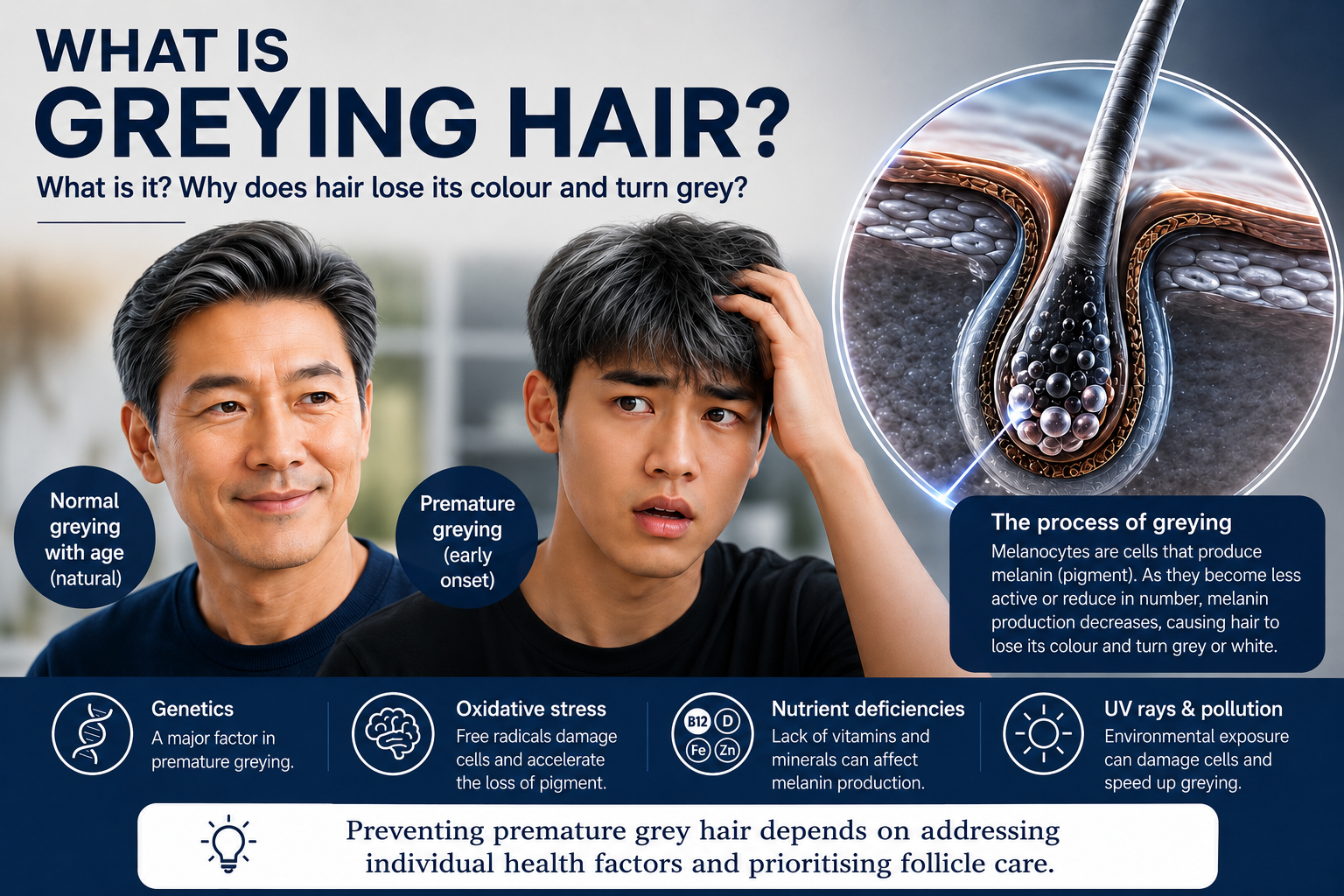
How do middle-aged men with age-related greying hair differ from teenage boys with premature greying hair? What are the factors that cause grey hair?
Finding your first white or grey hair can be a jarring experience. In Asian cultures, where thick, dark, and radiant hair is deeply tied to youth and vitality, the sudden appearance of silver strands often prompts immediate anxiety.
When grey hair appears, many people rush to the nearest pharmacy in Bangkok or Chiang Mai to buy "miracle" anti-grey shampoos. But what is actually happening inside your scalp when your hair changes colour? Is premature greying entirely genetic, or are modern lifestyles and environmental stressors accelerating the process?
By examining the latest medical data and foundational studies from UK Trichologists (hair and scalp specialists), we can separate marketing myths from genuine biological facts. Here is what you need to know about protecting your hair pigment from the inside out.
What is Greying Hair? (The Cellular Mechanism)
To understand greying hair—known medically as canities—we must look beneath the skin surface into the hair bulb. Your natural hair colour is determined by a pigment called melanin, which is produced by specialized cells called melanocytes (JCAD, 2021).
During the active growth phase (anagen) of the hair cycle, these melanocytes inject melanin pigment into the cells that form the actual hair shaft (keratinocytes). When the hair follicle functions perfectly, your hair emerges with its natural, rich dark pigment.
Hair greying is fundamentally caused by a reduction in active melanocytes within the hair bulb (JCAD, 2021). When these pigment-producing cells decline, fail to transfer melanin, or undergo programmed cell death (apoptosis), the hair shaft emerges completely unpigmented. What we perceive as "grey" is actually an optical illusion: it is a mix of completely white, unpigmented strands intertwined with your remaining dark hairs.
How Many Types of Greying Hair Are There?
Clinically, dermatologists and trichologists divide hair greying into two primary classifications based on the root cause :
1. Physiological Canities (Normal Ageing)
This is the completely natural, chronological fading of hair pigment that happens to everyone as they age. Over time, the reservoir of stem cells that replenish your melanocytes simply runs dry. Research shows an average human hair bulb undergoes roughly 7 to 15 cycles of replenishment before its regenerative capacity is exhausted (Tobin, 2011).
2. Pathological Canities (Premature Greying)
This occurs when the hair pigment system breaks down prematurely, long before chronological ageing should dictate it. Pathological greying is usually triggered by genetic mutations, acute systemic stress, metabolic shifts, or profound nutritional deficiencies that disrupt the delicate stem cell niche.
The Aging Timeline: Normal vs. Premature Greying in Asians
Hair ageing varies significantly by racial and ethnic background. According to a comprehensive comparative review published in The Journal of Clinical and Aesthetic Dermatology, the global timelines for normal versus early grey onset break down along clear ethnic lines (JCAD, 2021):
| Ethnicity | Average Onset of Normal Greying (JCAD, 2021) | Medical Threshold for Premature Greying (JCAD, 2021) |
|---|---|---|
| Caucasians | Mid-30s | Before 20 years old |
| Asians | Late 30s | Before 25 years old |
| Africans | Mid-40s | Before 30 years old |
The Vital Difference: Normal vs. Premature
Normal Greying: Driven by intrinsic cellular senescence. The stem cells slowly lose their ability to move back and forth between the follicle bulge and the hair root, eventually getting physically stuck and failing to mature into active pigment cells (NIH / Nature, 2023).
Premature Greying: Characterized by abrupt, early follicular failure. The melanocyte stem cells are either destroyed entirely, forced into premature exhaustion, or undergo "ectopic differentiation" (maturing in the wrong place inside the follicle, rendering them useless for future hair cycles).
Why Are Asian Teens Experiencing Premature Greying?
It is becoming increasingly common to see teenagers and young adults in Asian countries presenting with silver strands. While genetics dictate your baseline susceptibility—often inherited as an autosomal dominant trait—medical journals highlight several modern triggers driving premature canities in young people:
The Oxidative Stress Theory: In unpigmented hair follicles, researchers have documented a massive accumulation of hydrogen peroxide (H2O2) in the millimolar range. This buildup occurs because the body’s natural antioxidant enzymes—specifically catalase and methionine sulfoxide reductase—are heavily suppressed, which literally bleaches the hair from the inside out (Kumar et al., 2018).
The Core Triggers in Young Asians
Severe Nutritional Deficiencies: Modern, fast-paced diets often lack critical micro-co-factors needed for melanin synthesis. Landmark studies show that young adults suffering from premature greying exhibit significantly lower serum levels of Vitamin B12, ferritin (iron stores), calcium, and Vitamin D3 (Kumar et al., 2018). Copper deficiency is also a major culprit, as copper is the core element required to activate tyrosinase, the enzyme responsible for creating pigment.
Psychological and Academic Stress: A groundbreaking study proved that intense psychological stress triggers the sympathetic nervous system to release an overload of noradrenaline (Zhang et al., 2020). This stress chemical directly floods the hair follicle bulge, causing the resident melanocyte stem cells to rapidly and irreversibly deplete, leading to a permanent loss of pigmentation.
Environmental Toxin Exposure & Smoking: Air pollution in major urban areas combined with smoking (or vaping) introduces massive amounts of free radicals into the bloodstream. Studies reveal that smokers are 1.99 times more likely to develop premature grey hair before the age of 30 due to systemic oxidative damage (JCAD, 2021).
The Trichological Connection: How Follicle Health Keeps Hair Dark
UK Trichologist studies focus heavily on the microenvironment of the hair follicle. For a strand of hair to grow with healthy pigment, the hair follicle must maintain its immune privilege and structural integrity.
A breakthrough study explores a cellular survival mechanism called the "Evolutionary Checkpoint Theory" (Chin et al., 2025). When a hair follicle is compromised by inflammation, poor blood circulation, or chemical stress, the body institutes a biological "safe mode". To protect the deeper stem cell pool from acquiring DNA mutations or turning malignant, the follicle deliberately sacrifices cosmetic pigmentation to prioritize basic structural survival (Chin et al., 2025).
Furthermore, for hair to remain pigmented, an intricate cellular cross-talk called Wnt/β-catenin signaling must occur perfectly between the epithelial cells (which grow the physical hair) and the melanocyte stem cells (which provide the colour).
If the follicle matrix is inflamed, clogged with heavy sebum, or suffocated by harsh chemicals, this signaling uncouples (Chin et al., 2025). The hair continues to grow, but the pigment mechanism is completely silenced—resulting in a coarse, white strand.
The Danger of "Anti-Grey" Shampoos vs. Clinical Trichology
Walk into any pharmacy or scroll through social media in Thailand, and you will see dozens of miracle shampoos, traditional herb extracts, and oils claiming to permanently reverse grey hair.
The Scientific Truth About Commercial "Miracle" Shampoos
From a medical and trichological standpoint, it is biologically impossible for a topical shampoo to reactivate dead or genetically exhausted melanocyte stem cells.
Most mass-market "grey reversal" products rely on two deceptive mechanisms :
Progressive Direct Dyes: They contain hidden metallic salts or semi-permanent dyes that coat the hair shaft over time, turning the white hair into a dull charcoal or yellowish-brown.
Harsh Chemical Surfactants: To get these active coatings or heavy herbs to stick, these formulations often have highly aggressive pH levels and heavy silicones.
Over time, coating your scalp in these unverified, over-the-counter products creates a toxic layer of chemical buildup. This clogs the follicular infundibulum, sparks chronic contact dermatitis, destroys the scalp's microbiome, and ultimately causes follicular miniaturisation and telogen effluvium (severe hair fall) (Trueb, 2015).
Why You Should See a Trichologist (Hair and Scalp Specialist)
Instead of masking the issue with products that risk permanent hair thinning, the safest and most effective approach to premature greying is seeking professional care. A Trichologist uses specialised trichoscopy tools to perform a comprehensive scalp and follicle health check.
Rather than guessing, a trichologist (Hair and Scalp Specialist) can identify the precise underlying cause (Kumar et al., 2018) / (Chin et al., 2025).
Your hair health is an outward reflection of your internal biochemistry. If you are noticing an unexpected increase in grey hair, skip the over-hyped, risky chemical shampoos. Invest in the long-term health of your scalp by consulting a certified Trichologist or medical specialist to treat the root cause safely and effectively.
Medical References :
Chin, X., Tobin, D. J., & Paus, R. (2025). Hair Graying as an Evolutionary Checkpoint against Malignancy: a Stem Cell Perspective. Stem Cell Reviews and Reports, 22(6), 1499–1501.JCAD. (2021). Hair Aging in Different Races and Ethnicities. The Journal of Clinical and Aesthetic Dermatology, 14(1), 38–41.Kumar, A. B., Shamim, H., & Prabhu, S. S. (2018). Premature Graying of Hair: Review with Updates. International Journal of Trichology, 10(5), 198–203.NIH / Nature. (2023). Dedifferentiation maintains melanocyte stem cells in the hair follicle bulge. Nature Cell Biology, 25(4), 543–552.Tobin, D. J. (2011). Hair cycle and hair pigmentation: dynamic interactions and changes associated with aging. Biogerontology, 12(4), 279–290.Trueb, R. M. (2015). Scalp condition impacts hair growth and retention via oxidative stress. International Journal of Trichology, 7(1), 2–15.Zhang, B., Ma, S., & Rachmin, I. (2020). Hyperactivation of sympathetic nerves drives depletion of melanocyte stem cells. Nature, 577(7792), 676–681.