What Is Alopecia Areata? The Latest Medical Journal Updates on Patchy Hair Loss and the Path to True Recovery
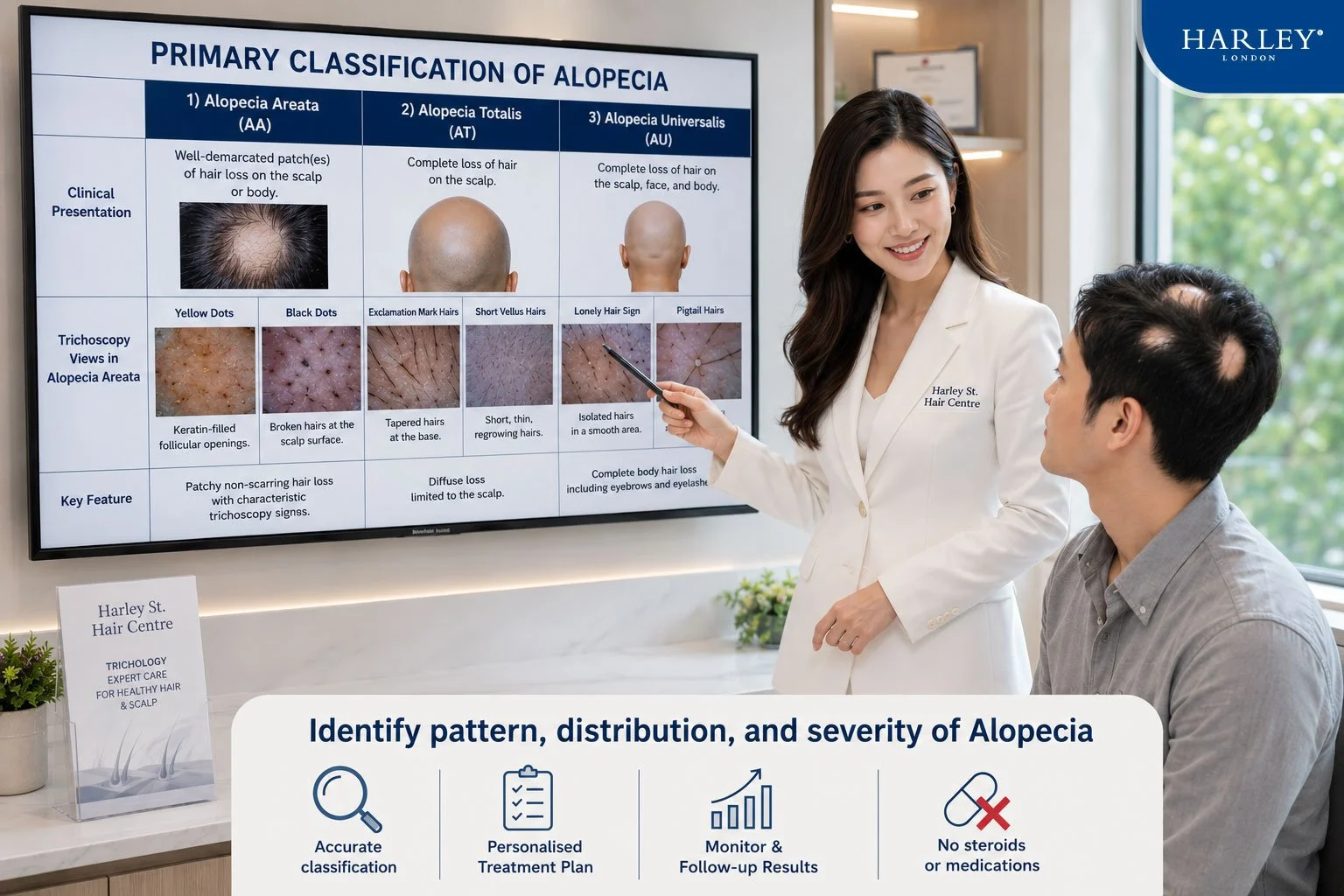
An Asian man with patchy hair loss symptoms visits a Hair and Scalp Specialist to consult about the latest medical classification of Alopecia Areata (AA, AT, AU) and why patchy hair loss is rising in Thailand post-COVID-19. He Learns how a holistic Trichological approach offers a safer, steroid-free path to long-term hair regrowth compared to conventional treatments.
Sudden, patchy hair loss can be deeply distressing. Finding smooth, coin-sized bald spots on your scalp out of nowhere leaves many people in Thailand searching for answers. This condition is known as Alopecia Areata (AA).
While historically viewed as a simple, isolated autoimmune quirk, the latest global clinical research paints a much more intricate picture. The medical understanding of how this condition behaves, what triggers it, and how to safely treat it without damaging your long-term health is shifting rapidly.
Defining Alopecia Areata: Patterns, Distribution, and the Latest Medical Classifications
At its absolute core, Alopecia Areata is a non-scarring condition where the body’s cellular defenses mistakenly target hair follicles during their active growth phase (anagen), forcing them into a premature resting state.
According to the groundbreaking 2025 Nature Reviews Disease Primers clinical update, the ultimate driver of this condition is the collapse of the hair follicle's immune privilege. Normally, your hair follicles are shielded from your immune system. When this shield breaks down, an accumulation of autoreactive T-lymphocytes and natural killer (NK) cells clusters around the bulb—often described under a microscope as a "swarm of bees"—triggering localized inflammation and rapid shedding (Ungar et al., 2025, Nature Reviews Disease Primers).
Medical journals classify the condition based on its severity, distribution pattern, and structural footprint across the body :
The Primary Classifications
Patchy Alopecia Areata (AA): The most common manifestation, characterised by one or multiple well-demarcated, round or oval bald patches. It is primarily confined to the scalp but can occur on any hair-bearing site (ISHRS, 2024, Complete Guide to AA).
Alopecia Totalis (AT): An advanced and severe progression marked by the total or near-total loss of all terminal hair across the entire scalp, while body hair remains intact (Simakou et al., 2018, PubMed / Glasgow Caledonian).
Alopecia Universalis (AU): The most extensive form of the condition, resulting in a complete absence of hair across the entire epidermal landscape, including the scalp, eyebrows, eyelashes, axillary hair, and pubic hair (Journal of Drugs in Dermatology, 2025).
Newly Recognized Morphological Variants
Recent medical archives highlight that Alopecia Areata is not always linear. A major multi-year study published in the Medical Research Archives (July 2025) revealed that more than half of patients exhibit hair involvement stretching far beyond classic scalp boundaries. This has led to updated diagnostic categories:
Ophiasis Pattern: Hair loss that snakes along the lower perimeter of the scalp (the occipital and temporal regions).This pattern is statistically more resistant to conventional systemic therapies (ISHRS, 2024).
Alopecia Subuniversalis: A newly proposed morphological subtype introduced in 2025 to classify patients who present with extensive scalp hair loss alongside severe, widespread involvement of other facial and body hair zones (such as the beard, eyebrows, and eyelashes), yet stop just short of absolute head-to-toe hairlessness (Cutis Institute of Dermatology, 2025, Medical Research Archives).
Why Are Thai Citizens Experiencing a Surge in Alopecia Areata? The Post-COVID-19 Connection
In clinical settings across Thailand, hair specialists are observing an unprecedented influx of patch alopecia cases. While lifestyle stress in urban centers like Bangkok plays a role, modern medical literature points directly to a major viral catalyst: Post-COVID-19 syndrome.
Emerging evidence shows that the SARS-CoV-2 virus acts as a potent hyper-inflammatory trigger. A peer-reviewed analysis in Frontiers in Pediatrics (2026) notes that the post-COVID-19 state is defined by a prolonged, dysregulated elevation of pro-inflammatory cytokines, specifically Interferon-gamma (IFN-γ), Interleukin-10 (IL-10), and Tumor Necrosis Factor-alpha (TNF-α). This systemic "cytokine storm" breaks down the body's immune tolerance, frequently causing the immune system to misidentify hair follicle tissue (Frontiers, 2026, Case Report: AA after COVID).
Furthermore, a study in the Journal of Drugs in Dermatology (2025) documented instances of sudden-onset, severe Alopecia Universalis occurring rapidly after viral recovery. The virus's intense stimulation of the IFN-γ-driven JAK-STAT pathway forces an aggressive collapse of the follicular immune privilege. This confirms that modern cases of Alopecia Areata across Thailand are heavily linked to persistent, post-viral immune hyperactivation rather than simple genetics alone (Journal of Drugs in Dermatology, 2025, Post-COVID AU Management).
The Diagnostic Divide: Why Many Dermatologists Still Confuse Alopecia Areata
There is a widening gap between conventional dermatology and advanced Trichology (the specialized science of the hair and scalp) regarding how this condition is diagnosed and framed to the patient.
| THE DIAGNOSTIC GAP | |
|---|---|
| CONVENTIONAL DERMATOLOGY | ADVANCED TRICHOLOGY |
|
|
Many conventional dermatologists look at Alopecia Areata through a single, rigid lens: a pure, isolated autoimmune disease. Because they identify the immediate cellular attack on the follicle, their diagnosis often stops there, leading them to prescribe heavy immunosuppressants to stop the attack.
In contrast, a certified Trichologist (Hair and Scalp Specialist) looks at the hair follicle as an interactive ecosystem. Trichological science emphasizes that while the mechanism of shedding is autoimmune-mediated, the condition itself is multifactorial.
As detailed in the medical journal Biology of Sex Differences (2025) and structural reviews by Simakou et al., the initiation of Alopecia Areata requires a complex intersection of environmental, neuroendocrine, and biochemical triggers.
Medical literature proves that a breakdown in follicle tolerance is rarely random. It is frequently caused by a combination of factors working together:
Neuroinflammatory Pathways: Psychological and physical stress causes the upregulation of Substance P and Corticotropin-Releasing Hormone (CRH) directly around the scalp tissue. This local stress response activates mast cells, causing immediate neurogenic inflammation that dismantles the follicle's immune shield (Ungar et al., 2025, Nature Reviews).
Biochemical & Trace Element Deprivation: Critical nutritional deficiencies actively disrupt immune regulation.Large-scale meta-analyses in the Journal of Cosmetic Dermatology (2025) have verified a direct link between low serum levels of essential trace elements—such as zinc, iron, and Vitamin D—and the onset and severity of patchy hair loss (Journal of Cosmetic Dermatology, 2025, Association Between Serum Trace Elements and AA).
By ignoring these co-factors and treating the issue as a simple autoimmune disease, conventional approaches often miss the true underlying causes of the flare-up.
Common Conventional Treatments for Alopecia Areata
When treating Alopecia Areata, standard dermatology typically relies on a specific set of clinical interventions designed to suppress the local immune response:
Topical and Intralesional Corticosteroids : High-potency steroid creams or direct injections of triamcinolone acetonide into the hairless patches. These are used as a first-line treatment to temporarily shut down the local immune attack (Japanese Dermatological Association Clinical Practice Guidelines, 2024).
Systemic Immunosuppressants : Oral steroids or immunosuppressive medications intended to quiet widespread, aggressive shedding.
JAK Inhibitors (Janus Kinase Inhibitors) : Modern medical entries, including guidelines from the National Institute for Health and Care Excellence (NICE, 2024), highlight the rise of targeted oral therapies like ritlecitinib and deuruxolitinib. These block the intracellular JAK-STAT signaling pathway to stop T-cells from attacking the hair bulb (NICE, 2024 / Ungar et al., 2025).
While these treatments can yield rapid hair regrowth, they come with a catch. They do not address the environmental, nutritional, or neurogenic triggers that caused the flare-up in the first place. Consequently, medical records show a high rate of relapse once the medication is stopped (Journal of Drugs in Dermatology, 2025).
The Case for Trichology: A Safer, Holistic Way to Long-Term Hair Regrowth
If you are looking for a sustainable recovery from Alopecia Areata in Thailand, it is vital to prioritize a qualified Trichologist over standard counter brands or conventional, steroid-heavy regimens.
The Pitfalls of Over-the-Counter Brands and Chemical Detoxes
Many commercial counter brands use aggressive marketing, claiming their "scalp detoxes" or strong anti-hair loss shampoos can regrow hair. In reality, many of these products are formulated with harsh chemicals and hidden stimulants that cause contact dermatitis and scalp irritation. Rather than healing the tissue, they trigger chronic, low-grade inflammation that further destabilizes the fragile hair follicle environment.
The Problem with Continuous Steroid and Hormone Therapy
While conventional dermatology relies on steroids, synthetic hormones, and strong medications to force hair growth, these methods carry inherent long-term health risks.
Topical and injected steroids can cause skin thinning (atrophy), telangiectasia (broken blood vessels), and follicle damage over time. Furthermore, because systemic immunosuppressants and JAK inhibitors alter your broader immune system, they often cause a rebound effect—meaning the hair can fall out again as soon as the medication is discontinued (Journal of Drugs in Dermatology, 2025).
The Trichological Approach: Wellness, Safety, and Longevity
A professional Trichologist takes a different route, focusing on gentle, non-invasive therapies designed to restore the scalp's natural balance.
Instead of heavy medications, Trichologists design bespoke, botanical topical programs tailored precisely to your unique scalp profile. These botanical formulas work to calm neurogenic inflammation, naturally inhibit overactive local cytokines, and improve capillary microcirculation around the hair bulb—all without damaging the follicle structure or relying on synthetic hormones and steroids.
Medical studies confirm that addressing hair health through cellular wellness, antioxidant support, and correcting nutritional deficiencies provides a safer and more durable recovery path for Alopecia Areata (Journal of Cosmetic Dermatology, 2025 / Simakou et al., 2018). By working with your body’s natural biology rather than overriding it with heavy pharmaceuticals, Trichology promotes long-term scalp health and lasting hair regrowth.
Medical References :
Cutis Institute of Dermatology. (July 2025). Alopecia areata - need for a revision in morphological classification and scoring. Medical Research Archives, 13(6).Frontiers in Pediatrics. (2026). Case Report: Alopecia areata in an adolescent after COVID-19 infection.Frontiers in Pediatrics, 14, Article 1723836.ISHRS. (2024).A Complete Guide to Alopecia Areata. International Society of Hair Restoration Surgery Clinical Database.Japanese Dermatological Association. (2024). Clinical practice guidelines for alopecia areata 2024. PubMed, JDA-Guidelines-40698756.Journal of Cosmetic Dermatology. (2025). Association Between Serum Trace Elements Level and Alopecia Areata: A Systematic Review and Meta-Analysis. Journal of Cosmetic Dermatology, 24(2).Journal of Drugs in Dermatology. (2025). Post-COVID-19 Alopecia Universalis: Autoimmune Hair Loss and the Challenge of Relapse Management. JDD Online, S1545961625P9216X.National Institute for Health and Care Excellence (NICE). (2024).Ritlecitinib for treating severe alopecia areata in people 12 years and over. NICE Technology Appraisal Guidance.Simakou, T., Butcher, J. P., Reid, S., & Henriquez, F. L. (2018). Alopecia areata: A multifactorial autoimmune condition. PubMed / Glasgow Caledonian University Research Repository.Ungar, B., et al. (December 2025). Alopecia areata. Nature Reviews Disease Primers, 11(77).