Alopecia Areata in Children: Hidden Inflammatory Triggers, the Dangers of Steroids, and Safe Trichological Solutions
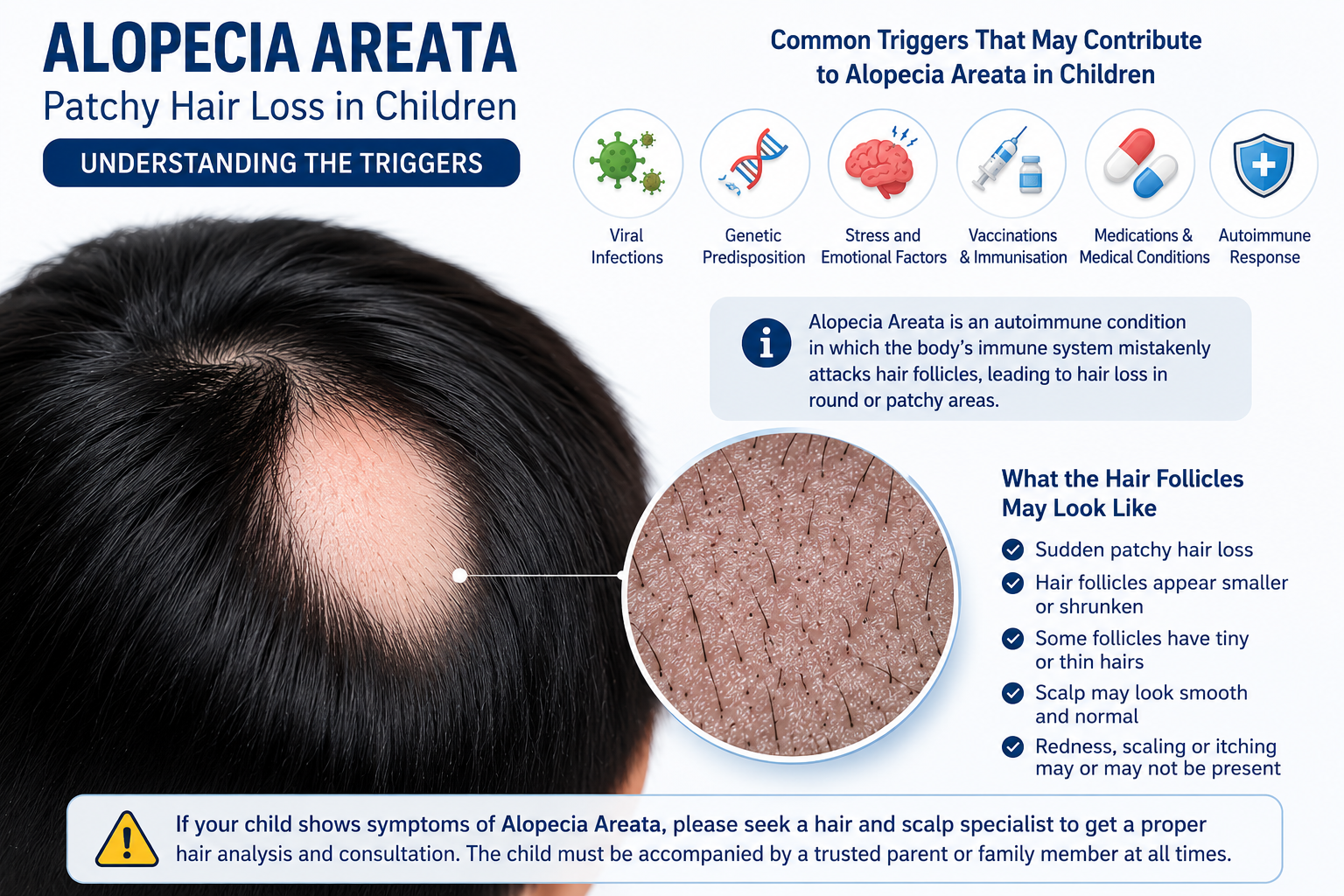
A close-up of Alopecia Areata (Patchy Hair Loss) symptoms on a child's scalp.
Discovering sudden, circular bald patches on a young child's scalp is an incredibly emotional experience for any parent in Thailand. Alopecia Areata (AA) —a condition where hair follicles prematurely shut down and shed hair—is becoming a rapidly growing concern across the country.
While conventional medicine immediately turns to aggressive chemical suppression, a child's delicate scalp requires a fundamentally different level of care. At Harley St. Hair Centre, our specialists treat pediatric Alopecia Areata through safe, non-invasive, bespoke hair and scalp solutions that avoid the physical and structural harm caused by standard dermatological pharmaceutical routines.
Why are Pediatric Alopecia Areata Cases Rising Yearly?
The clinical landscape has shifted drastically over recent years, with hair and scalp specialists globally and throughout Thailand documenting an unprecedented annual surge in childhood Alopecia Areata. To understand why these numbers are climbing, we must look at the distinct differences between adult and pediatric manifestations found in peer-reviewed clinical studies.
In adults, Alopecia Areata is frequently tied to chronic lifestyle stressors, metabolic shifts, or standard age-related cellular updates. However, the latest medical journals reveal that early-onset pediatric Alopecia Areata exhibits a far more volatile and severe immunological profile. Children diagnosed with AA carry a significantly higher genetic susceptibility and a powerful correlation with atopic diseases, such as eczema, asthma, and severe allergic rhinitis. Because a child’s immune and endocrine systems are still actively developing, their bodies are highly sensitive to systemic imbalances, making them far more prone to sudden follicular shutdown than adults. (Cureus Journal of Medical Science, 2025; StatPearls - NCBI Bookshelf, 2023)
Inner Body Inflammation: The Triggers Dermatologists Overlook
A major flaw in standard dermatological care is the reflex to immediately label every patch of childhood hair loss as a permanent autoimmune disease, assuming the body is naturally defective. However, cutting-edge medical research proves that a young child's Alopecia Areata can be triggered by many types of inner body inflammation that may not be related to an autoimmune disease at all.
Systemic inflammatory responses resulting from simple viral overloads, acute digestive tract inflammation, or localised immune responses can cause an overproduction of pro-inflammatory signaling proteins. This internal inflammation spills over into the scalp, disrupting the hair follicle's "immune privilege" and causing immediate shedding. (Frontiers in Immunology, 2025; StatPearls - NCBI Bookshelf, 2023)
Unfortunately, most dermatologists fail to specify or investigate these underlying inflammatory anomalies. Instead, they immediately assign young clients to aggressive steroid treatments or heavy medications without mapping out the true internal trigger first. Rushing into standard medical protocols without identifying the core catalyst can lead to disastrous consequences for a child. In highly reactive pediatric systems, this immediate chemical shock can severely damage the fragile scalp environment. Medical journals confirm that this blanket treatment can paradoxically make the condition worse, rapidly accelerating simple localized Alopecia Areata (AA) into devastating conditions like Alopecia Totalis (AT, complete loss of scalp hair) or Alopecia Universalis (AU, total loss of all body and facial hair). (Frontiers in Immunology, 2025; Journal of Voiceless Inclusion / HealthDisGroup, 2021)
The Pre vs. Post-Pandemic Link: COVID-19, Vaccinations, and Immune Spikes
Our hair and scalp specialists at Harley St. Hair Centre, our team have collected and monitored a vast directory of pediatric hair loss cases across Thailand, tracking individual recovery results during the pre- versus post-COVID-19 pandemic eras. Our meticulous case tracking has revealed an undeniable link between the post-pandemic timeline and the annual rise in childhood Alopecia Areata. We have identified specific patterns connecting COVID-19 infections, mRNA/viral-vector vaccinations, and other routine childhood immunizations as primary triggers for rapid follicular shutdown.
This local observation directly aligns with data published in international medical journals. Complex vaccines can trigger a sudden, intense surge of cellular inflammation (cytokines) or induce molecular mimicry in genetically predisposed children, causing the body's defense mechanisms to accidentally attack the healthy hair bulb. (MDPI / Viruses, 2022; PMC - NIH / European Journal of Medical Research, 2024)
This vaccine-induced inflammatory trigger is not unique to pandemic treatments. Long-term pediatric medical literature has established that standard routine vaccinations—such as the influenza, hepatitis B, or Japanese encephalitis vaccines—can act as acute inflammatory catalysts in sensitive children. When a child experiences an unbuffered immune spike from these foreign antigens, the scalp's delicate follicle population often bears the brunt of the internal inflammatory wave, leading to immediate hair loss. (Pediatric Dermatology - Ovid, 2016; PMC - NIH / European Journal of Medical Research, 2024)
Why Steroid Injections and Creams are Highly Harmful to a Child’s Scalp
While conventional clinical dermatology relies on steroids as a standard tool, this approach poses significant physical and structural risks to a developing child. Many parents seek out Harley St. Hair Centre after experiencing failed, agonizing results at traditional skin clinics and hospitals that utilise these standard methods.
1. The Physical Trauma of Corticosteroid Injections
Intralesional steroid injections require a practitioner to puncture a child’s bald patches repeatedly with needles. While an adult’s fully matured scalp can tolerate this, a young child’s scalp is thin, highly sensitive, and packed with delicate nerve endings. Forcing a child to undergo repeated clinical injections causes immense physical pain and deep emotional distress.
Furthermore, peer-reviewed medical studies warn that local steroid injections risk harming a child far more than an adult. These chemicals frequently cause severe localized dermal atrophy (permanent thinning and wasting away of the skin tissue), unsightly skin depressions, and chronic localized folliculitis. (Journal of Voiceless Inclusion / HealthDisGroup, 2021)
2. Why Topical Steroid Creams Fail the Hair Follicle
When needles are avoided, dermatologists often prescribe strong topical steroid creams. However, because a child’s scalp tissue is incredibly thin and permeable, they face a high risk of systemic chemical absorption into their bloodstream.
More importantly, topical steroid creams are an superficial surface remedy; they fail to target or prevent active hair fall at the root. A cream merely suppresses surface skin inflammation, whereas a dedicated hair and scalp specialist focuses directly on shielding the hair follicle, stopping active hair fall, and safely boosting long-term hair regrowth from deep within the hair bulb. Medical data reveals that when these harsh steroid creams are stopped, the unaddressed internal inflammation causes the hair loss to recur aggressively, often leaving the hair follicles in a significantly weaker, more damaged state. (Journal of Voiceless Inclusion / HealthDisGroup, 2021)
The Safe, Bespoke Solution at Harley St. Hair Centre
Harley St. Hair Centre operates on a strict non-pharmaceutical, non-invasive philosophy. Our customised pediatric treatment programs contain:
NO Corticosteroid Creams or Painful Needle Injections
NO Artificial Hormones or Systemic Suppressants
NO Toxic Chemical Regrowth Medications (Minoxidil or Finasteride)
NO Invasive Clinical Procedures
Rather than using harsh synthetic chemicals that can damage the delicate hair bulb, our hair and scalp specialists focus on identifying your child's specific, individualized inflammatory triggers. By assessing the precise health stage of the remaining hair follicles, we design custom-tailored, nutrient-rich topical protocols that calm the scalp ecosystem and restore peripheral tolerance naturally.
By feeding the hair root with safe, botanical extracts and structural micro-nutrients, we block the inflammatory signals causing hair fall and naturally reactivate the follicle’s growth cycle. This gentle approach ensures beautiful, permanent hair regrowth without the dangerous side effects or rebound hair loss associated with clinical drug dependency. (Journal of Voiceless Inclusion / HealthDisGroup, 2021)Over 18 Years of Elite Clinical Experience in Thailand
With over 18 years of specialized experience treating hair and scalp conditions in Thailand, our specialists have encountered and successfully resolved every variation of childhood and adult Alopecia Areata. We know that no two children share the exact same internal triggers or follicle health profiles, which is why our care is completely personalized.
Our chemical-free, safe trichological methods are perfectly suited for :Young children with highly sensitive, thin, or easily irritated scalp tissue
Children suffering from underlying atopic conditions, hyper-reactive allergies, or immune sensitivities
Pediatric patients who have experienced a severe worsening of hair loss after undergoing standard hospital steroid treatments
Our local clinical experience is paired with premium formulations and treatment philosophies developed by a UK-based hair and scalp specialist with over 30 years of elite experience in the field. International medical consensus supports that non-pharmaceutical, protective hair and scalp care provides a vastly superior, safer, and more sustainable recovery path for young children compared to the temporary, tissue-damaging solutions used by conventional clinics. Explore our successful client recovery reviews today and give your child the gift of safe, natural hair restoration.
Medical References :
Cureus Journal of Medical Science (2025): Pathophysiology, Environmental Triggers, and Global Pathogenesis of Autoimmune Non-Scarring Alopecia Areata.
Frontiers in Immunology (2025): Alopecia areata: From immunopathogenesis to emerging therapeutic approaches and follicular tissue protection.
Journal of Clinical and Aesthetic Dermatology (2023): Psychosocial Burden and Generalized Anxiety Disorders in Pediatric and Adolescent Patients with Alopecia Areata. PMC10291119.
Journal of Voiceless Inclusion / HealthDisGroup (2021): Recurrence Rates, Local Corticosteroid Side Effects, and Follicular Atrophy in Chronic Alopecia Areata Management.
MDPI / Viruses (2022): SARS-CoV-2 Infection and COVID-19 Vaccination Associated with Post-Acute Alopecia: Prevalence, Clinical Patterns, and Determinants.
Pediatric Dermatology - Ovid (2016): Alopecia Areata After Vaccination: Recurrence and Totalis Progression Following Routine Pediatric Immunizations.
PMC - NIH / European Journal of Medical Research (2024): New-Onset and Relapsed Alopecia Areata Post-COVID-19 Vaccination: A Comprehensive Review of Global Passive Surveillance Data. PMC9892995 / PMC8844677.
StatPearls - NCBI Bookshelf (2023): Alopecia Areata Clinical Manifestations, Cellular Swarm Infiltration, and Distinctions in Pediatric vs. Adult Management. NBK537000.