Do Antidepressants Cause Hair Loss? The Deep Scientific Truth and Safe Trichological Solutions
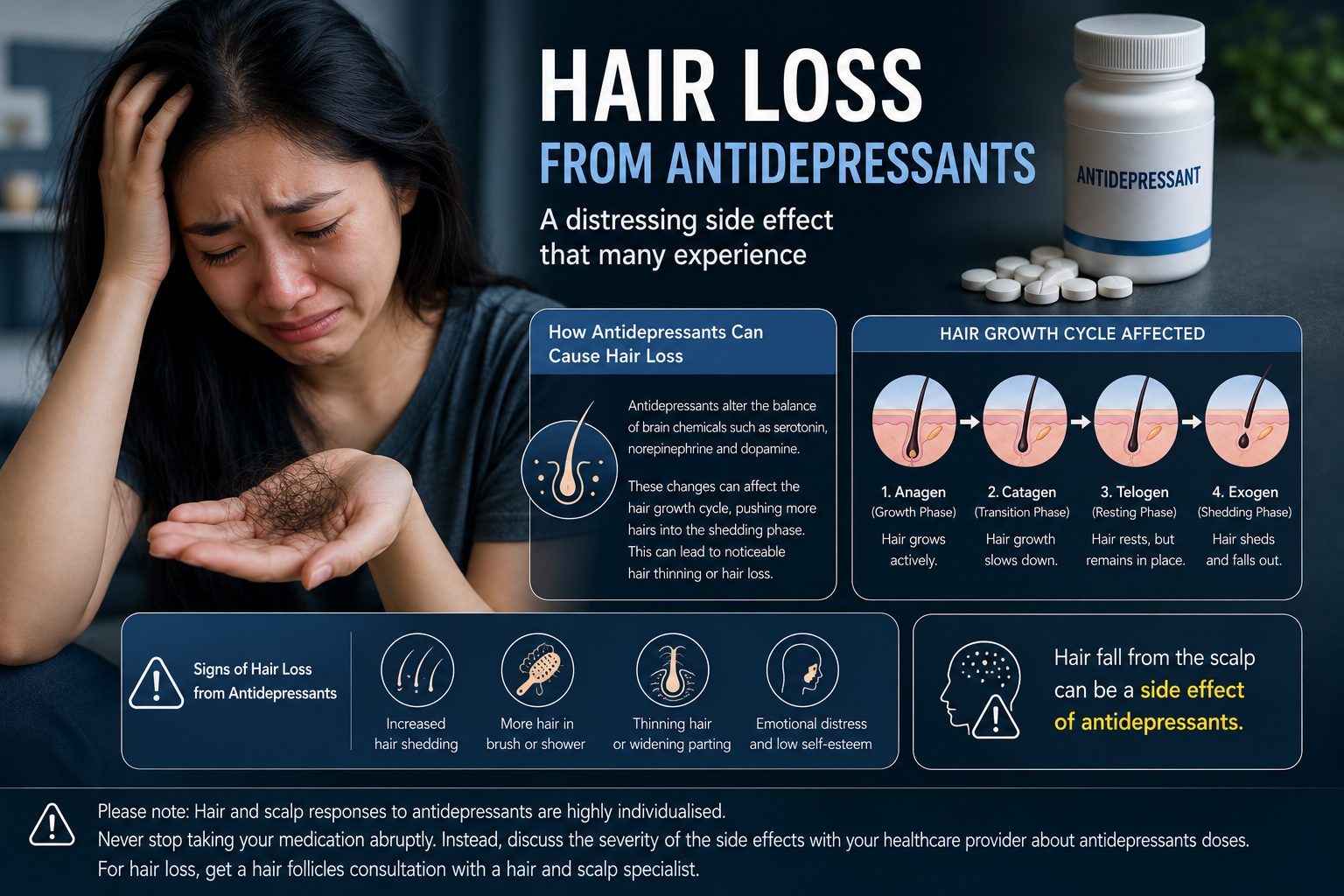
A distressed Asian lady showing signs of hair fall in clumps from side effects from taking antidepressants.
Navigating clinical depression is a complex and highly individualised journey. For millions of people worldwide, pharmacological interventions are essential pillars of stability, rectifying intricate neurological changes. However, an increasingly prevalent and deeply distressing adverse effect of these mood-regulating therapies is sudden, diffuse hair thinning. When progressive hair shedding impacts someone already fighting a mood disorder, the psychological blow can be severe, occasionally threatening compliance with their vital mental health protocols. To address this issue without altering neurological stability, we must explore the distinct types of depression, how various medication classes function, and the exact biological pathways through which these chemical agents affect human hair follicles. (Pejčić, A., et Al., 2022).
What is an Antidepressant and Who Needs to Take It?
An antidepressant is a sophisticated class of psychotropic medication engineered to modulate specific neurotransmitter pathways—primarily serotonin, norepinephrine, and dopamine—within the central nervous system. These medications are crucial clinical interventions deployed when a patient exhibits persistent, debilitating physiological and psychological symptoms that impair daily functioning.
Individuals who require antidepressants are those diagnosed with specific mood conditions, including :
Major Depressive Disorder (MDD): Characterised by a pervasive, unyielding low mood and anhedonia lasting at least two weeks.
Persistent Depressive Disorder (Dysthymia): A chronic, low-grade form of depression persisting for two or more years.
Bipolar Depression: The depressive phases experienced within bipolar affective disorder.
Seasonal Affective Disorder (SAD): Cyclical depression triggered by seasonal light variations.
Premenstrual Dysphoric Disorder (PMDD): Severe, cyclical depressive and physical symptoms occurring during the luteal phase.
(Karabulut, I., Et AL., 2021).
Understanding the Different Types of Antidepressants
Psychiatric medicine utilises several distinct chemical classes of antidepressants to alter brain chemistry. Each class possesses unique operational dynamics and carries varying degrees of risk regarding somatic side effects, including follicular shedding:
| Antidepressant Class & Follicular Risk Profile | |||
|---|---|---|---|
| Antidepressant Class | Primary Mechanism of Action | Common Examples | Follicular Risk Profile |
|
SSRIs (Selective Serotonin Reuptake Inhibitors) |
Prevents serotonin reabsorption, increasing its availability in synapses. | Sertraline, Fluoxetine, Escitalopram | Moderate risk; most widely prescribed. |
|
SNRIs (Serotonin-Norepinephrine Reuptake Inhibitors) |
Dual-action inhibition of both serotonin and norepinephrine reuptake. | Venlafaxine, Duloxetine | Moderate risk; linked to systemic vasoconstriction. |
|
NDRIs (Norepinephrine-Dopamine Reuptake Inhibitors) |
Blocks the reabsorption of norepinephrine and dopamine. | Bupropion | High risk; statistically linked to elevated alopecia rates. |
|
TCAs (Tricyclic Antidepressants) |
Older class blocking reuptake of serotonin and norepinephrine broadly. | Amitriptyline, Imipramine | Moderate-to-high risk; elevated systemic side effects. |
|
MAOIs (Monoamine Oxidase Inhibitors) |
Inhibits the monoamine oxidase enzyme from breaking down neurotransmitters. | Phenelzine, Tranylcypromine | Low-to-moderate risk; requires strict dietary restrictions. |
Reference: (Etminan, M., Et Al., 2018).
The Long-Term Risks and Side Effects of Antidepressant Consumption
While these compounds are highly effective at stabilising mood, long-term dependence can cause broad metabolic and systemic changes. Chronic use can lead to adverse effects including metabolic syndrome, significant weight fluctuations, sexual dysfunction, gastrointestinal distress, sleep architecture disruption, and emotional blunting.
Progressive hair loss is not an isolated symptom; rather, it is a visible manifestation of systemic, drug-induced metabolic shifts. Extended pharmaceutical exposure can induce subclinical alterations in thyroid function and micronutrient absorption, both of which directly impact the high-energy processes required for healthy hair growth. (Paterson, A. N. & Broadbear, J. H. 2019).
The Scientific Evidence: How Antidepressants Cause Hair Loss
Medical research confirms that antidepressant-induced alopecia primarily presents clinically as Telogen Effluvium (TE). The underlying biological mechanism involves these psychotropic chemicals acting as systemic stressors on the rapidly dividing matrix cells within the hair bulb. This exposure alters cellular mitosis, forcing a substantial percentage of active follicles to prematurely abort their anagen (growth) phase and transition into the catagen (regression) phase, eventually resting in the telogen (resting) phase.
Furthermore, certain medications like SNRIs can trigger peripheral vasoconstriction via norepinephrine pathways, reducing the blood supply to the dermal papilla. Deprived of oxygen and vital nutrients, the structural integrity of the hair anchoring system fails. Approximately two to three months following the start of the drug or a dosage increase, these club hairs detach concurrently, resulting in sudden, diffuse shedding across the entire scalp.
The Scalp Ecosystem: Why True Recovery Requires a Trichologist
When confronting medication-induced telogen effluvium, choosing an incorrect restoration path can exacerbate follicular damage. Conventional approaches often rely on harsh commercial lotions, systemic anti-androgens, or synthetic chemical blocks. For an individual whose system is already biochemically altered by depression and psychotropic medications, these aggressive compounds can cause contact dermatitis, lipid barrier depletion, and chronic micro-inflammation, trapping the hair follicles in a prolonged shedding state.
As a result, patients dealing with antidepressant-related hair loss are increasingly choosing to work with a Trichologist (a dedicated hair and scalp specialist). Trichologists approach hair thinning from a standpoint of wellness and physiological longevity. Because their specialisation centres entirely on the scalp's delicate ecosystem rather than broad dermatology, they employ bespoke, gentle botanical topical treatment programs tailored precisely to an individual’s unique scalp profile. These botanical treatments target localised oxidative stress, reduce micro-inflammation, and naturally stimulate dormant hair roots back into the anagen phase. This recovery occurs without using irritating chemical shampoos, steroids, or artificial hormones, ensuring there is zero interference with the patient’s psychiatric medication regimen. (Trüeb, R. M. 2021). / (Trüeb, R. M., Et AL., 2018).
The Rise of Depression in Thailand: A Call for Medical Collaboration
Modern Thailand is experiencing a significant rise in individuals diagnosed with clinical depression who rely on daily antidepressant therapies. While Thai medical practitioners provide exceptional psychiatric care, many doctors prescribe these potent mood regulators without fully recognising that diffuse hair loss is a documented side effect. This lack of information can cause panic, increasing the patient's anxiety and compounding their depressive symptoms.
To achieve optimal therapeutic outcomes, prescribing physicians in Thailand must work collaboratively with qualified Trichologists. This multidisciplinary model ensures that a patient's depression symptoms and follicular side effects are managed in unison. Under this cooperative framework, the medical doctor remains solely responsible for managing the patient's mental health, determining the correct antidepressant compounds and adjustments. Concurrently, the Trichologist takes full responsibility for managing the hair loss. By using safe, non-invasive, and non-chemical botanical methods, the Trichologist rehabilitates the scalp ecosystem, ensuring uninhibited hair regrowth while safeguarding the patient's emotional and physical well-being. (Harrison, S. & Bergfeld, W. 2009).
*Please note: Hair and scalp responses to antidepressants are highly individualised. Never stop taking your medication abruptly. Instead, discuss the severity of the side effects with your healthcare provider. They can explore adjusting your dosage, switching you to a different class of antidepressant. If there is sign of hair loss from antidepressants, please get a hair loss consultation with a Trichologist (Hair and Scalp Specialist).
Medical References :
Etminan, M., Sodhi, M., Procyshyn, R. M., Guo, M. Y. & Carleton, B. C. (2018). Risk of hair loss with different antidepressants: A comparative retrospective cohort study. International Clinical Psychopharmacology, 33(1), 44-48.Gautier, S., Chevalier, D. & Roche, D. (2014). Drug-induced alopecia: Mechanisms and clinical differentiation. Prescrire International, 23(151), 178-182.Harrison, S. & Bergfeld, W. (2009). Diffuse hair loss: Its importance and management. Cleveland Clinic Journal of Medicine, 76(6), 361-367.Karabulut, I., Gokcay, H. & Belli, H. (2021). Diffuse Hair Loss Induced by Sertraline Use. Psychiatria Danubina, 33(1), 41-45.Paterson, A. N. & Broadbear, J. H. (2019). Antidepressant-induced side effects: A long-term cross-sectional study of patient experiences. Journal of Psychopharmacology, 33(11), 1391-1403.Pejčić, A. V. & Paudel, V. (2022). Alopecia associated with the use of selective serotonin reuptake inhibitors: Systematic review. Psychiatry Research, 313, 114620.Trüeb, R. M. (2015). Effect of cigarette smoke on hair and skin. Experimental Dermatology, 24(7), 496-501.Trüeb, R. M. (2021). The Impact of Oxidative Stress on Hair Aging and the Trichological Approach. Journal of Cosmetic Dermatology, 20(1), 23-29.Trüeb, R. M., Henry, J. P., Davis, M. G. & Schwartz, J. R. (2018). Scalp Condition Impacts Hair Growth and Retention via Oxidative Stress. International Journal of Trichology, 10(6), 262-270.