Does Smoking Cause Premature Greying and Hair Loss? The Trichological Reality
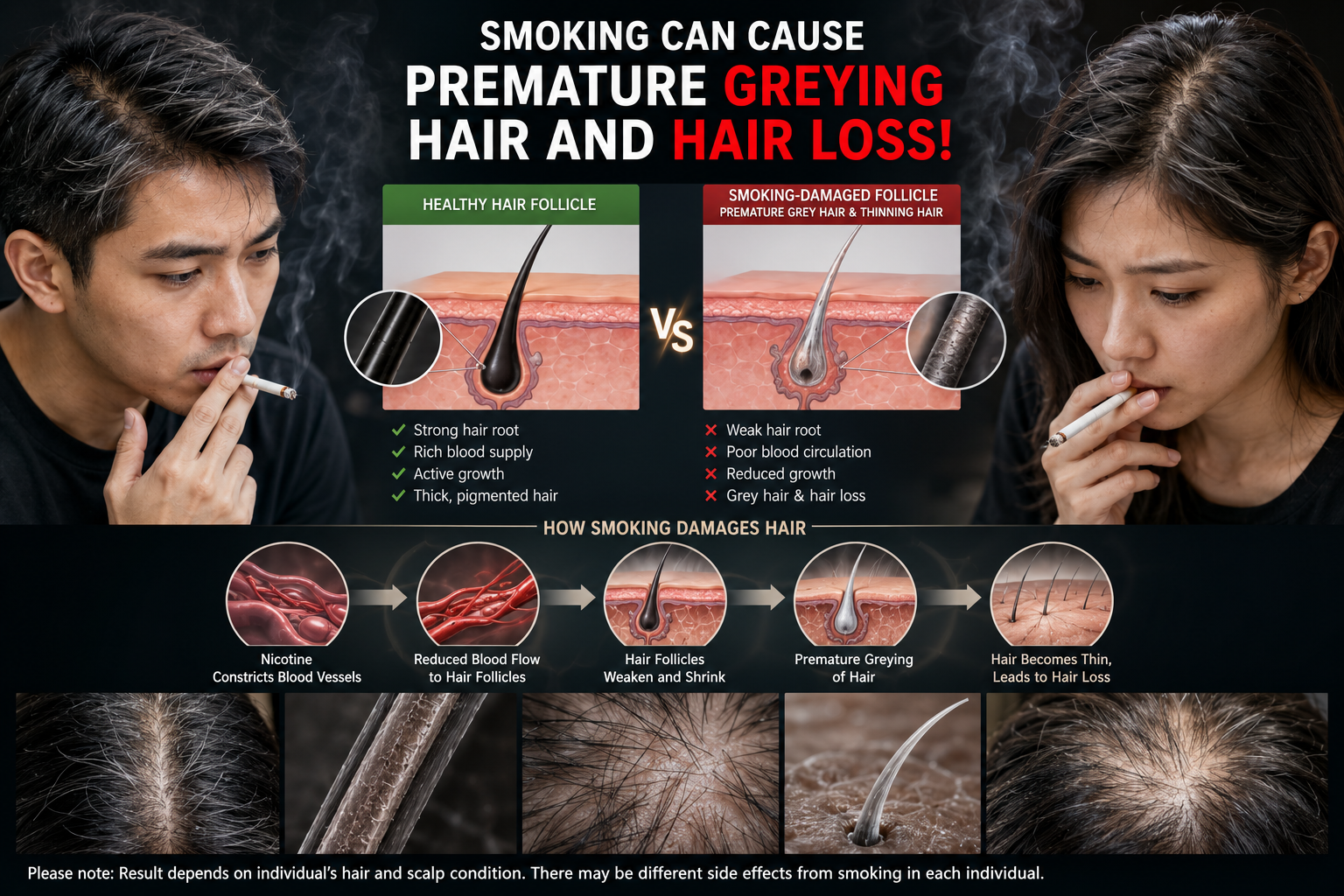
Scalp analysis photographs of a Smoking man and woman. It shows the difference between healthy hair follicles vs. those damaged by smoking, resulting in premature greying and hair thinning in Bangkok, Thailand.
Watching your strands turn grey prematurely or seeing your hairline thin can feel deeply unsettling. While many people attribute these changes purely to aging or genetics, medical research highlights a major, modifiable lifestyle culprit: cigarette smoking. For individuals living in Thailand's bustling urban centres, where environmental stressors are already elevated, smoking acts as an internal accelerator for follicular decline. The link between tobacco use, premature hair greying (PHG), and alopecia is not merely coincidental; it is rooted in profound systemic damage to the delicate micro-environment of the human hair follicle. (Babadjouni, A., Et Al., (2021).
The Scientific Evidence: How Smoking Toxifies Hair Follicles
The biological mechanisms connecting tobacco use to follicle degradation operate on multiple paths. Firstly, nicotine induces acute vasoconstriction—the narrowing of blood vessels. Because the hair follicle papilla requires an immense blood supply to sustain rapid cell division during the anagen (growth) phase, this reduction in localized blood flow starves the root of oxygen and vital nutrients. Secondly, cigarette smoke contains thousands of toxic chemicals that trigger systemic oxidative stress, generating vast quantities of free radicals. These free radicals directly damage the cellular DNA of the follicle and accelerate micro-inflammation, prematurely pushing hair into the telogen (shedding) phase and shortening the natural growth cycle. (Trüeb, R. M. (2015).
To fully understand how cigarette smoke systematically dismantles the hair's biological structures, we must look at the cellular, vascular, and genetic mechanisms verified by clinical research. Hair follicles are among the most metabolically active tissues in the human body; consequently, they are uniquely sensitive to the systemic toxins introduced by smoking.
1. Vasoconstriction and Microvascular Suffocation
The primary pathway through which smoking causes accelerated hair loss is the acute restriction of blood supply to the hair follicle apparatus.
Nicotine-Induced Ischemia: Inside the scalp, the dermal papilla relies on a dense network of capillaries to supply amino acids, oxygen, and vitamins required for mitosis (cell division) during the anagen (growth) phase. Clinical studies demonstrate that nicotine inhalation triggers an immediate release of catecholamines (like adrenaline), leading to acute vasoconstriction—the narrowing of these microscopic blood vessels.
Follicular Starvation: This constriction starves the follicle of blood flow, inducing microvascular ischemia (tissue blood deficiency). Starved of oxygen, the hair follicle cannot sustain the energy-intensive anagen phase, prematurely forcing the hair matrix to cease production and enter the telogen (shedding) phase. (Trüeb, R. M. (2015).
2. Oxidative Stress and the Destruction of Melanocytes (Premature Greying)
Hair greying occurs when the hair shaft lacks melanin, the pigment produced by specialized cells called melanocytes located in the hair bulb. Smoking acts as an internal accelerator of this pigment depletion.
Free Radical Overload: Tobacco smoke is an exogenous generator of massive quantities of reactive oxygen species (ROS) and free radicals. When these toxins circulate systemically, they overwhelm the scalp’s natural endogenous antioxidant defenses (such as catalase and superoxide dismutase).
Melanocyte Apoptosis: Melanocytes are incredibly vulnerable to this localized oxidative stress. The accumulation of ROS induces lipid peroxidation, damages cellular membranes, and mutates mitochondrial DNA within the pigment-producing cells. This metabolic injury triggers premature apoptosis (programmed cell death) of the follicular melanocytes.
The "Smoker’s Hair" Sign: Without viable melanocytes to transfer melanin into the emerging keratinocytes of the hair shaft, the hair grows out unpigmented—appearing as white, grey, or translucent. Epidemiological data indicates that smokers face up to a fourfold higher risk of developing premature hair graying (PHG) before the age of 30 compared to non-smokers. (Jo, S. J., Et Al., (2018). (Zayed, A. A., Et Al.,(2013).
3. Micro-Inflammation and Protease/Antiprotease Imbalance
The physical presence of circulating tobacco toxins alters the delicate enzymatic and immunological balance surrounding the hair root.
Perifollicular Micro-Inflammation: Toxins absorbed via smoke smoke cross into the follicular tissue, prompting an infiltration of inflammatory mononuclear cells and T-lymphocytes around the hair bulb. This state of chronic low-grade inflammation, known as micro-inflammation, gradually breaks down the extracellular matrix that anchors the hair strand.
Enzymatic Degradation: Oxidative stress from smoking disrupts the balance between proteases (enzymes that break down proteins) and antiproteases in the scalp. The overactivation of proteases damages the structural proteins of the follicle itself, leading to follicular miniaturisation—a process where the hair follicle shrinks with each growth cycle, producing increasingly finer, weaker hairs until it stops producing hair entirely. (Trüeb, R. M., Et Al., (2018). (Trüeb, R. M. (2021).
4. Genotoxic DNA Damage to the Hair Cycle
Beyond the vascular and pigmentary pathways, the chemical compounds in tobacco smoke (such as polycyclic aromatic hydrocarbons) exert genotoxic effects directly on the cellular machinery of the hair.
DNA Adduct Formation: Toxins form covalent bonds with the DNA inside the rapidly dividing matrix cells of the hair follicle, resulting in DNA adducts. This genetic damage breaks down the normal cellular replication required to build the keratin hair shaft.
Abrupt Cycle Transition: When the cellular DNA of the follicle is compromised, the hair growth engine stalls. The follicle receives a stress signal to prematurely abort the active anagen phase and transition immediately into the catagen (regression) and telogen (resting) phases, causing widespread, diffuse shedding across the scalp, clinically identified as chronic telogen effluvium. (Babadjouni, A., Et Al., (2021).
Why Smoking Turns Hair Grey Prematurely
Hair pigmentation relies entirely on melanocytes—specialised cells within the hair bulb that produce melanin. Medical studies have established an adjusted odds ratio showing that smokers have significantly higher chances of developing premature hair greying before the age of 30 compared to non-smokers. The immense oxidative stress caused by smoking overwhelms the antioxidant defense systems within the hair follicle. This specific oxidative damage destroys follicular melanocytes, rendering them incapable of transferring pigment into the growing hair shaft, which forces the hair to emerge translucent, or grey. (Zayed, A. A., Et Al., (2013).
The Impact on Thai Citizens and the Dangers of Overclaimed Treatments
In Thailand, the cumulative impact of smoking on citizens' hair follicle health is increasingly visible, manifesting as sluggish hair regrowth and chronic follicular miniaturisation. Unfortunately, many individuals seeking solutions fall prey to overclaimed hair regrowth advertisements from commercial counter brands or mainstream cosmetic clinics. Many over-the-counter brands aggressively market "scalp detoxes" that mix synthetic hair medications with harsh chemical detergents. This volatile combination strips the scalp's natural lipid barrier, causing persistent scalp inflammation and unending irritation that further compromises compromised follicles.
Simultaneously, conventional dermatological approaches heavily rely on aggressive synthetic medications, systemic anti-androgens, artificial hormones, and topical steroids to force temporary hair regrowth. While these pharmaceutical interventions may trigger a short-term response, they fail to address the underlying lifestyle-induced oxidative stress, create dependency, and risk damaging the long-term cellular integrity of the hair follicles. (Trueb, R. M., 2021).
why seeking a Trichologist is the safer choice for hair follicles health?
When dealing with smoking-induced hair thinning and premature greying, consulting a Trichologist (a dedicated hair and scalp specialist) is far superior to seeking standard dermatological or over-the-counter options. Unlike dermatologists, who treat hair as a secondary extension of general skin pathologies using synthetic drugs, a Trichologist focuses entirely on the specific ecosystem of the hair and scalp.
Trichologists treat impaired hair regrowth with bespoke, gentle, botanical topical treatment programs tailored specifically to an individual’s unique scalp type. This method successfully stimulates dormant follicles and neutralises smoking-induced oxidative damage without using any strong chemical shampoos, synthetic hormones, steroids, or prescription medications. A Trichologist’s methodology prioritises authentic follicular wellness, restoring the scalp’s natural pH and biological balance to ensure sustainable hair longevity and healthy, uninhibited regrowth. (Harrison, S. & Bergfeld, W., 2009).
MEDICAL REFERENCES :
Babadjouni, A., Pouldar Foulad, D., Hedayati, B., Evron, E. & Mesinkovska, N. (2021). The Effects of Smoking on Hair Health: A Systematic Review. Skin Appendage Disorders, 7(4), 251-264.Harrison, S. & Bergfeld, W. (2009). Diffuse hair loss: Its importance and management. Cleveland Clinic Journal of Medicine, 76(6), 361-367.Jo, S. J., Choi, J. W., Lee, S. Y. & Choi, J. H. (2018). Hair Graying Pattern Depends on Gender, Onset Age and Smoking Habits. Acta Dermato-Venereologica, 98(8), 748-752.Trüeb, R. M. (2015). Effect of cigarette smoke on hair and skin. Experimental Dermatology, 24(7), 496-501.Trüeb, R. M. (2021). The Impact of Oxidative Stress on Hair Aging and the Trichological Approach. Journal of Cosmetic Dermatology, 20(1), 23-29.Trüeb, R. M., Henry, J. P., Davis, M. G. & Schwartz, J. R. (2018). Scalp Condition Impacts Hair Growth and Retention via Oxidative Stress. International Journal of Trichology, 10(6), 262-270.Zayed, A. A., Shahait, A. D., Awwad, M. N. & Al-Alami, M. A. (2013). Smokers' hair: Does smoking cause premature hair graying? Indian Dermatology Online Journal, 4(2), 90-93.