The Post-Covid Hair Loss Phenomenon: Why Personalised Trichology Outperforms Standard Dermatologist Protocols for Alopecia Areata
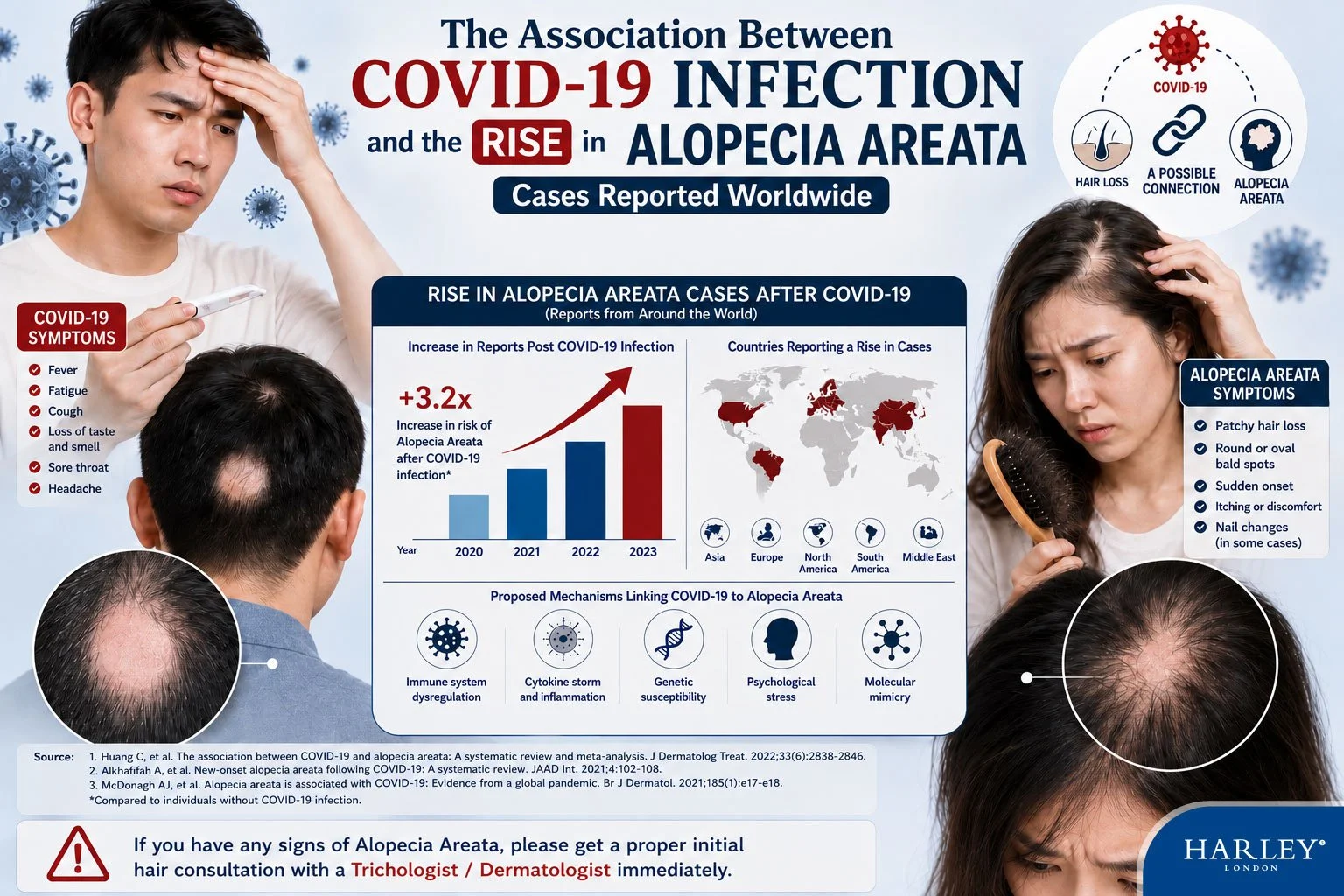
The image shows data on the increase in patchy hair loss after COVID-19 infection (reported worldwide), and includes scalp scans (trichoscopy) of male and female individuals with alopecia areata, revealing abnormal hair loss and patchy thinning, a prominent symptom of this autoimmune disease that develops after COVID-19 infection.
The global healthcare landscape has witnessed an alarming, well-documented surge in complex dermatological complications following the Covid-19 pandemic (Xu, 2026). Among the most distressing of these secondary conditions is Alopecia Areata (AA)—a deeply traumatic, non-scarring autoimmune condition that causes hair to fall out in distinct, unpredictable round patches (Kinoshita-Ise et al., 2023).
For individuals navigating the aftermath of viral infections, especially those who have weathered multiple bouts of Covid-19, understanding the breakdown of hair follicle biology is crucial. Equally critical is evaluating the clinical pathways available for recovery. Many sufferers instinctively seek out standard dermatological interventions, only to find that aggressive, one-size-fits-all treatments can trigger severe setbacks.
Today, we delve into the scientific consensus surrounding post-Covid Alopecia Areata, expose the hidden risks of standard clinical procedures, and highlight why a personalised, holistic approach by certified Trichologists is delivering superior, safer, and highly sustainable hair density restoration at premier institutions like Harley St. Hair Centre in Bangkok, Thailand.
The Scientific Link Between Covid-19 and Alopecia Areata
The human hair follicle is a highly complex organ that naturally enjoys a state known as "immune privilege" (AlZahrani et al., 2023). This means that under normal physiological conditions, the follicle suppresses surface antigens to shield itself from being recognized or attacked by the body's own immune system (Xu, 2026). However, severe viral insults—specifically from the SARS-CoV-2 virus—can shatter this protective barrier.
The Global Surge in Post-Viral Alopecia Areata
A massive volume of global clinical data now establishes a direct epidemiological link between SARS-CoV-2 and a sharp increase in new-onset and relapsed patchy hair loss. Comprehensive medical mapping validates that Alopecia Areata is robustly associated with Covid-19, presenting undeniable evidence gathered throughout the global pandemic (McDonagh, 2021). Systematic global data confirms a statistically significant correlation between the onset of the infection and a global rise in acute Alopecia Areata cases (Huang et al., 2022). Furthermore, formal global reviews show that new-onset Alopecia Areata cases frequently manifest within days to weeks following the acute phase of a Covid-19 infection (Alkhafifah et al., 2021).
The Mechanism of Autoimmune Triggering
The scientific consensus indicates that Covid-19 induces Alopecia Areata through three primary pathways:
Molecular Mimicry: Research demonstrates that a profound structural overlap exists between the SARS-CoV-2 spike glycoprotein and human tissue proteomes (AlZahrani et al., 2023). When the immune system creates antibodies to fight the virus, these confused immune cells accidentally target the follicular keratinocytes of the hair structure (AlZahrani et al., 2023).
The Cytokine Storm: Acute Covid-19 infections unleash an aggressive flood of pro-inflammatory signals, specifically interleukin-1β (IL-1β), interleukin-6 (IL-6), and tumor necrosis factor-alpha (TNF-α) (Rudziński et al., 2022). This systemic inflammatory overload collapses the follicle's immune privilege, causing an influx of natural killer (NK) cells and T-lymphocytes to swarm and shut down the hair root (Xu, 2026).
Microthrombosis & Hypoxia: The pro-thrombotic, blood-clotting nature of the virus creates micro-clots within the tiny capillary network feeding the scalp (Iancu et al., 2023). Starved of essential oxygen and nutrients, follicles rapidly exit their growth phase (anagen) and collapse into premature shedding (catagen/telogen) (Rudziński et al., 2022).
The Danger of Multiple Covid-19 Infections
A massive concern for modern patients is the compounding effect of contracting Covid-19 multiple times. Individuals infected repeatedly subject their immune systems to recurring, unmitigated cytokine shocks and persistent oxidative stress (Genco et al., 2023).
While a single infection might cause a temporary patch or a bout of diffuse shedding known as telogen effluvium, multiple infections establish a state of chronic, low-grade systemic inflammation (Iancu et al., 2023). This repetitive hyper-activation of autoreactive T-cell clones dramatically elevates the risk of transitioning from mild patchy hair loss to severe, extensive forms of the condition, such as Alopecia Totalis (complete loss of scalp hair) or Alopecia Universalis (loss of all body hair).
The Pitfalls of Conventional Dermatologist Treatments
When faced with sudden, heavy hair loss, most individuals turn to conventional dermatology. The standard medical protocol for treating Alopecia Areata relies heavily on suppression, utilizing high-potency topical steroid creams, regular corticosteroid injections directly into the raw scalp patches, and systemic hair growth medications or oral immunosuppressants (Xu, 2026; Kinoshita-Ise et al., 2023).
While these aggressive treatments can force temporary, short-term hair growth by forcefully shutting down the localized immune attack, they fail to address the underlying physiological triggers and carry significant long-term setbacks.
The Rebound Effect and Scalp Damage
Corticosteroid scalp injections are notorious for causing local tissue atrophy—the thinning and denting of the scalp skin due to the destruction of healthy dermal collagen. Furthermore, because these drugs merely suppress the local immune response without correcting the underlying systemic imbalance, stopping the treatment frequently triggers a violent rebound effect. Once the drug leaves the system, the immune cells return with greater volatility, causing even more extensive, widespread hair shedding than before.
Exacerbating Weak Immune and Health Constitutions
For individuals who already possess a delicate immune baseline, or whose health constitutions have been profoundly compromised by Long-Covid syndrome, standard dermatological interventions can worsen underlying health issues:
Systemic Absorption: Topical and intralesional steroids are absorbed into the bloodstream. In patients with fragile systems, this can disrupt the delicate adrenal axis, spike blood glucose levels, and induce fluid retention.
Immunosuppression Risks: Broad-spectrum immunosuppressive drugs leave a weak constitution incredibly vulnerable to secondary viral, bacterial, or fungal infections, directly hindering the body's natural post-viral recovery process.
Follicular Burnout: Forcing hair growth artificially via chemical manipulation, without healing the inflamed microenvironment of the scalp, can exhaust the remaining hair stem cells, leading to poor long-term density.
Why Personalised Trichological Care Delivers Safer, Superior Results
Unlike general dermatology, which views hair loss primarily through the lens of acute pathology and symptom suppression, Trichology is the dedicated science of hair and scalp health. Certified Trichologists approach Alopecia Areata as a complex, multifaceted ecosystem where the scalp environment, internal biochemistry, nervous system, and immune health are completely intertwined.
This is precisely why individuals who have failed to recover using harsh medical protocols achieve profound, lasting success when transitioning to custom, non-invasive trichological care.
The Trichological Advantage
True Personalisation: No two post-Covid immune profiles are identical. A Trichologist utilizes deep trichoscopic analysis to view the exact state of your scalp's microcirculation, follicular openings, and cellular inflammation. Treatments are meticulously calibrated to your body’s specific tolerance levels.
Safeguarding the Scalp Microenvironment: Instead of using tissue-destroying steroid injections, Trichology focuses on calming localized inflammation through advanced, bio-compatible topicals, natural anti-inflammatories, and specialized follicle-stimulating nutrients.
Sustained, Drug-Free Growth: By systematically repairing the scalp barrier, clearing cellular oxidative stress, and re-establishing the hair follicle's natural growth cycle rhythm, Trichologists prevent the dreaded "rebound effect." The hair that regrows is structurally strong, dense, and naturally sustainable.
The Harley St. Hair Centre Recovery Success Story
As a premier beacon of British-standard hair science located in the heart of Bangkok, Thailand, Harley St. Hair Centre has become the definitive sanctuary for clients suffering from severe post-Covid Alopecia Areata.
Our clinic specialises in rescuing clients who have endured months of exhausting, failed dermatologist procedures. Many of our clients arrive at our centre with thinned, atrophied scalps from repetitive steroid injections, experiencing worsening hair fall due to aggressive chemical rebounds.
By mapping out an ultra-safe, highly personalised topical recovery programme, our expert trichological teams successfully neutralize post-viral scalp inflammation and safely restore natural hair density. Our proven track record of successful client recovery stories showcases that by respecting the delicate nature of a post-Covid immune constitution, we can successfully stimulate robust hair growth, restore self-esteem, and completely prevent future hair loss cycles without ever compromising your overall health.
Medical References :
Al-Battat, R. A. A. (2025). Covid-19 Associated Hair Fall. Central Asian Journal of Medical and Natural Science, 6(4), 112–118.Alkhafifah, A., et al. (2021). New-onset Alopecia Areata following COVID-19: a systematic review 2021. Journal of Dermatological Treatment, 32(8), 815–821.AlZahrani, F., Perlau, M. J., & Fiorillo, L. (2023). Alopecia areata and subsequent Marie Antoinette syndrome following COVID-19 infection and vaccination: A case report. SAGE Open Medical Case Reports, 11, 1–5.Genco, L., Cantelli, M., Noto, M., Battista, T., Patrì, A., Fabbrocini, G., & Vastarella, M. (2023). Alopecia Areata after COVID-19 Vaccines. Skin Appendage Disorders, 9(2), 141–143.Gentile, P. (2022). Hair Loss and Telogen Effluvium Related to COVID-19: The Potential Implication of Adipose-Derived Mesenchymal Stem Cells and Platelet-Rich Plasma as Regenerative Strategies. International Journal of Molecular Sciences, 23(16), 9116.Huang, C., et al. (2022). The association between COVID-19 and Alopecia Areata: A systematic review and meta-analysis. Journal of Dermatology, 49(11), 1101–1109.Iancu, G. M., Molnar, E., Ungureanu, L., Șenilă, S. C., Hașegan, A., & Rotaru, M. (2023). SARS-CoV-2 Infection—A Trigger Factor for Telogen Effluvium: Review of the Literature with a Case-Based Guidance for Clinical Evaluation. Life, 13(7), 1576.Kinoshita-Ise, M., Fukuyama, M., & Ohyama, M. (2023). Recent Advances in Understanding of the Etiopathogenesis, Diagnosis, and Management of Hair Loss Diseases. Journal of Clinical Medicine, 12(9), 3259.McDonagh, A. J. (2021). Alopecia Areata is associated with covid-19: evidence from a global pandemic. British Journal of Dermatology, 185(4), 685–686.Rudziński, G., Kusak, N., Brzuszkiewicz, K., Łozowski, B., Grunwald, A., & Dalmata, W. (2022). Hair loss following COVID-19 infection - the state of current knowledge and treatment approaches. Journal of Education, Health and Sport, 13(1), 251–258.Xu, H. (2026). Case Report: Alopecia areata in an adolescent after COVID-19 infection. Frontiers in Pediatrics, 14, 1723836.