Ageing, Immunity, and the Scalp: The Scientific Truth Behind Alopecia Areata in Older Adults
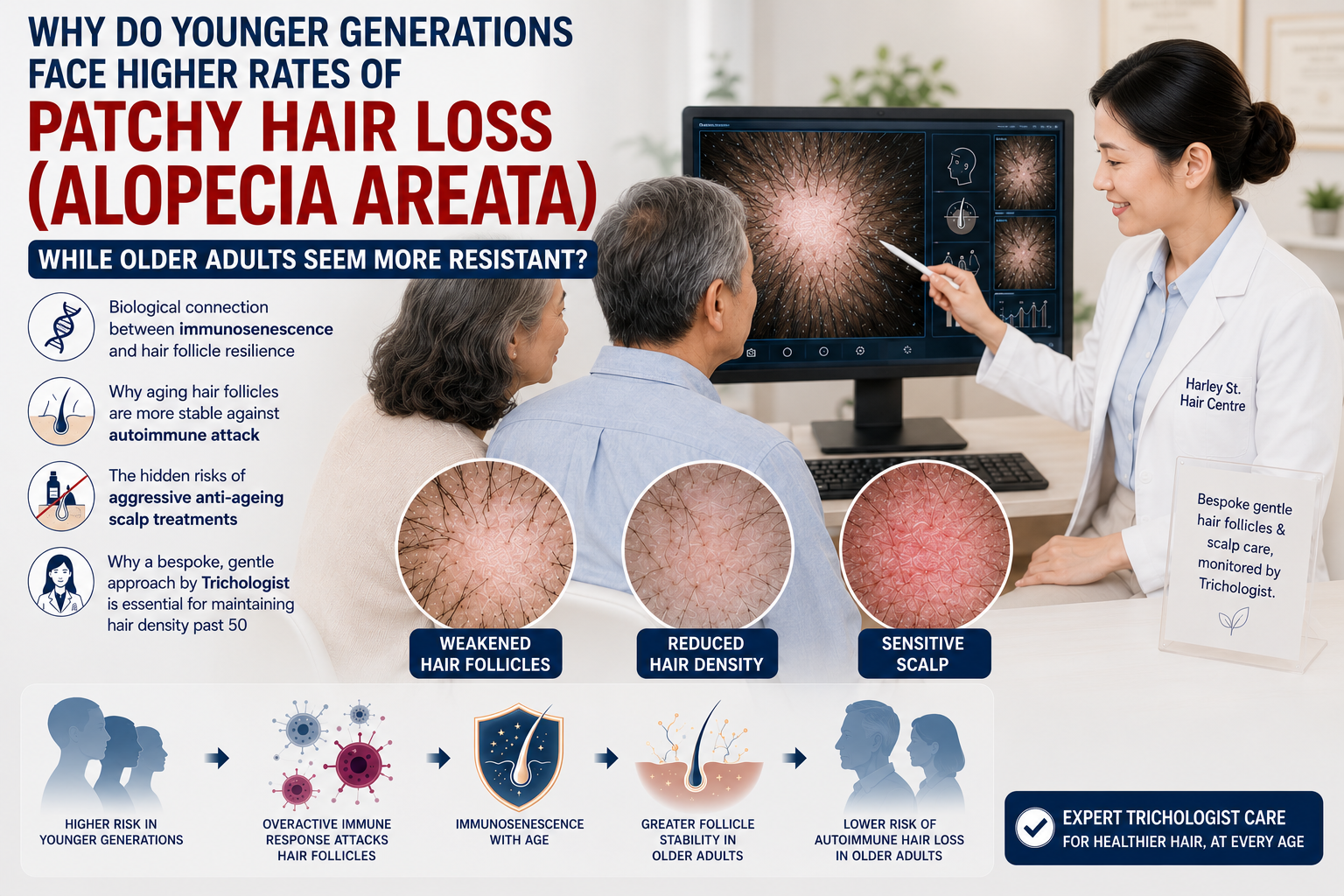
A Female Trichologist explaining Alopecia Areata (patchy hair loss) to older Asian adults using scalp imaging, illustrating immunosenescence, weakened hair follicles, reduced hair density and sensitive scalp in a professional hair and scalp consultation.
The conversation surrounding hair loss in mature adults almost always revolves around a predictable narrative: genetic thinning, receding hairlines, and the natural consequence of hormonal shifts. Yet, a fascinating dermatological phenomenon puzzles many: Why is Alopecia Areata—the sudden appearance of patchy, coin-sized bald spots—so common in adolescents and young adults, yet remarkably rare among the elderly?
Is it true that our scalps become naturally resistant to autoimmune hair loss as we age, or does the explanation lie deep within our changing genetics, cellular biology, and the structural shifting of the hair follicle itself?
For mature adults aged 45 to 70, protecting hair density requires looking beyond aggressive commercial promises. Understanding the science of the ageing scalp is the first step toward avoiding choices that inadvertently trigger severe, long-term damage.
The Cross-Generational Divide: Why Younger Generations Face Higher Risks
Epidemiological data consistently shows that Alopecia Areata is primarily a disease of youth. Clinical reviews confirm that up to 60% of patients experience their very first episode before the age of 20, and over 85% manifest the condition before turning 40 (Alkhalifah, 2013). The peak incidence occurs during the second and third decades of life, leaving the younger demographic disproportionately burdened by sudden, volatile patches of hair loss (Liang, 2026).
By contrast, late-onset Alopecia Areata (occurring after age 50) represents a tiny fraction of total clinical cases. When older adults experience hair loss, it is overwhelmingly driven by Androgenetic Alopecia (pattern hair loss) or Telogen Effluvium (diffuse shedding). The striking absence of patchy autoimmune responses in older populations prompts a fundamental question: what alters within our biological makeup over time?
The Biological Defense: Immunosenescence and Aging Hair Follicles
To understand why older adults exhibit a natural resistance to Alopecia Areata, we must look at the root cause of the condition. Alopecia Areata occurs when the immune system mistakenly attacks its own hair follicles. Specifically, cytotoxic T-cells breach the follicle's "immune privilege"—a natural protective shield that keeps the bulb hidden from immune detection (Żeberkiewicz et al., 2020).
As we grow older, our bodies undergo two profound changes that fundamentally alter this dynamic:
1. The Onset of Immunosenescence
As the human body ages, the immune system undergoes a gradual decline known as immunosenescence. While this weakens our defenses against new viruses, it also systematically tones down the hyper-reactive, cell-mediated autoimmune responses that drive Alopecia Areata. Because the ageing immune system produces fewer aggressive, naive T-cells, it lacks the cellular vitality required to launch an organized, acute attack against the hair bulb (Żeberkiewicz et al., 2020).
2. Miniaturisation and Genetic Shifting
Decades of exposure to dihydrotestosterone (DHT) and genetic ageing shift the hair follicles through a process called miniaturisation. The follicles slowly shrink, spending less time in the active growth phase (anagen) and more time resting (telogen).
Because the autoimmune mechanism of Alopecia Areata exclusively targets follicles during the peak anagen phase—when active pigment production (melanogenesis) occurs—the natural, age-related decline in anagen activity leaves fewer viable targets for an autoimmune attack (Żeberkiewicz et al., 2020). In short, the genetic shifts that cause traditional age-related thinning inadvertently shield older adults from acute patchy hair loss.
Can Older Adults Still Get Alopecia Areata?
While older adults are statistically more resistant, they are not entirely immune. Clinical cases of late-onset Alopecia Areata do exist within the 45-to-70 age bracket, though the disease behaves quite differently than it does in younger individuals. Long-term follow-up studies reveal that when Alopecia Areata manifests in mature adults, it is rarely severe enough to progress to complete scalp baldness (alopecia totalis) or total body hair loss (alopecia universalis) (Lyakhovitsky et al., 2019).
Instead, mature cases typically present as stable, localised patches that show a significantly higher rate of spontaneous, full hair regrowth (up to 90% in late-onset groups) and a much lower likelihood of recurring over time (Lyakhovitsky et al., 2019).
[Youth-Onset Alopecia Areata] -----> High T-Cell Vitality + Long Anagen Phase ===> High Risk, Severe Patches, Frequent Relapse
[Mature-Onset Alopecia Areata] ----> Immunosenescence + Short Anagen Phase ===> Low Risk, Mild Patches, High Regrowth Rate
The Post-Pandemic Reality: COVID-19 and Vaccinations
The structural landscape of late-onset hair loss shifted slightly following the COVID-19 pandemic. Large-scale global monitoring revealed a minor but distinct rise in de novo (newly onset) or relapsed cases of Alopecia Areata among older adults following both SARS-CoV-2 infection and certain mRNA vaccinations (Tassone et al., 2022).
Medical documentation shows that the massive systemic spike in pro-inflammatory cytokines and T-cell activation triggered by the vaccine or virus can temporarily shock the ageing immune system, overriding its baseline resistance and causing localised patches of hair loss even in individuals with zero prior history (Lo et al., 2022). However, real-world data demonstrates that these post-vaccination cases remain highly responsive to localised, gentle interventions, rarely leading to permanent follicular destruction (Lo et al., 2022).
Hidden Dangers: The Risks of Aggressive Over-Treatment in Mature Adults
As older generations seek to preserve their hair density and combat the natural signs of aging, they frequently fall victim to aggressive commercial marketing campaigns. The modern mature adult often exposes their scalp to a cocktail of harsh chemical treatments and invasive clinical procedures that cause far more harm than good.
1. Root-Dyeing Shampoos and Chemical Burns
The desire to hide gray hair leads many adults over 50 to frequently use permanent dyes and chemical-laden root-touch-up shampoos. The ageing scalp features a thinned epidermal barrier and a reduced supply of protective natural lipids (Yan et al., 2026). Continuous exposure to harsh paraphenylenediamine (PPD), ammonia, and bleaching agents strip away this delicate barrier, leaving the scalp highly vulnerable to severe chemical burns, chronic contact dermatitis, and permanent follicular scarring (Jensen, 2026).
2. High-Frequency Lasers and Aggressive Mesotherapy
Enticed by local clinics, many seniors undergo aggressive scalp procedures, including deep micro-needling, invasive mesotherapy injections, and high-intensity thermal lasers. While these treatments claim to stimulate growth, an aging, fragile scalp possesses a diminished capacity for cellular repair. Frequent, invasive trauma can easily trigger a chronic state of localised inflammation, which actually accelerates hair thinning and causes micro-scarring around the delicate hair roots (Yan et al., 2026).
3. Self-Prescribed Hair Growth Pills
Turning to systemic oral medications without strict medical supervision introduces severe systemic risks. Many popular hair growth pills alter hormonal pathways or fluid dynamics (such as unmonitored diuretics or high-dose synthetic supplements). In mature adults, these compounds can interact dangerously with existing medications for blood pressure, cardiac health, or endocrine functions, creating unnecessary risks for overall health.
The Harley St. Hair Centre Approach: Nurturing the Ageing Scalp
The foundational rule of trichology for the mature demographic is absolute: an ageing scalp must never be treated with the same aggressive methods used for a younger, resilient scalp. Peer-reviewed medical literature underscores that older adults exhibit a significantly higher risk of developing highly sensitive scalp conditions, characterized by chronic pruritus (itching), burning sensations, and impaired skin barrier function (Yan et al., 2026). When the scalp barrier is compromised, the follicle's micro-environment suffers, leading to premature hair shedding and diminished density.
Rather than relying on the heavy systemic medications, painful steroid injections, and harsh topical chemicals commonly prescribed by conventional hospital dermatology wards, a shift toward bespoke, non-invasive therapies is vital.
The ageing follicle does not require aggressive coercion; it requires a restored ecosystem. Mature hair health is best preserved through gentle, highly targeted botanical nourishment, lipid-replenishing topical treatments, and non-thermal stimulation designed to fortify the natural scalp barrier and supply essential micronutrients directly to the hair root (Yan et al., 2026).
Harley St. Hair Centre: Your Choice for Trichologist-Based Hair Care – British Standard
If you find that a Trichologist approach is what you're looking for, Harley St. Hair Centre is ready to be your choice. With over 18 years of experience and the trust of over 40,000 clients throughout Bangkok (Bangna, Silom, Ladprao, Rangsit), we offer a unique approach to hair care.
We combine safe, non-surgical, needle-free (Non-invasive), and drug-free hair care methods with exclusive proprietary formulas from Harley Street Centre For Hair Research London, England, overseen by Paul Gorton Davies (B.Sc., M.Phil., CChem, F.R.S.C., M.I.T.).
Take the first step with confidence! You can come in for a free hair check-up and consultation with our Hair and scalp experts to find the best solution for you. Click the “Start your gentle hair regrowth journey” button below.
Medical References :
Alkhalifah, A. (2013). Alopecia areata update. Dermatologic Clinics, 31(1), 93–108.Jensen, C. D. (2026). Chemical burns to the scalp from hair bleach and dye. Acta Dermato-Venereologica, 106, 12-16.Liang, S. (2026). Global, regional, and national burden of alopecia areata in adolescents and young adults aged 10–24 years from 1990 to 2021: a trend analysis. Frontiers in Public Health, 14, 1731022.Lo, A., Mir, A., & Sami, N. (2022). Letter in reply: Alopecia areata after SARS-CoV-2 vaccination. JAAD Case Reports, 25, 25–26.Lyakhovitsky, A., Aronovich, A., Gilboa, S., Baum, S., & Barzilai, A. (2019). Alopecia areata: a long‐term follow‐up study of 104 patients. Journal of the European Academy of Dermatology and Venereology, 33(8), 1602–1609.Tassone, F., Cappilli, S., Antonelli, F., Zingarelli, R., Chiricozzi, A., & Peris, K. (2022). Alopecia areata occurring after COVID-19 vaccination: a single-center, cross-sectional study. Vaccines, 10(9), 1467.Yan, X. (2026). Evaluation, symptoms, influencing factors, and prospects of sensitive scalp: a literature review. Cosmetics, 13(6), 236.Żeberkiewicz, M., Rudnicka, L., & Malejczyk, J. (2020). Immunology of alopecia areata. Central European Journal of Immunology, 45(3), 325–333.