The Hidden Cost of the Slender Trend: Understanding Bariatric Surgery Hair Loss in Thailand
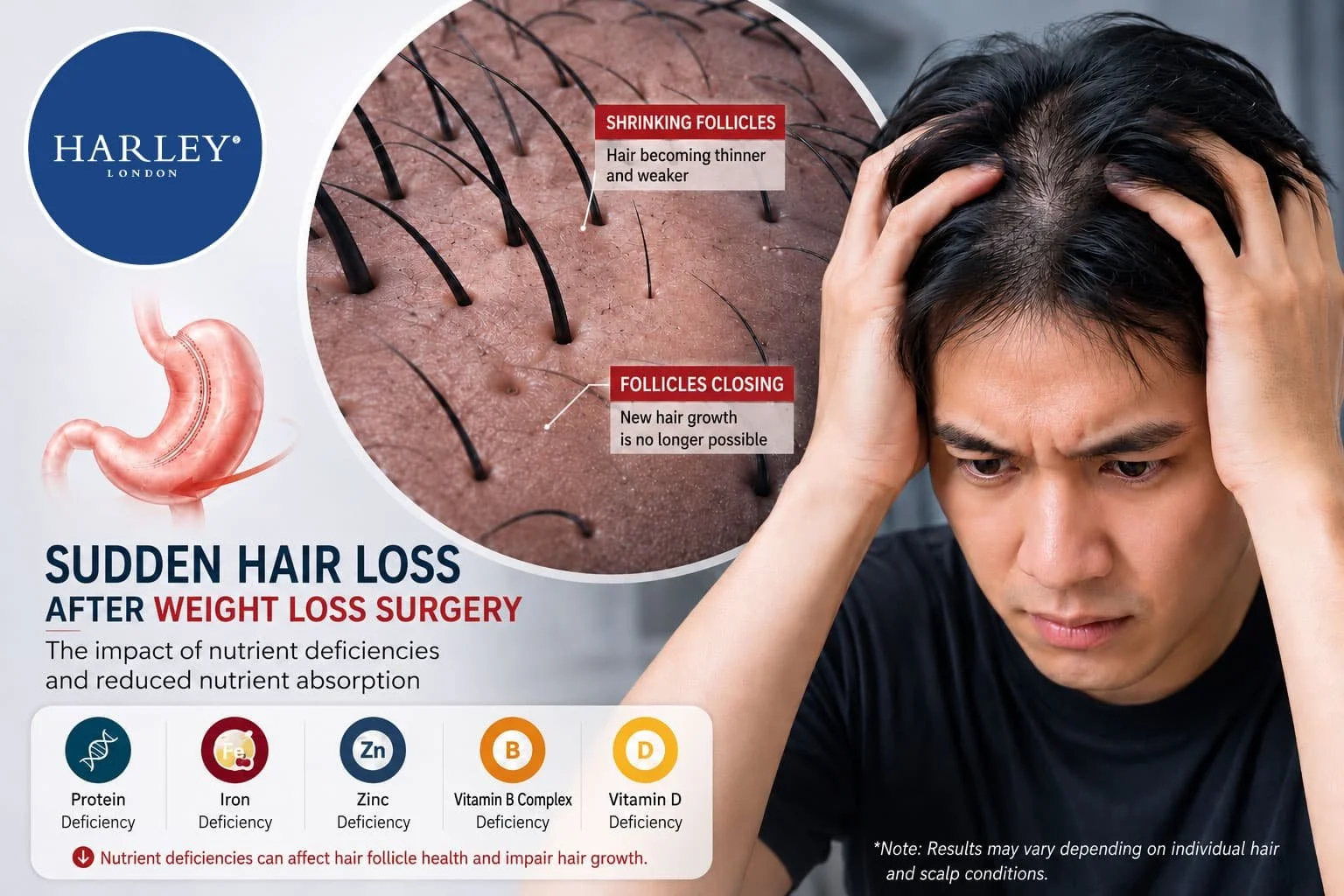
A close-up of thinning hair on a young man's scalp, illustrating bariatric surgery-induced telogen effluvium and nutritional hair loss.
The pursuit of health and body confidence has sparked a massive trend across Thailand: bariatric surgery. From laparoscopic sleeve gastrectomies to gastric bypasses, weight loss surgery has become an incredibly popular medical solution for individuals looking to shed significant weight quickly. However, this transformative metabolic shift comes with a distressing, lesser-known side effect that catches many Thai patients off guard—severe, rapid hair thinning and the threat of long-term hair follicle deterioration.
If you have undergone weight loss surgery, or are considering it, seeing your hair fall out in handfuls months after the procedure can be terrifying. To understand why this happens, we must look at the profound biological shift occurring beneath your scalp.
The Science: How Weight Loss Surgery Triggers Rapid Hair Thinning
Post-bariatric hair loss is not a random complication; it is a direct physiological response to two major bodily events: metabolic shock and malabsorption.
1. Bariatric Surgery-Induced Telogen Effluvium (Bar SITE)
The immediate wave of hair shedding that occurs within the first three to six months following weight loss surgery is medically classified as Bariatric Surgery-Induced Telogen Effluvium, or Bar SITE (Cohen-Kurzrock & Cohen, 2021).
Under normal circumstances, roughly 85% to 90% of your hair follicles are actively growing in the anagen phase, while the rest rest in the telogen phase before shedding. However, the profound physical trauma of major surgery, combined with sudden caloric restriction and rapid weight reduction, throws the body into a state of acute homeostatic disequilibrium (Leite, 2025; Smolarczyk et al., 2024).
To preserve energy for vital organs like the heart and brain, the body prematurely shocks a massive percentage of active anagen follicles into the shedding telogen phase (Cohen-Kurzrock & Cohen, 2021). The result is a diffuse, aggressive thinning across the entire scalp.
2. Chronic Malabsorption and Follicle Starvation
While acute shedding often levels off, a second, more insidious wave of hair loss can develop six months to a year down the line. Bariatric procedures alter the anatomy of your digestive system, drastically reducing the stomach's capacity and bypassing key sections of the small intestine where nutrients are absorbed (Smolarczyk et al., 2024).
Hair follicles are among the most metabolically active structures in the human body, requiring a constant stream of vitamins and minerals to produce healthy hair shafts (Almohanna et al., 2018). When chronic post-surgical malabsorption sets in, the follicles are systematically starved of critical building blocks:
Iron and Ferritin: Vital for oxygen delivery to the hair bulb. Severe depletion compromises follicle function and halts the growth cycle (Almohanna et al., 2018).
Zinc: An essential immunomodulator that regulates cellular turnover and prevents follicle regression (Almohanna et al., 2018).
Biotin and B-Vitamins: Crucial for protein synthesis and the structural integrity of keratin (Almohanna et al., 2018).
Protein-Energy Malnutrition: Rapid weight loss often comes with a severe drop in lean protein intake, causing the hair structure to weaken, turn brittle, and enter early decay.
Without targeted intervention, prolonged nutritional deficiencies can cause follicles to miniaturise and weaken to the point where they struggle to produce visible hair (Smolarczyk et al., 2024).
Trichologist vs. Dermatologist: Why the Holistic Route is Safer for Post-Bariatric Recovery
When facing severe hair loss, the instinct for many in Thailand is to visit a traditional dermatologist. However, the standard dermatological toolkit for alopecia relies heavily on systemic pharmaceutical medications and invasive surgical hair transplants. For a post-bariatric patient, this approach often addresses the symptoms while ignoring—or worsening—the root cause.
Choosing a Trichologist (a dedicated hair and scalp specialist) offers a fundamentally safer, more comprehensive, and sustainable path to hair restoration.
| Dermatological Approach | Trichological Approach |
|---|---|
| Primarily focuses on generic skin, nail, and hair diseases. | Specialises exclusively in the hair follicle ecosystem. |
| Relies heavily on drugs (Minoxidil, Finasteride). | Prioritises non-invasive, holistic recovery protocols. |
| May recommend early surgical hair transplants. | Focuses on cellular nutrition, scalp health, and root causes. |
| Treats hair loss as a symptom. | Restores the biological balance of the hair growth cycle. |
The Pitfalls of Standard Medication and Surgery
Dermatologists frequently prescribe medications like oral Minoxidil or Finasteride. While these can stimulate temporary blood flow or alter hormones, they do nothing to correct the underlying malabsorption or nutritional voids caused by your bariatric surgery. Furthermore, introducing synthetic pharmaceuticals can place an extra processing burden on a metabolism that is already working hard to adapt to post-surgery life.
Surgical hair transplants are also an unsuitable option during active post-bariatric shedding. Transplanting hair into an inflamed, nutrient-deficient scalp yields poor graft survival rates and fails to fix the systemic depletion causing the surrounding hair to fall out.
The Trichology Advantage: True Follicular Rehabilitation
A Trichologist looks at your hair through a holistic lens, recognizing that your scalp health is an outward reflection of your internal biochemistry.
Instead of masking the shedding with drugs, a Trichologist uses advanced digital trichoscopy to evaluate the exact state of your hair cycling, scalp inflammation, and follicle health. Their recovery roadmap focuses on:
Targeted Nutritional Rehabilitation
Non-Invasive Scalp Therapies
Preserving the Follicle Microenvironment
Match personalised treatment to regain hair Follicles health
By treating the body as an interconnected system, a Trichologist safely helps you overcome the metabolic shock of weight loss surgery—allowing you to fully enjoy your new, slender physique without sacrificing the crown that completes your confidence.
Medical References :
Almohanna, H. M., Ahmed, A. A., Tsatalis, J. P., & Tosti, A. (2018). The role of vitamins and minerals in hair loss: A review. Dermatology and Therapy, 9(1), 51-70.Cohen-Kurzrock, R. A., & Cohen, P. R. (2021). Bariatric surgery-induced telogen effluvium (Bar SITE): Case report and a review of hair loss following weight loss surgery. Cureus, 13(4).Leite, A. C. (2025). Telogen effluvium and metabolic stress in modern weight loss interventions: A narrative clinical review. Brazilian Journal of Hair Health, 1(1).Smolarczyk, K., Meczekalski, B., Rudnicka, E., Suchta, K., & Szeliga, A. (2024). Association of obesity and bariatric surgery on hair health. Medicina, 60(2), 325.