Understanding SLE: Why Young Thai Adults Face Autoimmune Hair Loss and How Trichology Restores Scalp Health
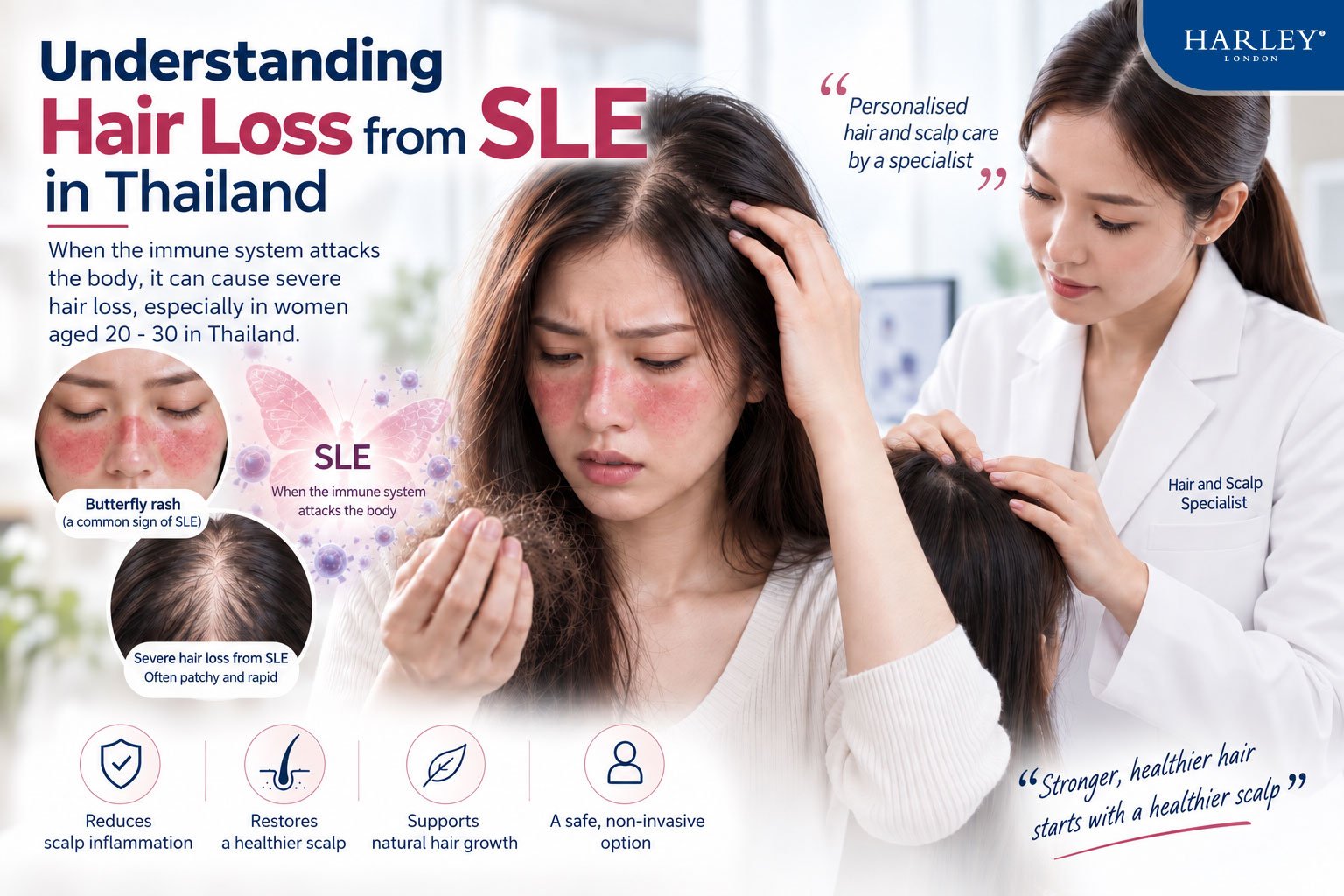
Hair and Scalp Specialist performing microscopic scalp trichoscopy analysis on a Lady recovering from SLE hair loss at Harley St. Hair Centre in Bangkok.
Systemic Lupus Erythematosus (SLE) is an autoimmune disease characterised by multi-organ inflammatory damage driven by pathogenic autoantibodies (Lupus, 2018; Lupus Science & Medicine, 2025).
Nationwide epidemiological data in Thailand shows an overall prevalence of 85.8 cases per 100,000 individuals, with a pronounced female predominance (Lupus Science & Medicine, 2025).
While SLE affects the kidneys, joints, and cardiovascular system, cutaneous involvement and hair loss remain classic clinical signs (Lupus, 2018).
Why Are Young Thai Adults Diagnosed with SLE in Their 20s and 30s?
National health data indicates that SLE incidence in Thailand peaks among individuals between 20 and 39 years of age (Lupus Science & Medicine, 2025).
This specific demographic concentration involves multiple factors:
Hormonal Peaks: Oestrogen enhances autoantibody production and type I interferon expression during peak reproductive years (Lupus Science & Medicine, 2025).
Ultraviolet Light Exposure: Tropical solar radiation induces keratinocyte apoptosis, releasing nuclear antigens that precipitate flares in genetically susceptible hosts (Lupus, 2018).
Early Clinical Screening: Modern diagnostic protocols in urban Thai health centers facilitate earlier antinuclear antibody (ANA) detection when young patients present with joint pain or hair shedding (Lupus, 2018; Lupus Science & Medicine, 2025).
The Trichologist Perspective: The Scientific Connection Between SLE and Hair Loss
A Trichologist evaluates hair loss through a functional, non-surgical lens focused on micro-vascular and follicular biology (Indian Journal of Dermatology, Venereology and Leprology, 2021).
From a professional trichological perspective, hair loss driven by Systemic Lupus Erythematosus differs fundamentally from hereditary pattern baldness (Androgenetic Alopecia) or age-related thinning (Lupus, 2018; Indian Journal of Dermatology, Venereology and Leprology, 2021).
| Parameter | SLE-Induced Alopecia | Genetic Pattern Baldness (AGA) | Age-Related Thinning |
|---|---|---|---|
| Primary Root Cause | Autoimmune Capillary Inflammation And Systemic Cytokine Stress (Lupus, 2018). | Dihydrotestosterone (DHT) Binding To Androgen Receptors. | Cellular Senescence And Reduced Micro-Vascular Flow Over Decades. |
| Onset Pattern | Acute Diffuse Shedding Or Frontal Hairline Breakage (Lupus, 2018). | Gradual, Predictable Recession At Crown Or Temples. | Generalised Overall Loss Of Density Across The Entire Scalp. |
| Follicular Status | Micro-Vascular Disruption And Telogen Shift Without Stem Cell Destruction (Lupus, 2018; StatPearls, 2024). | Progressive Miniaturisation Of Terminal Follicles Into Vellus Hair. | Slow Decline In Active Anagen Follicle Density. |
| Reversibility | High In Non-Scarring Cases Once Scalp Inflammation Is Managed (Lupus, 2018). | Requires Ongoing Anti-Androgens Or Surgical Redistribution. | Managed Primarily Via Preventive Cellular Maintenance. |
The Biological Proof: Why Lupus Hair Loss Is Neither Hereditary Nor Age-Related
Micro-Vascular Inflammation: Autoantibody complexes deposit along perifollicular capillary walls, causing localised hypoxia at the dermal papilla (Lupus, 2018; Indian Journal of Dermatology, Venereology and Leprology, 2021).
Telogen Effluvium Shift: Systemic immune stress shifts growing anagen follicles prematurely into the telogen resting phase (Lupus, 2018; StatPearls, 2024).
Structural Fragility ("Lupus Hair"): Disturbed keratin matrix production leads to dry, brittle shafts along the frontal hairline that fracture easily under low mechanical stress (Lupus, 2018).
Pharmacological Stress: Immuno-suppressive drugs required for systemic organ protection can induce secondary hair shedding as an adverse side-effect (Lupus, 2018).
Importantly, non-scarring lupus alopecia leaves the epithelial stem cell reservoir within the follicular bulge intact(Lupus, 2018). This confirms that the hair loss is non-genetic and fully capable of regrowing once micro-vascular inflammation resolves (Lupus, 2018).
Why Patients Choose Non-Surgical, Personalised Trichology Treatments
Patients managing systemic autoimmune disease often seek non-invasive approaches to hair restoration (Lupus, 2018). Surgical options are generally avoided during active disease states due to the risks of poor graft survival and surgery-induced inflammatory flares (Lupus, 2018).
Personalised topical trichological treatments address hair loss by maintaining scalp barrier integrity, calming micro-inflammation, and delivering nutrient-rich topical care directly to dormant follicles (Indian Journal of Dermatology, Venereology and Leprology, 2021).
Client Recovery at Harley St. Hair Centre, Bangkok
In Bangkok, Harley St. Hair Centre applies non-surgical trichological care to support clients experiencing hair loss from autoimmune conditions (Indian Journal of Dermatology, Venereology and Leprology, 2021). Utilizing microscopic trichoscopy assessment and customized topical regimens, the centre works to restore scalp health and encourage hair recovery (Indian Journal of Dermatology, Venereology and Leprology, 2021).
"Receiving an SLE diagnosis in my mid-twenties was overwhelming, especially when my hair began shedding rapidly," shares a recovery client at Harley St. Hair Centre (Lupus, 2018). "Because my scalp felt sensitive, I wanted to avoid invasive procedures. The non-surgical topical treatments and personalized care at Harley St. Hair Centre allowed me to nurture my hair back to health safely." (Lupus, 2018).
Note: Each client’s hair and scalp condition may vary. Treatment outcomes depend on individual disease stability, scalp health, and adherence to prescribed topical regimens.
Harley St. Hair Centre: Your Choice for Trichologist-Based Hair Care – British Standard
If you find that a Trichologist approach is what you're looking for, Harley St. Hair Centre is ready to be your choice. With over 18 years of experience and the trust of over 40,000 clients throughout Bangkok (Bangna, Silom, Ladprao, Rangsit), we offer a unique approach to hair care.
We combine safe, non-surgical, needle-free (Non-invasive), and drug-free hair care methods with exclusive proprietary formulas from Harley Street Centre For Hair Research London, England, overseen by Paul Gorton Davies (B.Sc., M.Phil., CChem, F.R.S.C., M.I.T.).
Take the first step with confidence! You can come in for a free hair check-up and consultation with our Hair and scalp experts to find the best solution for you. Click the “Start your gentle hair regrowth journey” button below.
-
Systemic Lupus Erythematosus (SLE) causes hair loss through two primary pathological pathways:
Active Lupus Inflammation (Non-Scarring): Autoimmune activity generates circulating immune complexes and inflammatory cytokines that disrupt the hair growth cycle (Concha & Werth, 2018; Desai & Miteva, 2021). This leads to widespread hair thinning (telogen effluvium) or fragile, coarse hair along the frontal hairline, clinically termed "lupus hair" (Perales et al., 2023).
Discoid Lupus Erythematosus (Scarring Alopecia): Chronic cutaneous inflammation causes interface dermatitis that destroys the stem cells in the hair follicle bulge, permanently replacing the follicle with fibrous scar tissue if left untreated (Concha & Werth, 2018).
In the latest classification criteria by the Systemic Lupus International Collaborating Clinics (SLICC), non-scarring alopecia is formally recognized as a primary diagnostic marker for active SLE (Concha & Werth, 2018; Desai & Miteva, 2021).
-
Research shows that environmental factors interact with genetic susceptibility to trigger autoimmune reactions in young adults (typically ages 15 to 35) (Chanprapaph et al., 2019; Concha & Werth, 2018):
High Ultraviolet (UV) Exposure: Ultraviolet radiation is a well-established environmental trigger for lupus. Strong solar radiation induces keratinocyte apoptosis, releasing nuclear antigens that trigger systemic autoimmune reactions and localized scalp inflammation (Concha & Werth, 2018).
Physical & Psychological Stress: Chronic stress elevates systemic cortisol and inflammatory cytokines, exacerbating autoimmune activity and triggering secondary telogen effluvium (Desai & Miteva, 2021).
Delayed Early Intervention: Non-scarring lupus hair loss is often mistaken for standard stress-induced shedding or androgenetic alopecia, delaying target therapy until follicle function is significantly compromised (Desai & Miteva, 2021; Perales et al., 2023).
-
While a rheumatologist or medical dermatologist manages systemic immunosuppression, a certified Trichologist focuses on non-invasive scalp health restoration and follicular recovery (Chanprapaph et al., 2019; Desai & Miteva, 2021):
Digital Trichoscopy: High-magnification scalp evaluation identifies early vascular changes, follicular plugging, and peri-infundibular erythema before visible scarring occurs (Chanprapaph et al., 2019).
Scalp Barrier Support: Gentle topical regimens restore compromised epidermal barrier function and soothe micro-inflammation without irritating sensitive skin (Desai & Miteva, 2021).
Photobiomodulation (Low-Level Laser Therapy): Non-thermal light therapy stimulates localized microcirculation and cellular adenosine triphosphate (ATP) production to encourage dormant, non-scarred follicles back into the growth (anagen) phase (Desai & Miteva, 2021).
-
Yes, hair lost from non-scarring SLE can fully recover once systemic inflammatory activity is successfully brought into medical remission (Chanprapaph et al., 2019; Perales et al., 2023).
Hair regrowth generally follows a 3- to 9-month biological recovery cycle:
Months 1–2 (Stabilization): Hair shedding decreases as systemic disease activity stabilizes and scalp micro-inflammation subsides (Desai & Miteva, 2021).
Months 3–6 (Re-activation): Dormant hair follicles transition from the resting (telogen) phase back into active growth (anagen) (Desai & Miteva, 2021; Perales et al., 2023).
Months 6–9+ (Density Recovery): Visible improvements in hair thickness, shaft quality, and overall scalp density become noticeable (Desai & Miteva, 2021).
Note: Areas affected by discoid lupus (scarring alopecia) cannot regrow hair naturally due to follicular destruction, highlighting the necessity of early trichological screening and medical intervention (Concha & Werth, 2018; Desai & Miteva, 2021).
-
Conventional hospital and clinical approaches to autoimmune hair loss in Thailand often rely heavily on systemic immunosuppressants, harsh oral hair-growth medications, or aggressive steroid scalp injections. For a scalp already compromised by SLE, these harsh interventions can trigger severe rebound hair shedding, systemic drug side effects, scalp skin thinning (atrophy), or hormonal disruptions.
Harley St. Hair Centre offers a safer, drug-free alternative designed specifically to protect sensitive autoimmune scalps:
Non-Invasive & Medication-Free Protocol: Utilising over 30 years of British trichology expertise, Harley St. Hair Centre strictly avoids systemic pharmaceuticals, oral hair stimulants (like Minoxidil/Finasteride), and steroid injections.
Bespoke, Gentle Micro-Inflammation Care: SLE-compromised scalps require delicate barrier stabilisation. Their personalised, non-irritating topical formulas soothe peri-follicular micro-inflammation without triggering chemical sensitivities or drug-induced rebound loss.
Preserving Native Follicular Integrity: By focusing on non-thermal light therapy, deep microscopic trichoscopy analysis, and botanical scalp nourishment, dormant follicles are gently revitalised into the active growth (anagen) phase without risking systemic stress or surgical trauma.
Choosing Harley St. Hair Centre as your primary trichological consultation ensures a holistic, non-pharmaceutical path to restoring scalp health while working safely alongside your primary physician's medical care.
Research & Medical Journal References :
Chanprapaph, K., Udompanich, S., Visessiri, Y., Ngamjanyaporn, P., & Suchonwanit, P. (2019). Nonscarring alopecia in systemic lupus erythematosus: A cross-sectional study with trichoscopic, histopathologic, and immunopathologic analyses. Journal of the American Academy of Dermatology, 81(6), 1319–1329.Concha, J. S. S., & Werth, V. P. (2018). Alopecias in lupus erythematosus. Lupus Science & Medicine, 5(1), e000291.Desai, K., & Miteva, M. (2021). Recent Insight on the Management of Lupus Erythematosus Alopecia. Clinical, Cosmetic and Investigational Dermatology, 14, 333–347.Indian Journal of Dermatology, Venereology and Leprology. (2021). Trichoscopic signs in autoimmune diseases and scalp dermatoses.Lupus. (2018). Alopecias in lupus erythematosus: Clinical characteristics and diagnostic criteria.Lupus Science & Medicine. (2025). Prevalence and incidence of systemic lupus erythematosus in Thailand based on national health data.Perales, A., Lipsker, D., Cribier, B., & Lenormand, C. (2023). Non-scarring alopecia of lupus erythematosus: A comprehensive review. Annales de Dermatologie et de Vénéréologie, 150(4), 260–269.
StatPearls. (2024). Telogen effluvium: Pathophysiology and clinical management.