Surviving the Monsoon: How to Prevent Rainy Season Scalp Concerns (A Trichologist's Guide)
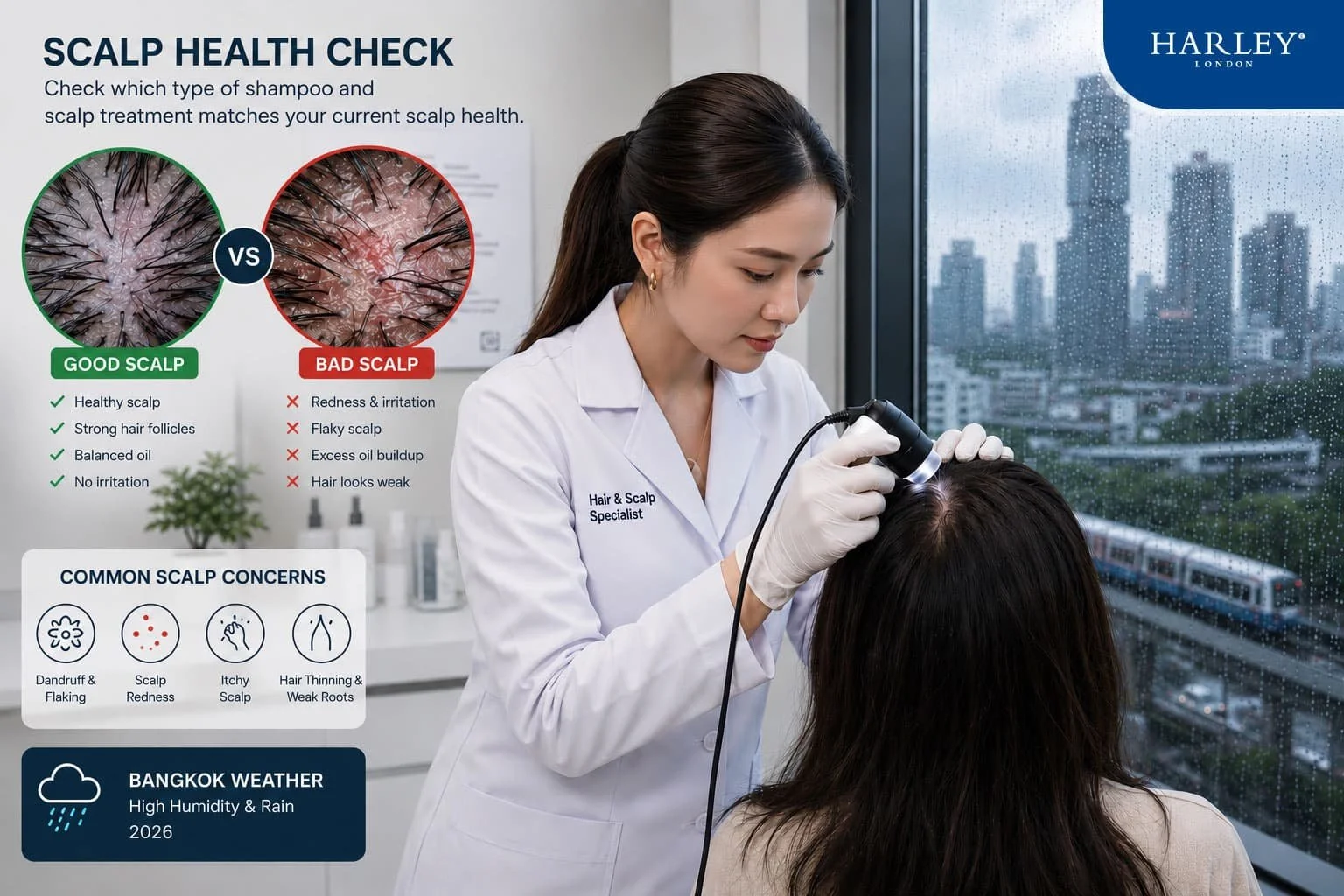
A Hair & Scalp Specialist (trichologist) examining a lady's inflamed scalp under a trichoscope to check for possible scalp concerns during Bangkok’s humid weather.
When the southwest monsoon rolls across Thailand, it brings a dramatic atmospheric shift. While the rain lowers ambient temperatures, it drives relative humidity levels up between 78% and 81% (Paichitrojjana & Chalermchai, 2022).
As a Trichologist (a hair and scalp specialist) at Harley St. Hair Centre, we see a massive influx of clients during these months complaining of intense itching, sudden dandruff flare-ups, and painful, acne-like bumps along the hairline. These are not coincidences; they are direct biological reactions to Thailand's microclimatic shifts.
The Science: Why the Rainy Season Destroys Your Scalp Ecology
Your scalp naturally hosts a delicate ecosystem of microflora. However, when outdoor humidity climbs alongside average local temperatures of 28.6°C to 29°C, it creates a literal greenhouse effect on your head (Paichitrojjana & Chalermchai, 2022).
The primary culprit behind monsoon scalp distress is a lipophilic (fat-loving) yeast genus called Malassezia, specifically Malassezia restricta and Malassezia globosa (Rubenstein, 2014). This yeast survives by consuming the lipids found in human sebum (natural scalp oil).
When trapped rainwater mixes with your sweat and excess sebum under high humidity, the environmental balance collapses. The yeast undergoes rapid, abnormal proliferation, releasing lipase and phospholipase enzymes that break down your skin barrier, triggering severe inflammation, irritation, and accelerated cell shedding (Paichitrojjana & Chalermchai, 2022).
Top 3 Rainy Season Scalp Conditions to Watch For
1. Malassezia Folliculitis (Fungal Acne of the Scalp)
Often misdiagnosed as standard acne or bacterial infections, Malassezia folliculitis presents as small, intensely itchy, uniform red bumps or pustules along the hairline and crown (Paichitrojjana & Chalermchai, 2022). A clinical study conducted right here in Bangkok during the rainy season revealed that nearly 28.8% of patients presenting with acne-like symptoms actually suffered from Malassezia overgrowth (Paichitrojjana & Chalermchai, 2022). Treating this with standard bacterial acne medications can alter your normal cutaneous flora and significantly worsen the condition (Rubenstein, 2014).
2. Seborrheic Dermatitis & Aggravated Dandruff
The metabolic byproducts of excessive yeast induce inflammatory responses that cause the scalp to shed skin cells rapidly. This manifests as greasy, yellowish flakes accompanied by a persistent, stubborn itch.
3. Tinea Capitis (Scalp Ringworm)
Though less common than simple yeast overgrowth, actual dermatophyte fungal infections like Tinea Capitis thrive aggressively in hot, humid climates like Southeast Asia (Al Aboud, 2023). This fungus penetrates the hair follicle's outer root sheath, making hair shafts extremely brittle and causing patchy hair loss (Al Aboud, 2023).
Clinical Prevention: The Trichologist's Protocol
To keep your scalp healthy when the downpours hit, you must switch from regular hair cosmetic habits to an active, preventative scalp routine.
1 Never Let Rainwater Dry Naturally
Immediate Intervention
Rainwater in modern urban areas traps atmospheric pollutants, acidic compounds, and mold spores. If you get caught in a Bangkok downpour, wash your hair as soon as you get home. Allowing rainwater to sit on a warm scalp creates the perfect incubation environment for fungi.
2 Don't self-medicate with anti-fungal shampoos without first checking your scalp condition
Daily or 2-3 Times Weekly (Depends on scalp condition)
Scalp conditions vary from person to person and can change constantly. It is not recommended to switch from a regular moisturizing shampoo to a medicated shampoo containing antifungal ingredients without a doctor or hair and scalp specialist confirming your scalp condition first. In cases of fungal infections on the scalp, most medical professionals recommend shampoos containing Ketoconazole 2%, Zinc Pyrithione, or Selenium Sulfide. During washing, leave the lather on the scalp for 3 to 5 minutes before rinsing to allow the medication to fully penetrate the hair follicles. However, using such strong shampoos without consulting a doctor or hair and scalp specialist who understands the side effects of these shampoos can lead to chronic scalp problems and hair loss. It is crucial to research and consult a hair and scalp specialist who understands the side effects of these shampoos before purchasing and using them yourself.
3 De-Humidify with a Cool Blow Dry
Post-Wash Routine
Never sleep on damp hair or tie it up while wet. Tying up wet hair in a humid climate traps heat and moisture, structurally increasing hair fragility and predisposing you to superficial fungal infections like White Piedra (Gaurav et al., 2021). Use a hair dryer on the cool or medium heat setting to fully dry your roots and scalp. Avoid high heat, which can further trigger sweat and sebum production.
4 Sanitize Hair Tools and Accessories
Weekly Maintenance
Fungal spores can live on surfaces for months, leading to constant re-infection (Al Aboud, 2023). Disinfect your hairbrushes, combs, and helmets weekly. Wash your pillowcases in hot water at least once a week to disrupt the cycle of microbial accumulation.
When to Seek Professional Help
If you have tried adjusting your cleansing routine for two weeks but continue to experience persistent, localized hair shedding, painful boggy swellings, or intense nocturnal itching, you need to see a clinical specialist.
A trichologist or dermatologist can perform a non-invasive trichoscopy (microscopic scalp analysis) or a scraping smear to pinpoint the exact organism causing your symptoms (Gaurav et al., 2021). If Malassezia or dermatophytes have burrowed deep within the infundibular portion of the hair follicle, topical over-the-counter options may be insufficient, and a short course of oral antifungals may be required under medical supervision (Al Aboud, 2023; Rubenstein, 2014).
Don't let the monsoon season dictate your hair health. By prioritizing a clean, completely dry, and microbiologically balanced scalp, your hair will easily survive Thailand's wettest months.
Don't Let the Monsoon Rain Ruin Your Hair Roots: Book Your Scalp Health Check with Our Specialist Today!
How often have you tried to tackle hair loss, dandruff, or an itchy scalp during the rainy season by blindly switching shampoos based on online reviews?
Trial and error with various products without knowing the actual root cause can be a costly waste of time. Worse still, it can strip away your scalp's protective barrier, causing fungal acne to flare up and weakening the hair follicles—ultimately leading to chronic hair thinning and loss.
Why consulting a Hair and Scalp Specialist (Trichologist) is a far better approach:
Safer and More Accurate: We utilise advanced Trichoscopy (high-powered microscopic scalp analysis) to look deep into your hair roots and assess the exact yeast population on your scalp. There is absolutely no guesswork involved.
Bespoke Treatment Plans: Because everyone's skin type and triggers are unique, you will receive a tailored care programme designed to safely restore your microbial balance in a way that suits your lifestyle.
Halt Hair Loss for Good: Once your scalp is clean, free from fungal overgrowth, and oil production is properly regulated, your hair follicles can grip securely again. This allows new hair to grow healthily, so you no longer have to worry about your hair thinning out every time the weather turns wet.
Exclusive Monsoon Season Offer! Take the first step towards proper care with a specialist today for results that are both visible and safe.
Medical References :
Al Aboud, A. M. (2023). Tinea Capitis. StatPearls. NCBI Bookshelf.Gaurav, V., Grover, C., Das, S., & Rai, G. (2021). White Piedra: An uncommon superficial fungal infection of hair. Skin Appendage Disorders, 8(1), 34-37.Paichitrojjana, A., & Chalermchai, T. (2022). The prevalence, associated factors, and clinical characterization of Malassezia folliculitis in patients clinically diagnosed with acne vulgaris. Clinical, Cosmetic and Investigational Dermatology, 15, 2647-2654.Rubenstein, R. M. (2014). Malassezia (Pityrosporum) Folliculitis. The Journal of Clinical and Aesthetic Dermatology, 7(3), 37–41.