Celebrating Pride with Confidence: Navigating Hair Loss & Scalp Health in Thailand’s LGBTQ+ Community
An LGBTQ+ lady in Thailand celebrating Pride Month, navigating information on the mobile phone with a concerned expression regarding hormone-induced hair loss types.
Happy Pride Month, Thailand! As Bangkok transforms into a sea of rainbow flags, parades, and vibrant celebrations, the LGBTQ+ community takes centre stage. Pride is about self-expression, identity, and feeling confident in your own skin. However, for many gender-diverse individuals, there is a silent, stressful barrier to that confidence: hair loss and scalp distress.
From the physiological impacts of gender-affirming hormone therapies to the structural damage caused by intensive styling for performance and self-expression, the LGBTQ+ community faces highly specific hair and scalp challenges.
Unfortunately, misconceptions run rampant in Thailand, leading many to resort to extreme, unverified medical cocktails. This Pride Month, let’s dismantle the myths, explore the true science of hair loss, and discuss why consulting a Trichologist—rather than a traditional dermatologist—is the safest, most efficient path to vibrant hair health.
Specific Types of Hair Loss in the LGBTQ+ Community
Hair loss is not a one-size-fits-all condition. Within the diverse spectrum of the LGBTQ+ community, the biological mechanisms driving hair thinning vary drastically.
1. Androgenetic Alopecia (Pattern Hair Loss) from Hormone Therapy
For transgender men undergoing Testosterone Replacement Therapy (TRT), pattern hair loss is incredibly common. The body's natural enzymes convert free testosterone into Dihydrotestosterone (DHT). DHT binds to receptors on the scalp’s hair follicles, causing follicular miniaturization—a process where follicles shrink, causing hair to grow back finer and shorter until growth stops entirely (Tominaga, 2025). Clinical data shows that over 75% of transgender men develop male pattern hair loss within two years of initiating testosterone therapy (Rutnin et al., 2023).
Conversely, transgender women who fluctuate or abruptly stop their hormone regimens—or experience the sudden endocrine drop following gender-affirming surgeries (such as an orchiectomy)—can trigger a systemic shock to their hair cycle.
2. Chronic Telogen Effluvium (Shock Shedding)
The hair cycle consists of growth (anagen), regression (catagen), and resting/shedding (telogen) phases.
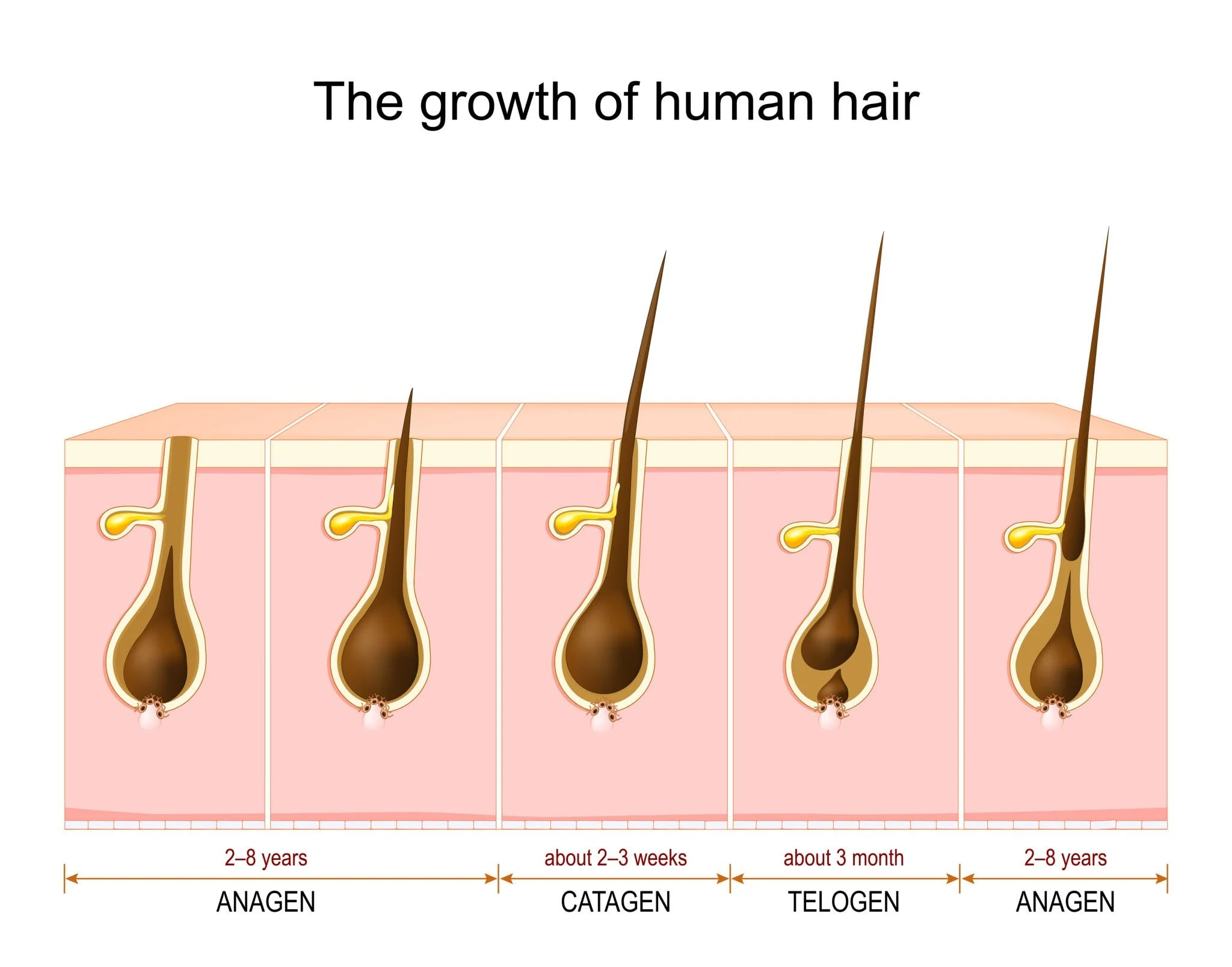
Hair growth cycle from anagen and catagen to telogen phase.. Source: Getty Images
When the body undergoes massive physiological shifts—such as starting high-dose oral contraceptives, undergoing major surgery, or experiencing extreme emotional stress—up to 30% of active hairs can be shocked prematurely into the telogen phase. Roughly two to four months after the trigger, massive, diffuse shedding occurs across the entire scalp.
3. Traction Alopecia and Chemical Trauma
Self-expression is a cornerstone of Pride, often involving intricate hairstyling, tight wigs, hair extensions, bleaching, and chemical straightening. For drag performers and expressive individuals, the constant physical pulling on the hair root causes Traction Alopecia, which destroys the follicle over time. Paired with chemical burns on the scalp from unverified bleaching agents, the skin barrier becomes compromised, leading to chronic inflammation, contact dermatitis, and scarring.
Dangerous Misconceptions of Hair Care in Thailand
In Thailand, over-the-counter medications and beauty treatments are exceptionally accessible. This convenience has birthed several dangerous misconceptions within the local LGBTQ+ community:
The "Pharmacy Cocktail" Myth: A highly prevalent trend involves buying high-dose oral minoxidil or crushing up finasteride (prostate medication) and mixing it with birth control pills to create DIY hair growth tonics. Because these medications radically alter blood pressure and systemic hormones, unmonitored use regularly leads to severe complications, including dangerous drops in blood pressure (orthostatic hypotension), acute liver toxicity, and severe mood disorders (Motosko & Tosti, 2021).
Shampoo as a Cure-All: Many believe that expensive anti-hair-fall shampoos can cure hormonal or genetic hair loss. In reality, shampoo only cleanses the surface of the scalp; it cannot penetrate deep into the dermis to alter follicle biochemistry.
More Estrogen Equals More Hair: Some young transgender women (Kathoey) assume increasing their oral contraceptive dose will automatically stop hair thinning. In truth, erratic spikes in synthetic hormones throw the endocrine system into further chaos, worsening telogen effluvium.
Trichologist vs. Dermatologist: Why Trichology is Safer and More Efficient
When facing severe hair loss, most people instinctively book an appointment with a general dermatologist. However, for the specific needs of the LGBTQ+ community, a Trichologist—a specialized practitioner dedicated exclusively to the study of the hair and scalp—offers a vastly superior approach.
| CLINICAL APPROACH TO HAIR LOSS | |
|---|---|
| DERMATOLOGIST | TRICHOLOGIST |
| Focus: General skin diseases | Focus: Hair & scalp only |
| Method: Hardcore pharmaceuticals | Method: Holistic & targeted |
| Often jumps to transplants | Preserves transition goals |
1. General Skin Care vs. Absolute Hair Specialization
Dermatologists balance an immense medical scope, treating skin cancers, acne, rashes, and nail disorders. Hair loss is often treated as a secondary aesthetic concern, frequently resulting in standardized prescriptions for heavy pharmaceuticals. Trichologists focus 100% of their clinical training on the scalp ecosystem, interpreting subtle changes in hair density and scalp health through advanced digital trichoscopy.
2. Avoiding Hardcore Systemic Medications
Dermatologists heavily rely on systemic, oral medications to combat hair loss. For an LGBTQ+ individual whose endocrine system is already meticulously balanced via gender-affirming hormone therapy, adding heavy oral anti-androgens can disrupt their entire transition roadmap. Trichologists prioritize localized, non-hormonal, and non-pharmaceutical interventions—such as Low-Level Laser Therapy (LLLT), Platelet-Rich Plasma (PRP) therapy, and bio-peptide scalp treatments—to stimulate follicles safely without affecting blood serum hormone levels (Schiffer, 2021).
3. Understanding the Transgender Experience
A trichologist evaluates hair health through a holistic lens, taking into account transition timelines, surgical histories, and styling habits. They understand how to safely block DHT at the scalp level for a transgender man without compromising the systemic testosterone needed for his masculine physical goals (Tominaga, 2025).
Conclusion: Empowering the Next Generation Safely
Navigating identity as a young teen or young adult within the LGBTQ+ community comes with enough challenges; watching your hair thin prematurely shouldn't be one of them.
Seeking the guidance of a Trichologist early on empowers young adults to understand their unique hair and scalp issues through a scientific, accurate lens. By opting for trichological care over generalized dermatology, the younger generation can avoid the dangers of unmonitored, hardcore oral medications that strain the liver and heart.
Furthermore, early non-invasive interventions—such as photobiomodulation and targeted botanical scalp therapies—can completely revitalize dormant follicles, eliminating the future emotional and financial risk of undergoing invasive hair transplant surgeries. This Pride Month, take control of your identity from the root up. Celebrate safely, express yourself boldly, and give your scalp the specialized care it truly deserves.
Medical References :
Motosko, C. C., & Tosti, A. (2021). Dermatologic care of hair in transgender patients: A systematic review of literature. Dermatology and Therapy, 11(5), 1457–1468.Rutnin, S., Suchonwanit, P., Kositkuljorn, C., Pomsoong, C., Korpaisarn, S., Arunakul, J., & Rattananukrom, T. (2023). Characterizing dermatological conditions in the transgender population: A cross-sectional study. Transgender Health, 8(1), 89–99.Schiffer, R. (2021). Non-surgical Treatment Options for Male-pattern Baldness: A Comparative Meta-Analysis of LLLT and PRP. Touro Scholar, 14(2), 43–49.Tominaga, Y. (2025). The safety and efficacy of finasteride for transgender men with androgenetic alopecia. PMC.