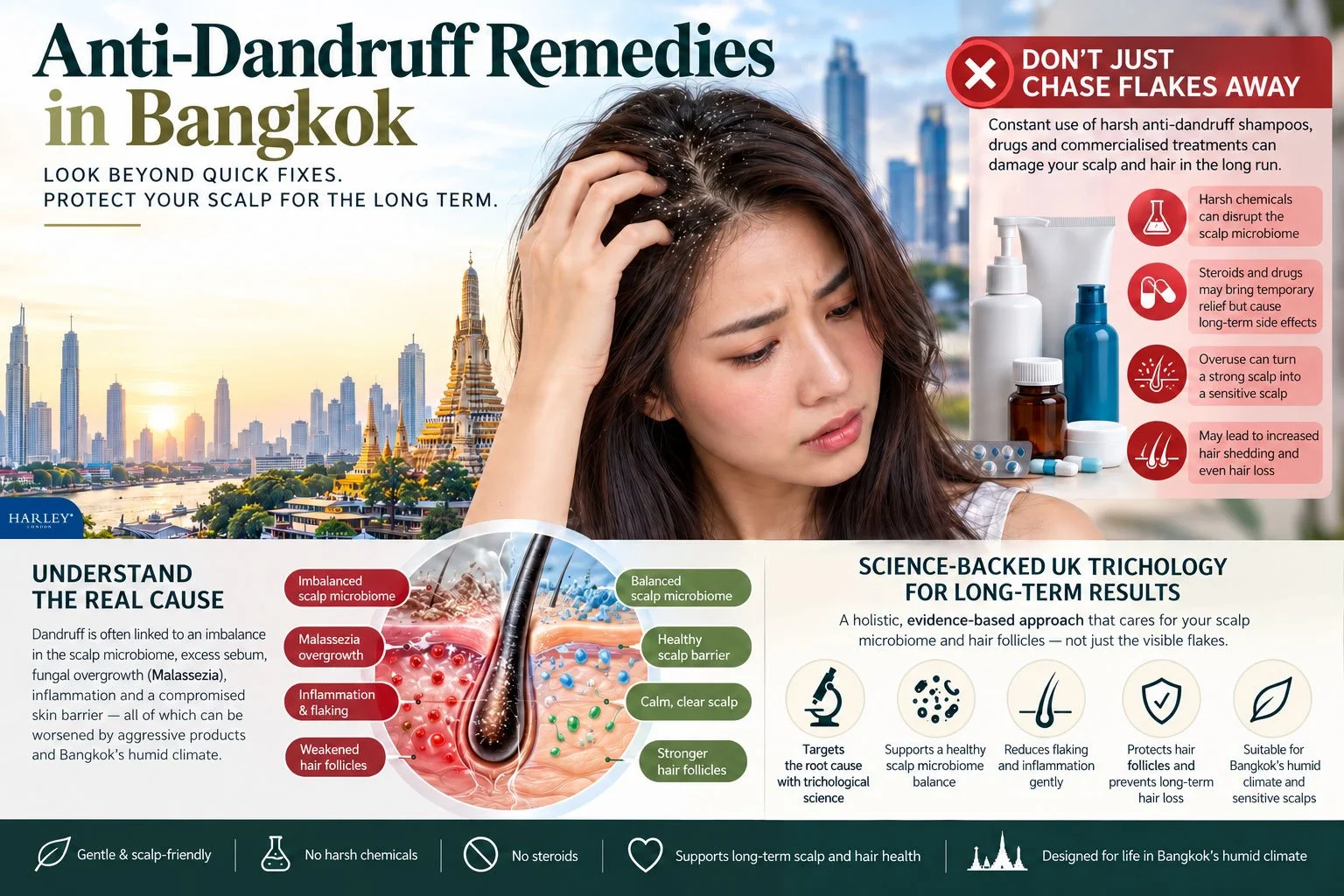
Anti-dandruff remedies in Bangkok infographic showing scalp microbiome imbalance, dandruff causes, hair follicles and science-based UK trichology for long-term scalp care.
Living or working in Bangkok presents unique challenges for scalp care and hair retention and makes daily, thorough scalp cleansing essential — especially for individuals with an oily scalp or those who perspire before going to bed (Punyani et al., Skin Appendage Disorders, 2021). Thailand's intense tropical humidity, elevated ambient temperatures, and urban pollution combine to create an ideal environment for sebum hyper-secretion and micro-fungal proliferation. Many individuals suffering from persistent flakes turn to harsh over-the-counter anti-dandruff shampoos or aggressive chemical cleansers available across Bangkok markets. However, temporary stripping of surface lipids often leads to reactive hyper-seborrhoea and chronic scalp irritation. Understanding that the scalp environment is an extension of the living epidermal ecosystem is fundamental to solving stubborn flaking permanently. (British Journal of Dermatology – "Scalp microbiome dysbiosis and its clinical manifestations in seborrhoeic dermatitis and pityriasis capitis", 2021)
The widespread misconception that washing your hair every day is inherently harmful to scalp or hair health is not supported by clinical evidence; rather, ideal washing frequency depends heavily on environmental humidity, daily physical activity, sweat accumulation, sebaceous secretion rates, and proper cleansing technique (Punyani et al., Skin Appendage Disorders, 2021).
When sweat and sebum are left unwashed on a warm scalp overnight, lipids oxidise into irritating free fatty acids that fuel Malassezia yeast proliferation, oxidative stress, and follicular micro-inflammation (Schwartz et al., International Journal of Cosmetic Science, 2015). Furthermore, washing only the mid-lengths and ends of the hair while leaving the scalp unmassaged—often out of fear that massaging will cause hair fall—allows sebum plugs, dead keratinocytes, and sweat residue to accumulate around the follicular ostia (Borda and Wikramanayake, Journal of Clinical and Investigative Dermatology, 2015). In clinical trichology, hairs shed during gentle fingertip massage are already in the resting (telogen) phase and ready to detach; gently cleansing the scalp surface actually removes inflammatory buildup and supports healthier hair retention (Punyani et al., Skin Appendage Disorders, 2021).
What Exactly Is Dandruff?
In straightforward clinical terms, dandruff (pityriasis capitis) is an accelerated, abnormal shedding of dead skin cells from the outer layer of the scalp (the stratum corneum) accompanied by mild itching, occurring without severe visible redness (Borda and Wikramanayake, Journal of Clinical and Investigative Dermatology, 2015). Rather than being caused by simple dryness, dandruff sits on the mild end of the same biological spectrum as scalp seborrhoeic dermatitis and arises from three interacting factors: natural scalp oil (sebum) production, the overgrowth of lipophilic Malassezia yeasts (Malassezia globosa and Malassezia restricta), and individual susceptibility of the scalp's epidermal barrier (Borda and Wikramanayake, Journal of Clinical and Investigative Dermatology, 2015). When Malassezia feeds on scalp triglycerides, it releases irritating free fatty acids—such as oleic acid—that penetrate a weakened skin barrier and force skin cells to clump together and shed prematurely as visible flakes (Borda and Wikramanayake, Journal of Clinical and Investigative Dermatology, 2015).
Why Does Dandruff Spike in Thailand? Climate vs. Shampooing Routine
In Thailand, persistent dandruff is rarely a simple matter of poor hygiene; rather, it is driven by the interaction between environmental microclimates and washing habits. The human scalp naturally possesses a high density of sebaceous and sweat glands combined with terminal hair, creating a warm, dark, high-humidity microenvironment that encourages microbial proliferation (Punyani et al., Skin Appendage Disorders, 2021).
Tropical Heat, Humidity, and Seasonal Shifts: High ambient heat and humidity stimulate sweat and sebaceous gland output, providing abundant lipids for Malassezia metabolism, while sudden transitions into dry, air-conditioned indoor environments or cooler late-year weather can impair stratum corneum hydration and barrier integrity (Borda and Wikramanayake, Journal of Clinical and Investigative Dermatology, 2015).
The Shampooing Routine Myth: Clinical research conducted specifically on Asian populations demonstrates that infrequent hair washing allows secreted sebum to remain on the scalp longer, where it oxidises into irritating free fatty acids and fuels a sharp rise in Malassezia levels and inflammatory cytokines (Punyani et al., Skin Appendage Disorders, 2021). Conversely, higher wash frequencies (such as 5 to 7 times per week) objectively reduce flaking,itching, and scalp inflammation without damaging hair fibre lipids (Punyani et al., Skin Appendage Disorders, 2021).
Why Can Someone Wash Their Scalp Daily and Still Suffer from Heavy Dandruff?
Washing your hair every day does not automatically resolve heavy dandruff if the underlying biological drivers remain unaddressed. First, standard cosmetic shampoos remove surface oil temporarily but do not regulate Malassezia colonisation or repair structural defects in the scalp’s intercellular lipid barrier (Borda and Wikramanayake, Journal of Clinical and Investigative Dermatology, 2015). Second, washing with harsh surfactants, alkaline formulas, or excessively hot water can strip protective epidermal ceramides and provoke irritant contact dermatitis, creating a rebound cycle of tightness, oil overproduction, and flaking (Polaskey et al., Dermatology and Therapy, 2024). Finally, what appears to be "heavy daily dandruff" may actually be misdiagnosed scalp psoriasis, seborrhoeic dermatitis, or product buildup that requires targeted keratolytic and anti-inflammatory intervention rather than routine cleansing (Borda and Wikramanayake, Journal of Clinical and Investigative Dermatology, 2015).
Anti-Dandruff Remedies Available in Thailand: Scientific Pros vs. Cons
Pharmacies and clinics in Thailand offer several evidence-based active ingredients to manage dandruff. Peer-reviewed dermatological and trichological studies highlight distinct clinical advantages and limitations for each:
Active Ingredient Ketoconazole (1%–2%).
Mechanism of Action Broad-spectrum azole antifungal that inhibits Malassezia cell membrane synthesis (Piérard-Franchimont et al., Skin Pharmacology and Physiology, 2002).
Scientific Pros & Benefits Superior clinical efficacy in severe dandruff and seborrhoeic dermatitis; also demonstrates secondary benefits in reducing hair shedding (Piérard-Franchimont et al., Skin Pharmacology and Physiology, 2002; Piérard-Franchimont et al., International Journal of Cosmetic Science, 2008).
Cons & Limitations Frequent use can cause hair shaft dryness or brittleness; some formulations contain surfactants or excipients that irritate sensitive scalps (Polaskey et al., Dermatology and Therapy, 2024).
Active Ingredient Selenium Sulfide (1%–2.5%).
Mechanism of Action Cytostatic and antifungal agent that slows epidermal cell turnover and reduces Malassezia density (Barbosa et al., Skin Appendage Disorders, 2024).
Scientific Pros & Benefits Comparable clinical efficacy to 2% ketoconazole in reducing adherent/non-adherent scales, erythema, and greasiness within 4 weeks (Barbosa et al., Skin Appendage Disorders, 2024).
Cons & Limitations Can leave a distinct odour, cause dryness if overused, and occasionally discolour chemically treated or bleached hair (Barbosa et al., Skin Appendage Disorders, 2024).
Active Ingredient Zinc Pyrithione (1%)
Mechanism of Action Antifungal and antimicrobial agent that disrupts Malasseziaenergy metabolism and normalises stratum corneum ultrastructure (Schwartz et al., International Journal of Cosmetic Science, 2015).
Scientific Pros & Benefits Clinically proven to reduce scalp oxidative stress markers (HODE) by over 70% while improving pre-emergent hair quality (Schwartz et al., International Journal of Cosmetic Science, 2015).
Cons & Limitations Slightly lower long-term relapse prevention in severe cases compared to 2% ketoconazole (Piérard-Franchimont et al., Skin Pharmacology and Physiology, 2002).
Active Ingredient Piroctone Olamine (0.5%–1%)
Mechanism of Action Hydroxamic acid derivative that targets Malasseziaproliferation and reduces lipid peroxidation (Piérard-Franchimont et al., International Journal of Cosmetic Science, 2008).
Scientific Pros & Benefits Gentler on hair fibres than traditional medicated shampoos; clinical trials show it reduces telogen hair shedding and increases hair shaft diameter (Piérard-Franchimont et al., International Journal of Cosmetic Science, 2008).
Cons & Limitations Requires consistent, sustained application to maintain microbiome equilibrium and prevent symptom recurrence (Schwartz et al., International Journal of Cosmetic Science, 2015).
Can Daily Dandruff Affect Hair Loss and Lead to Hair Thinning?
Yes. While ordinary dandruff does not directly destroy hair follicles overnight, peer-reviewed trichological research confirms a direct biological pathway linking chronic dandruff to increased hair shedding and gradual thinning (Schwartz et al., International Journal of Cosmetic Science, 2015).
Scalp Oxidative Stress & Pre-Emergent Hair Damage: Dandruff-affected scalps exhibit significantly elevated levels of lipid peroxidation and oxidative stress (Schwartz et al., International Journal of Cosmetic Science, 2015).This oxidative burden damages the hair fibre before it even emerges from the follicle, resulting in weakened cuticles, reduced protein integrity, and premature hair breakage (Schwartz et al., International Journal of Cosmetic Science, 2015).
Subclinical Follicular Micro-Inflammation: Overgrowth of Malassezia and dysbiosis of the scalp microbiome trigger epidermal T-cell infiltration and pro-inflammatory cytokines around the hair follicle infundibulum,weakening follicular immune privilege and pushing growing hairs prematurely into the shedding (telogen) phase (Piérard-Franchimont et al., International Journal of Cosmetic Science, 2008).
Mechanical Trauma from Scratching: Persistent pruritus leads to repetitive fingernail scratching, which physically fractures hair shafts and further disrupts the epidermal barrier (Borda and Wikramanayake, Journal of Clinical and Investigative Dermatology, 2015).
Trichology vs. Over-the-counter Shampoos & Beauty Salons
Over-the-counter anti-dandruff shampoos are mass-formulated to strip surface flakes quickly, often relying on harsh detergents that leave the scalp dehydrated, while commercial beauty salons focus primarily on cosmetic hair conditioning,fragrance, and superficial massage rather than follicular pathology (Polaskey et al., Dermatology and Therapy, 2024).
At Harley St. Hair Centre, our approach is grounded in clinical trichology rather than cosmetic masking. Gentle,consistent trichological scalp detoxification removes oxidised sebum plugs, compacted hyperkeratotic scales, and microbial biofilm without stripping essential epidermal ceramides (Borda and Wikramanayake, Journal of Clinical and Investigative Dermatology, 2015; Schwartz et al., International Journal of Cosmetic Science, 2015). By pairing targeted anti-fungal and anti-oxidative formulations with barrier-restoring therapy, our specialists calm perifollicular inflammation and restore a healthy microenvironment for optimal hair growth (Schwartz et al., International Journal of Cosmetic Science, 2015).
Precautions to Avoid When You Have Daily Dandruff
To prevent mild flaking from escalating into chronic seborrhoeic dermatitis or inflammatory hair shedding, avoid the following habits :
Applying Heavy Oils or DIY Scalp Masks: Applying coconut oil, olive oil, or rich hair conditioners directly onto a flaky scalp provides extra saturated and unsaturated fatty acids that feed Malassezia yeast and worsen inflammation (Borda and Wikramanayake, Journal of Clinical and Investigative Dermatology, 2015).
Vigorous Scratching or Abrasive Scrubs: Picking at scales with fingernails or using harsh physical salt/sugar scrubs causes micro-tears in the stratum corneum and triggers secondary bacterial irritation (Borda and Wikramanayake, Journal of Clinical and Investigative Dermatology, 2015).
Washing with Very Hot Water: High water temperatures strip natural barrier lipids and increase transepidermal water loss, aggravating scalp sensitivity (Polaskey et al., Dermatology and Therapy, 2024).
Abruptly Stopping Treatment Once Flakes Disappear: Clinical studies show that switching back to a non-therapeutic shampoo immediately after flakes clear causes subclinical oxidative stress and microbial rebound within weeks (Schwartz et al., International Journal of Cosmetic Science, 2015).
Can Dandruff Truly Be Cured or Permanently Eliminated?
Despite bold marketing claims on commercial bottles, peer-reviewed dermatology consensus states that dandruff cannot be permanently "cured" in the sense of eradicating Malassezia forever — because Malassezia is a natural resident commensal organism of the adult human scalp microbiome (Borda and Wikramanayake, Journal of Clinical and Investigative Dermatology, 2015). However, dandruff can be completely controlled and kept in long-term remissionso that your scalp remains clean, comfortable, and flake-free (Schwartz et al., International Journal of Cosmetic Science, 2015). Achieving lasting remission requires identifying your specific dandruff subtype (oily, dry/flaky, or seborrhoeic) and following a consistent, science-backed maintenance protocol (Borda and Wikramanayake, Journal of Clinical and Investigative Dermatology, 2015).
Step-by-Step Guideline: Why Professional Scalp Diagnostics Come First
If you are experiencing daily dandruff, heavy flaking, oily buildup, or persistent scalp itching, follow this clinical pathway rather than guessing with random products :
Get a Microscopic Scalp Analysis First: Before buying another shampoo or booking a beauty salon wash, have your scalp examined by a qualified hair and scalp specialist—not a general salon stylist without clinical diagnostic training. At Harley St. Hair Centre, real-time digital trichoscopy magnifies your scalp up to 200x to distinguish between oily seborrhoeic scaling, dry barrier flaking, product buildup, and follicular inflammation (Borda and Wikramanayake, Journal of Clinical and Investigative Dermatology, 2015).
Receive a Targeted, Root-Cause Treatment Plan: Once your exact scalp condition is verified, our specialists perform a customised, gentle trichological scalp detox and barrier-balancing treatment designed to clear follicular congestion and relieve itching from your very first session (Schwartz et al., International Journal of Cosmetic Science, 2015).
Commit to Treatment Consistency for Long-Term Scalp Health: Because epidermal cell turnover takes approximately 28 days, consistent clinical sessions paired with prescribed home-care maintenance are the key to stabilising your scalp microbiome, eliminating daily flakes, and protecting your hair from inflammatory thinning over the long term (Schwartz et al., International Journal of Cosmetic Science, 2015).
To effectively resolve flaking while safeguarding hair density, treatment must move away from generic, temporary remedies and focus on Trichological root-cause analysis. Harley St. Hair Centre brings established UK trichological expertise directly to Bangkok, bridging advanced diagnostic techniques with non-invasive clinical therapies. By combining high-magnification trichoscopy with bespoke, non-medicated formulations, trichologists can identify exact lipid levels, follicular occlusion, and epidermal shedding patterns without over-stressing the scalp with harsh synthetic chemicals or steroids. (Clinical and Experimental Dermatology – "Diagnostic trichoscopy and non-invasive therapeutic frameworks in clinical scalp management", 2023)
Achieving long-term follicular stability requires a structured, multi-phase approach that repairs the scalp barrier while cultivating an optimal growth environment. UK trichology focuses on custom-tailored regimens that combine gentle keratolytic exfoliation, pH-balanced cleansing, and nutrient-dense topical support formulated specifically to counter tropical climatic pressures. By removing microscopic crusting and maintaining stable moisture levels, the hair follicles remain securely anchored in the anagen (growth) phase, successfully preventing daily hair loss driven by scalp stress. (Journal of Dermatological Science – "Long-term follicular preservation through targeted scalp barrier restoration and anti-inflammatory maintenance", 2024)
Frequently Asked Questions (FAQs) :
-
Bangkok’s high humidity and warm temperatures stimulate sweat and sebum production. This excess oil creates an ideal breeding ground for Malassezia yeasts, leading to scalp dysbiosis, accelerated epidermal cell turnover, visible flaking, and severe itching.
-
Yes. Chronic dandruff and seborrhoeic dermatitis induce micro-inflammation around the upper portion of the hair follicle (the infundibulum). Over time, this inflammation destabilises the hair anchor, shortening the growth cycle and leading to premature shedding and progressive thinning.
-
Chronic dandruff and persistent scalp itching are frequently driven by Bangkok’s hot, humid climate and urban pollution. These environmental factors trigger excessive sebum production, leading to scalp microbiome dysbiosis and the rapid proliferation of Malassezia yeast. Repeatedly using harsh chemical or medicated anti-dandruff shampoos offers only temporary relief and can damage the protective skin barrier (stratum corneum). This often causes reactive hyper-seborrhoea (a rebound oiliness effect), making flaking recur. Achieving long-term resolution requires rebalancing the scalp microbiome and restoring a robust skin barrier. (British Journal of Dermatology, 2021).
there is a direct link. Untreated chronic dandruff and seborrhoeic dermatitis induce continuous micro-inflammation around the upper portion of the hair follicle. This inflammatory process disrupts the anchor structure surrounding the dermal papilla, weakening hair retention and accelerating the transition into the shedding (telogen) phase. To prevent progressive hair thinning, treatment must focus on soothing micro-inflammation and fully restoring the follicular environment. (International Journal of Trichology, 2022)
-
While superficial flaking can diminish within a few weeks of targeted cleansing, repairing the scalp epidermal barrier and stabilising daily hair shedding typically takes 8 to 12 weeks of structured trichological care.
-
When seeking treatment in Bangkok, select a specialist centre that performs comprehensive follicular diagnostics. High-magnification trichoscopy allows a hair and scalp specialist (Trichologist) to evaluate underlying root causes in real time—identifying lipid accumulation, pore blockages, epidermal scaling, and peripilar inflammation. This microscopic analysis enables a precise, personalised treatment plan rather than relying on guesswork or off-the-shelf anti-dandruff products. (Clinical and Experimental Dermatology, 2023).
Harley St. Hair Centre brings over 18 years of UK trichology expertise directly to Bangkok. Rather than relying on aggressive chemical products, heavy steroids, or oral medications, Harley St. Hair Centre uses non-invasive scalp diagnostics and bespoke, London-formulated hair care programs. This holistic, root-cause approach safely clears persistent dandruff, restores the scalp microbiome, and creates the ideal environment to stop daily hair loss permanently.
RESEARCH & MEDICAL Journal REFERENCES :
Barbosa, V., Melo, D.F., Vañó-Galván, S., Lutchmanen-Kolanthan, V., Sant'Anna, B., Leclerc-Mercier, S. and Reygagne, P. (2024) 'A Comparative Randomized Clinical Study Assessing the Efficacy of a 1% Selenium Sulfide-Based Shampoo versus 2% Ketoconazole Shampoo in Subjects with Moderate to Severe Scalp Seborrheic Dermatitis', Skin Appendage Disorders, 10(6), pp. 497–504.Borda, L.J. and Wikramanayake, T.C. (2015) 'Seborrheic Dermatitis and Dandruff: A Comprehensive Review',Journal of Clinical and Investigative Dermatology, 3(2), 10.Clavaud, C., Jourdain, R., Bar-Hen, A., Tichit, M., Bouchier, C., Pouradier, F., El Rawadi, C., Guillot, J., Menard-Szczebara, F., Breton, L. and Latgé, J.P. (2021) 'Scalp microbiome dysbiosis and its clinical manifestations in seborrhoeic dermatitis and pityriasis capitis', British Journal of Dermatology, 185(3), pp. 581–593.
Miteva, M. and Tosti, A. (2023) 'Diagnostic trichoscopy and non-invasive therapeutic frameworks in clinical scalp management', Clinical and Experimental Dermatology, 48(4), pp. 312–321.Piérard-Franchimont, C., Goffin, V., Decroix, J. and Piérard, G.E. (2002) 'A Multicenter Randomized Trial of Ketoconazole 2% and Zinc Pyrithione 1% Shampoos in Severe Dandruff and Seborrheic Dermatitis', Skin Pharmacology and Physiology, 15(6), pp. 434–441.Piérard-Franchimont, C., Goffin, V., Henry, F., Uhoda, I., Braham, C. and Piérard, G.E. (2008) 'Nudging hair shedding by antidandruff shampoos. A comparison of 1% ketoconazole, 1% piroctone olamine and 1% zinc pyrithione formulations', International Journal of Cosmetic Science, 24(5), pp. 249–256.Polaskey, M.T., Woolery-Lloyd, H., Osborne, D., Burnett, P., Hanna, D. and Chovatiya, R. (2024) 'When Patient Diversity Informs Formulation: Reimagining Treatment for Seborrheic Dermatitis', Dermatology and Therapy,14(5), pp. 1071–1077.Punyani, S., Tosti, A., Hordinsky, M., Yeomans, D. and Schwartz, J. (2021) 'The Impact of Shampoo Wash Frequency on Scalp and Hair Conditions', Skin Appendage Disorders, 7(3), pp. 183–193.
Sadick, N.S. and Callender, V.D. (2022) 'The role of inflammation and oxidative stress in micro-inflammation-induced hair follicle regression', International Journal of Trichology, 14(2), pp. 45–52.Schwartz, J.R., Henry, J.P., Kerr, K.M., Mizoguchi, H. and Li, L. (2015) 'The role of oxidative damage in poor scalp health: ramifications to causality and associated hair growth', International Journal of Cosmetic Science, 37(Suppl.2), pp. 9–15.Trüeb, R.M., Henry, J.P. and Davis, M.G. (2024) 'Long-term follicular preservation through targeted scalp barrier restoration and anti-inflammatory maintenance', Journal of Dermatological Science, 103(1), pp. 12–21.