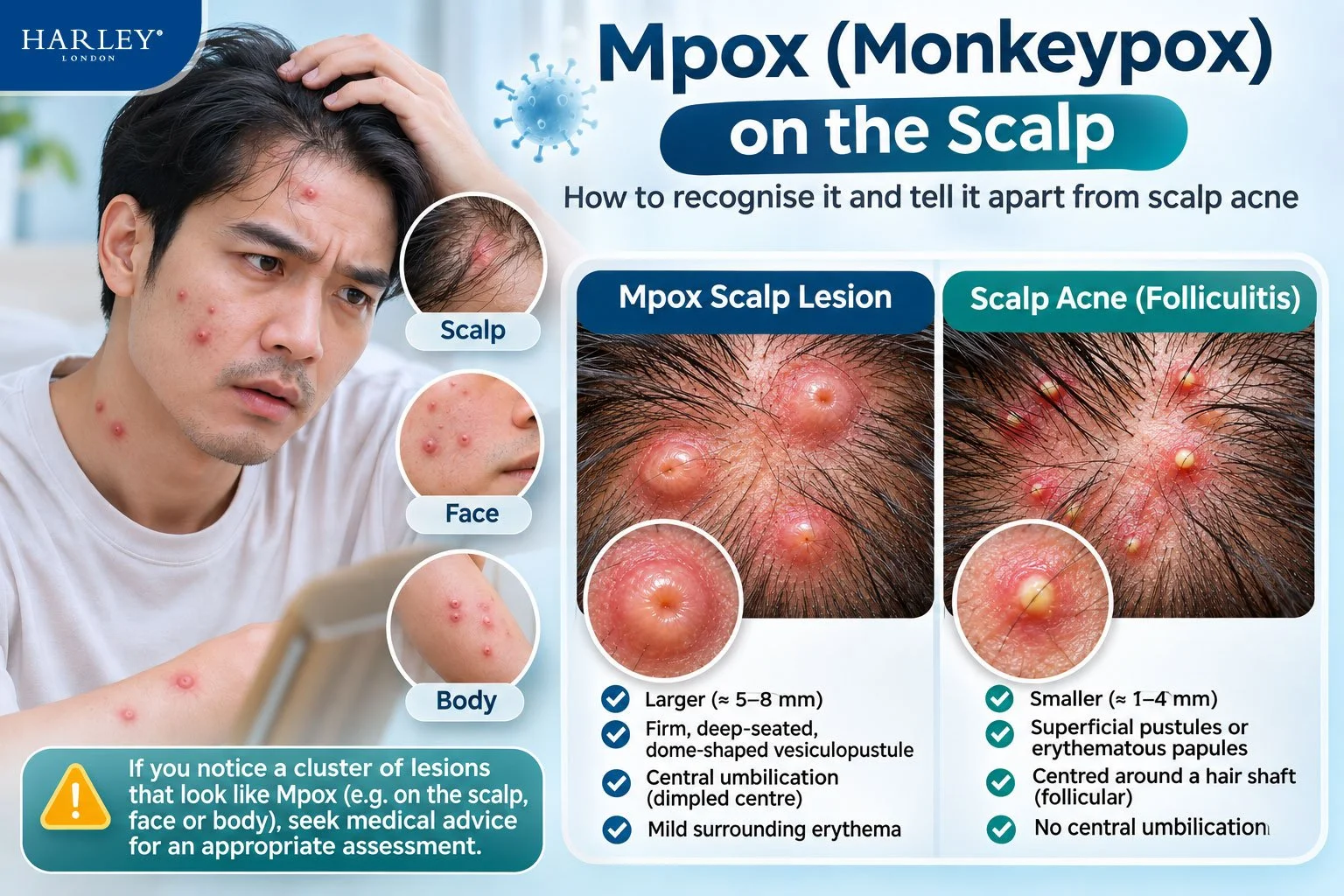
An image comparison showing a close-up of a male Asian scalp with umbilicated mpox viral pustules versus inflamed bacterial scalp acne folliculitis.
Recent public health surveillance released in November 2026 by Thailand’s Department of Disease Control has renewed nationwide awareness regarding mpox, with 470 confirmed cases and three fatalities recorded across the Kingdom between January and October 2026. While most public health messaging centres on systemic illness and skin rashes on the face, torso, or extremities, peer-reviewed dermatological and infectious disease literature confirms that the human scalp is also a recognised anatomical site for mpox lesions and subsequent post-viral hair shedding. Understanding the intersection between systemic viral infections and follicular biology is essential for protecting long-term scalp health.
What Is Mpox and When Was It First Detected in Thailand?
Mpox (formerly known as monkeypox) is a zoonotic viral infection caused by the monkeypox virus (MPXV), a double-stranded DNA virus belonging to the Orthopoxvirus genus—the same viral family responsible for variola (smallpox) (Thornhill et al., New England Journal of Medicine, 2022). First identified in laboratory monkeys in 1958 and in humans in the Democratic Republic of the Congo in 1970, the virus comprises two primary genetic clades: Clade I (subclades Ia and Ib) and Clade II (subclades IIa and IIb) (Gessain et al., Travel Medicine and Infectious Disease, 2023). In Thailand, the first laboratory-confirmed human case of mpox was detected on 21 July 2022 in a 27-year-old traveller in Phuket province, followed by sporadic local and imported transmissions monitored through national surveillance (Puenpa et al., Emerging Infectious Diseases, 2024).
What Are the Core Symptoms of Mpox?
Clinically, mpox progresses through an incubation period of 3 to 21 days, typically followed by a prodromal phase lasting 1 to 5 days before cutaneous eruptions appear (Thornhill et al., New England Journal of Medicine, 2022). Common systemic and dermatological manifestations include :
Prodromal Flu-Like Symptoms: Fever, intense headache, myalgia (muscle aches), back pain, profound lethargy, and sore throat (Thornhill et al., New England Journal of Medicine, 2022).
Lymphadenopathy: Swollen, tender lymph nodes (particularly in the cervical, submandibular, axillary, or inguinal regions), which serves as a key clinical feature distinguishing mpox from varicella (chickenpox) (Gessain et al., Travel Medicine and Infectious Disease, 2023).
Sequential Cutaneous Rash: Skin lesions typically evolve over 14 to 21 days from flat macules into raised papules, fluid-filled vesicles, firm pustules, and finally dry crusts that desquamate once new epidermis forms (Al-Raeei et al., Medicine, 2024).
Can Mpox Affect the Scalp Area, and How Does It Trigger Hair Loss?
Yes. Clinical reviews of cutaneous mpox manifestations explicitly identify the scalp alongside the face, trunk, limbs, palms, and soles as a documented site for viral skin eruptions (Al-Raeei et al., Medicine, 2024). Following mucosal or dermal inoculation, Langerhans cells transport the virus to regional lymph nodes, leading to viraemia and viral seeding in specific epithelial tissues—including the hair-bearing scalp (Al-Raeei et al., Medicine, 2024). Case reports in infectious disease literature have documented discrete, umbilicated papulopustular lesions directly on the scalp, which can become intensely pruritic (itchy) or painful during the active eruptive phase (Mmerem et al., Journal of Infection in Developing Countries, 2024).
Beyond direct viral lesions on the scalp skin, mpox can trigger acute hair loss through two distinct trichological mechanisms :
Acute Telogen Effluvium (Post-Febrile Shedding): High fever, systemic inflammation, and acute physiological stress stimulate pro-inflammatory cytokines that prematurely force actively growing hair follicles (anagen phase) into the resting phase (telogen) (Malkud, Journal of Clinical and Diagnostic Research, 2015). Roughly 2 to 3 months after recovering from the systemic viral illness, patients frequently experience sudden, diffuse hair shedding across the entire scalp (Malkud, Journal of Clinical and Diagnostic Research, 2015).
Localised Follicular Trauma or Scarring: If deep-seated scalp pustules become severely inflamed, scratched, or complicated by secondary bacterial infection, localized tissue necrosis can damage the follicular unit, occasionally resulting in patchy alopecia or small atrophic scars (Gessain et al., Travel Medicine and Infectious Disease, 2023).
Mpox Scalp Lesions vs. Scalp Acne: Key Clinical Differences
Because early mpox bumps on the scalp or hairline can initially resemble common folliculitis or scalp acne, accurate differentiation is critical (Al-Raeei et al., Medicine, 2024).
Clinical Feature Mpox Scalp Lesions Scalp Acne (Bacterial Folliculitis)
Lesion Morphology Deep-seated, firm, rubbery, well-circumscribed nodules (5–10 mm) with central umbilication (a dimple-like central depression) (Al-Raeei et al., Medicine, 2024). Superficial, small erythematous papules or soft pustules (1–4 mm) centred directly on a hair follicle pore without central umbilication (Al-Raeei et al., Medicine, 2024).
Progression Pattern Lesions in the same anatomical region typically evolve synchronously through macule, papule, vesicle, pseudopustule, and crust stages over 2–4 weeks (Gessain et al., Travel Medicine and Infectious Disease, 2023). Lesions appear asynchronously at varying stages of development and resolve quickly within days (Al-Raeei et al., Medicine, 2024).
Associated Symptoms. Frequently accompanied by fever, malaise, sore throat, and tender swollen lymph nodes (e.g., behind the ears or neck) (Thornhill et al., New England Journal of Medicine, 2022). Strictly localised to the skin; no systemic fever, body aches, or lymphadenopathy (Gessain et al., Travel Medicine and Infectious Disease, 2023).
Diagnostic Confirmation Requires laboratory PCR swab testing of lesion fluid or crust material (Thornhill et al., New England Journal of Medicine, 2022). Diagnosed clinically based on follicular distribution and sebum activity (Al-Raeei et al., Medicine, 2024).
Precautions to Avoid Mpox Infection
Mpox spreads primarily through direct skin-to-skin contact with infectious rashes, scabs, or body fluids, prolonged face-to-face respiratory droplets, and contact with contaminated fomites such as towels, bedsheets, hairbrushes, or salon linens (Gessain et al., Travel Medicine and Infectious Disease, 2023). To minimise transmission risk :
Avoid Direct Lesion Contact: Refrain from close physical or intimate contact with anyone displaying unexplained rashes, blisters, or scabs (Thornhill et al., New England Journal of Medicine, 2022).
Do Not Share Personal Scalp Items: Never share combs, hairbrushes, hats, pillows, or towels, as orthopoxviruses can persist on contaminated fabrics (Gessain et al., Travel Medicine and Infectious Disease, 2023).
Practise Strict Hand Hygiene: Wash hands regularly with soap and water or alcohol-based sanitisers, particularly in shared public spaces (Al-Raeei et al., Medicine, 2024).
Consider Targeted Vaccination: High-risk individuals should consult healthcare authorities regarding pre-exposure or post-exposure orthopoxvirus vaccination (Ogoina et al., The Lancet Infectious Diseases, 2023).
Can Mpox Be Cured, and What Should You Do If You Spot Symptoms?
For the vast majority of immunocompetent patients, mpox is a self-limiting viral illness that resolves completely within 2 to 4 weeks with supportive medical care—including hydration, pain relief, antipyretics, and wound hygiene to prevent secondary bacterial infection (Ogoina et al., The Lancet Infectious Diseases, 2023). In severe cases or immunocompromised patients, physicians may prescribe targeted antiviral therapies such as tecovirimat (Thornhill et al., New England Journal of Medicine, 2022).
Step-by-Step Recovery Guideline: Hospital First, Trichology Second
Isolate Immediately: If you notice suspicious bumps on your scalp or body—especially alongside fever or swollen neck lymph nodes—self-isolate at home and avoid touching or scratching the lesions (Al-Raeei et al., Medicine, 2024).
Visit a Hospital First for Medical Diagnosis: Seek prompt evaluation at a hospital or accredited infectious disease clinic for confirmatory PCR testing and medical management (Thornhill et al., New England Journal of Medicine, 2022). Do not visit hair salons, barbershops, or trichology clinics while lesions are active.
Wait for Complete Epidermal Clearance: You remain contagious until all scabs have naturally fallen off and a fresh, intact layer of skin has formed underneath—typically 2 to 4 weeks (Ogoina et al., The Lancet Infectious Diseases, 2023).
Book a Post-Recovery Scalp & Follicle Assessment: Once medically cleared and completely healed, schedule a diagnostic consultation at Harley St. Hair Centre if you experience lingering scalp sensitivity, post-crusting dryness, or sudden diffuse hair shedding 6 to 12 weeks later (Malkud, Journal of Clinical and Diagnostic Research, 2015).
Root-Cause Trichology & Strict Clinical Hygiene at Harley St. Hair Centre
At Harley St. Hair Centre, patient safety and clinical hygiene remain uncompromising priorities. Since the COVID-19 pandemic, our centre has maintained rigorous medical-grade infection control and daily sanitisation protocols—including hospital-grade surface disinfection between every appointment, single-use sterile consumables, high-temperature instrument sterilisation, and strict client health screening—to prevent contact transmission and ensure absolute peace of mind during every visit (Gessain et al., Travel Medicine and Infectious Disease, 2023).
Once you are fully recovered from mpox, our certified trichologists use high-magnification digital trichoscopy to examine your scalp barrier, evaluate whether residual follicular inflammation is present, and differentiate temporary post-viral telogen effluvium from underlying pattern thinning (Malkud, Journal of Clinical and Diagnostic Research, 2015).Through targeted scalp barrier restoration, anti-inflammatory follicular therapies, and nutritional root-cause support, we help reactivate dormant follicles safely and restore healthy hair density.
Frequently Asked Questions (FAQ) :
-
Yes. Even when mpox lesions appear exclusively on other parts of the body, the high fever, systemic immune response, and physical stress of the viral infection can trigger acute telogen effluvium (Malkud, Journal of Clinical and Diagnostic Research, 2015). This causes a large percentage of growing hairs to enter the resting phase simultaneously, leading to noticeable diffuse hair shedding roughly 2 to 3 months after you recover (Malkud, Journal of Clinical and Diagnostic Research, 2015).
-
Common scalp acne (folliculitis) presents as small, superficial red bumps or whiteheads centred directly around individual hair pores that appear and resolve at different times (Al-Raeei et al., Medicine, 2024). Mpox lesions are typically deeper, firm, rubbery nodules measuring 5–10 mm that develop a distinct central dimple (umbilication) and are often accompanied by fever, fatigue, or swollen lymph nodes behind the ears and neck (Thornhill et al., New England Journal of Medicine, 2022; Al-Raeei et al., Medicine, 2024). A hospital PCR swab is the only way to confirm mpox (Thornhill et al., New England Journal of Medicine, 2022).
-
In the vast majority of cases, post-viral hair shedding caused by acute telogen effluvium is temporary and reversible, with normal regrowth typically resuming within 3 to 6 months once systemic inflammation subsides and the scalp environment is supported (Malkud, Journal of Clinical and Diagnostic Research, 2015). However, if deep scalp lesions were severely scratched or secondarily infected, localised scarring alopecia can occur—making early trichological evaluation important once the skin has healed (Gessain et al., Travel Medicine and Infectious Disease, 2023).
-
You must first seek medical diagnosis and care at a hospital and remain in isolation until every lesion on your scalp and body has completely crusted over, all scabs have fallen off naturally, and fresh intact skin has formed—usually 2 to 4 weeks from symptom onset (Ogoina et al., The Lancet Infectious Diseases, 2023). Once medically cleared and non-infectious, it is completely safe to visit a trichology clinic for scalp recovery care.
-
Rather than guessing with harsh over-the-counter hair loss products that can irritate recovering scalp skin, booking a professional trichological consultation at Harley St. Hair Centre gives you an accurate, microscope-guided diagnosis (Malkud, Journal of Clinical and Diagnostic Research, 2015). Protected by our strict daily clinical disinfection protocols maintained since the COVID-19 era, our specialists assess your follicular density, calm post-inflammatory scalp sensitivity, and design a tailored, root-cause trichology treatment plan to accelerate healthy hair regrowth safely. Schedule your private scalp diagnostics appointment with Harley St. Hair Centre today.
RESEARCH & MEDICAL Journal REFERENCES :
Al-Raeei, M., Almouallem, S. and Al-Raeei, R. (2024) 'Cutaneous manifestations of mpox (monkeypox) infection:A comprehensive review of clinical presentation, differential diagnosis, and dermatological management',Medicine, 103(18), e37942.Gessain, A., Nakoune, E. and Yazdanpanah, Y. (2023) 'Monkeypox', Travel Medicine and Infectious Disease, 52,102539.Malkud, S. (2015) 'Telogen Effluvium: A Review', Journal of Clinical and Diagnostic Research, 9(9), pp. WE01–WE03.Mmerem, J.I., Ogoina, D., Akanmu, A.S. and Onyemelukwe, G.C. (2024) 'Atypical scalp and facial cutaneous lesions in confirmed mpox cases: Clinical observations and diagnostic challenges', Journal of Infection in Developing Countries, 18(4), pp. 612–618.Ogoina, D., Damon, I. and Nakoune, E. (2023) 'Clinical review of human mpox', The Lancet Infectious Diseases,23(11), pp. e473–e485.Puenpa, J., Chansaenroj, J., Wanlapakorn, N., Yorsaeng, R., Vichaiwattana, P., Sudhinaraset, N. and Poovorawan, Y.(2024) 'Molecular epidemiology and clinical characteristics of mpox virus clade IIb in Thailand, 2022–2023',Emerging Infectious Diseases, 30(2), pp. 345–350.Thornhill, J.P., Barkati, S., Walmsley, S., Rockstroh, J., Antinori, A., Harrison, L.B., Palich, R., Nori, A., Reeves, I., Habibi, M.S., Apea, V., Boesecke, C., Vandekerckhove, L., Yakubovsky, M., Sendagorta, E., Blanco, J.L., Florence, E., Moschese, D., Maltez, F.M., Goorhuis, A., Pourcher, V., Migaud, P., Noe, S., Pintado, C., Maggi, F., Hansen, A.B.E., Hoffmann, C., Lezama, J.I., Mussini, C., Cattelan, A., Makofane, K., Tan, D., Nozza, S., Nemeth, J., Klein, M.B. and Orkin, C.M. (2022) 'Monkeypox virus infection in humans across 16 countries — April–June 2022', New England Journal of Medicine, 387(8), pp. 679–691.