What causes ALOPECIA AREATA? Is it treatable?
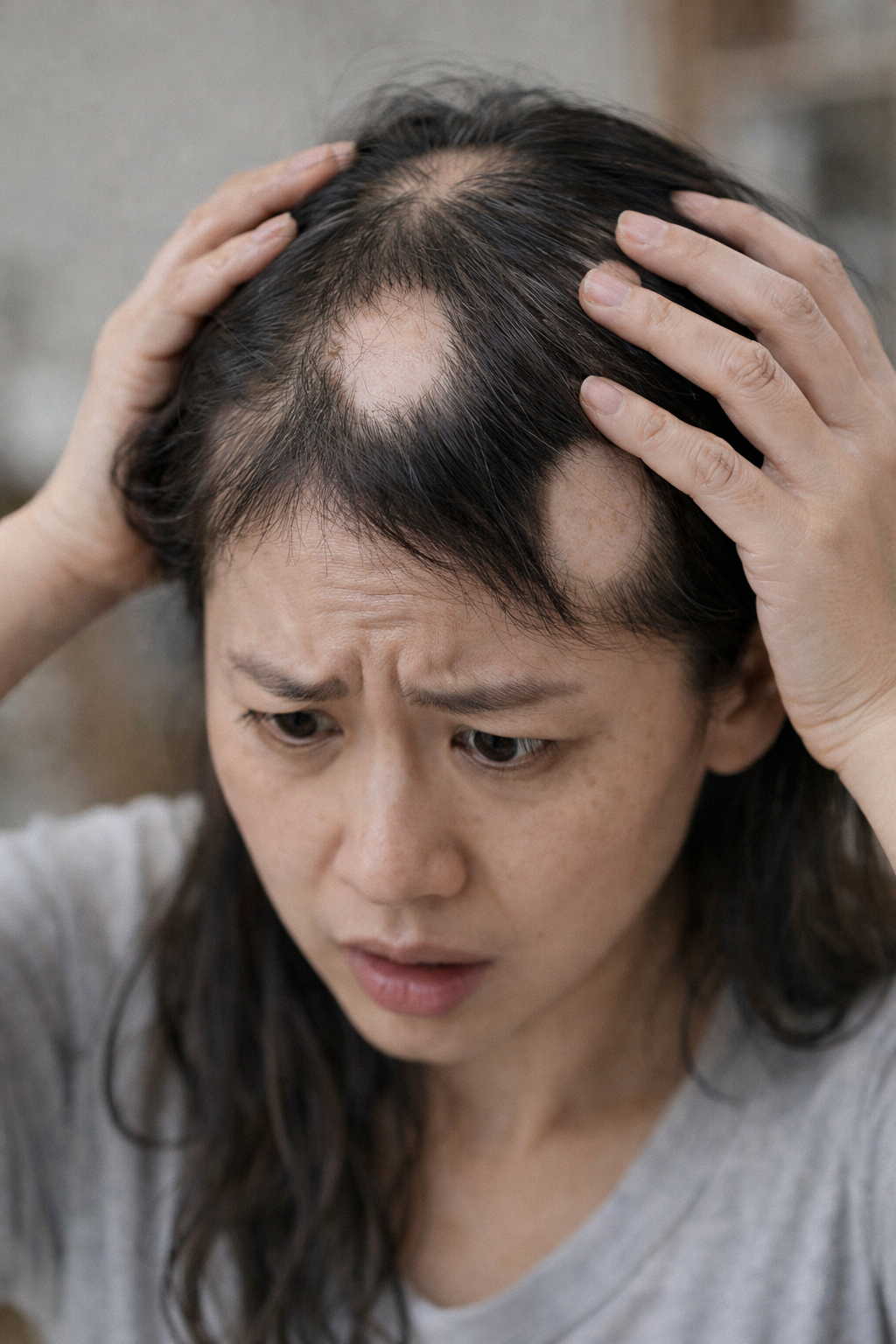
Woman experiencing patchy hair loss becomes anxious because of hair loss in multiple circular patches across her scalp.
What is Alopecia Areata (patchy hair loss)?
Alopecia areata (patchy hair loss) is an autoimmune condition in which the immune system mistakenly attacks hair follicles, causing hair to fall out in small, round or oval patches. It can affect the scalp, beard, eyebrows, eyelashes and other hair-bearing areas. The course of the condition is highly variable: some people experience a single patch that regrows without treatment, while others have multiple episodes, more extensive hair loss, or progression to complete scalp hair loss (alopecia totalis) or total body hair loss (alopecia universalis).
Key features
Appearance: Well-defined, smooth, circular or oval patches of hair loss. Skin in the affected areas usually looks normal and not scarred.
Onset: Often sudden — hair can fall out over days to weeks.
Age and prevalence: Can occur at any age, most commonly begins in childhood or young adulthood. Affects both sexes and all ethnicities.
Associated signs: “Exclamation mark” hairs (short broken hairs that taper at the base) at the margins of patches; nail changes such as pitting, ridging or brittleness occur in some people.
Course: Unpredictable. Spontaneous regrowth is common, but relapses may occur. Severity ranges from a single small patch to widespread hair loss.
Causes and risk factors
Autoimmune mechanism: T cells target hair follicles, particularly during the anagen (growth) phase, disrupting normal hair production.
Genetic predisposition: Family history of alopecia areata or other autoimmune diseases increases risk.
Associated conditions: Higher prevalence of other autoimmune disorders such as thyroid disease, vitiligo, type 1 diabetes and rheumatoid arthritis.
Triggers: Physical or emotional stress, infections or other immune-activating events may precede onset in some cases, though direct triggers are not consistently identified.
What are the different types of Alopecia Areata?
Alopecia areata is an autoimmune condition that primarily causes non‑scarring hair loss. It presents in several clinical patterns, each differing in extent, distribution and course. The main types are:
Alopecia areata (patchy Hair Loss)
The most common form. Well‑defined, round or oval patches of hair loss on the scalp or elsewhere on the body. Patches may appear suddenly and can regrow spontaneously or enlarge/merge over time.
Alopecia totalis
Complete loss of all scalp hair. It may develop from untreated or progressive patchy alopecia areata. Scalp skin is typically smooth and without scarring.
Alopecia universalis
The most extensive form — complete loss of all body hair, including scalp, eyebrows, eyelashes and body hair. It can develop rapidly or progressively from less extensive forms.
Ophiasis pattern
Band‑like hair loss along the occipital and temporal scalp margins (around the sides and back of the head). Often more resistant to treatment and may have a tendency to recur.
Sisaipho (inverse ophiasis)
Hair loss affecting the top of the scalp with preservation of the frontal and occipital hairline; essentially the reverse distribution of ophiasis. The term “sisaipho” is “ophiasis” spelled backwards.
Diffuse (acute diffuse or diffuse alopecia areata)
Widespread, often sudden thinning across the scalp rather than discrete patches. More common in adults and can mimic telogen effluvium; hair pull test is often positive and regrowth may be rapid.
Alopecia areata incognita
A variant that presents with sudden, diffuse shedding resembling telogen effluvium but without obvious bald patches. Often diagnosed by trichoscopic or histological features.
Partialis (multifocal) patterns
Multiple separate patches across the scalp or body without progressing to totalis or universalis. Behaviour and prognosis vary.
Causes of Alopecia Areata (Patchy Hair Loss)
Alopecia areata is an autoimmune condition that causes patchy hair loss. The exact cause is multifactorial; several interacting factors contribute to the immune system targeting hair follicles and producing discrete bald patches. Key causes and contributing factors include:
Autoimmune reaction
The primary mechanism is an autoimmune attack in which the body’s immune cells (mainly T lymphocytes) mistakenly target hair follicles in their growth phase (anagen), disrupting normal hair production and causing sudden, well‑defined patches of hair loss.
Genetic predisposition
A family history of alopecia areata or other autoimmune diseases increases risk. Specific genetic variants (including HLA genes and other immune‑related genes) are associated with greater susceptibility, although inheritance is complex and not strictly Mendelian.
Immune system dysregulation
Imbalances in immune signalling (cytokines, interferons) and loss of the hair follicle’s immune privilege can activate local immune responses. Regulatory T cell dysfunction and abnormal antigen presentation are implicated.
Environmental triggers
Infections (viral or bacterial), physical stressors, and certain medications can precipitate or exacerbate episodes in genetically predisposed individuals. Often a clear trigger is not identified.
Emotional and physical stress
Acute psychological stress or major life events are commonly reported before onset or flare of alopecia areata. The relationship is not fully causal but stress may modulate immune function and provoke flares.
Other autoimmune conditions and systemic disease
People with thyroid disease, vitiligo, type 1 diabetes, lupus and other autoimmune disorders have higher rates of alopecia areata. Metabolic or systemic illnesses may influence disease course.
Atopy and allergic tendencies
A history of atopic dermatitis, allergic rhinitis or asthma is more common among those with alopecia areata, suggesting immune hyperreactivity as a contributing background.
Age and hormonal factors
Onset often occurs in childhood or early adulthood, though it can arise at any age. Hormonal changes may influence disease activity in some individuals.
Local scalp factors (less common)
Although alopecia areata is not caused by scalp infections, local trauma (including scalp injury) has been reported to precipitate patch formation in some cases (isomorphic or Koebner phenomenon).
Can patchy Alopecia Areata be treated?
Yes — alopecia areata can often be treated, but outcomes vary by individual, type and severity of the condition.
Common treatment options (*Beware of side effects.)
Topical corticosteroids: applied to affected patches to reduce local inflammation. Often used for limited patchy alopecia, especially in children and adults with small areas.
Intralesional corticosteroid injections: small steroid injections into individual patches are a widely used and effective option for patchy alopecia on the scalp, eyebrow and beard. They can produce noticeable regrowth within weeks to months.
Topical immunotherapy: agents such as diphencyprone (DPCP) intentionally provoke a mild allergic reaction to distract the immune response and stimulate regrowth. Often used for extensive or treatment-resistant cases.
Topical minoxidil: can support regrowth and is frequently used alongside other treatments.
Systemic corticosteroids: short courses or pulsed regimens can suppress the immune response for more extensive or rapidly progressive disease; long-term use is limited by side effects.
Oral immunosuppressants / immunomodulators: drugs such as methotrexate, ciclosporin or mycophenolate may be considered in severe or refractory cases under specialist supervision.
JAK inhibitors: Janus kinase inhibitors (for example, tofacitinib and ruxolitinib) have shown meaningful hair regrowth for many people with alopecia areata, including severe forms. They are a significant advance but require specialist prescribing, monitoring and consideration of risks (infections, blood abnormalities, other adverse effects). Access and licensing vary by country.
Biologic therapies and emerging treatments: clinical trials continue to evaluate new targeted treatments.
Light therapies and platelet-rich plasma (PRP): evidence is mixed; some clinics use these adjunctively.
Cosmetic and supportive options: wigs, hairpieces, scalp micropigmentation, eyebrow tattooing, and concealers can aid appearance and confidence while medical treatments take effect.
Safety and monitoring
Many treatments carry potential side effects and require monitoring. Decisions about systemic or newer therapies should be made with full discussion of benefits, risks and practicalities.
Conclusion: Alopecia areata can often be treated successfully, particularly in limited cases. A tailored plan from a hair specialist offers the best chance of regrowth and safe management. If you or someone you care for is affected, seek an assessment to discuss the most appropriate options.
When to seek a Hair specialist?
Rapid progression of hair loss, multiple or large patches
Involvement of eyebrows, eyelashes or other visible areas
Associated symptoms or personal/family history of autoimmune disease
Significant psychological distress
If you are concerned about patchy hair loss, an assessment by a trichologist can clarify the cause, screen for associated conditions and discuss appropriate treatment and support options tailored to your situation.